

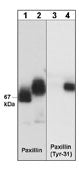

Anti-Phospho-Paxillin-Tyr-31 antibody [M102] (STJA0041307)
SPECIFICATIONS
ClonalityMonoclonal
HostMouse
ConjugationUnconjugated
IsotypeIgG1
ImmunogenClone M102 was generated from phospho-Paxillin (Tyr-31) synthetic peptide (coupled to KLH) corresponding to amino acid residues around tyrosine 31 of human paxillin. This human sequence is highly conserved in rat and mouse paxillin.
General Information
| Short Description | Mouse monoclonal anti-Phospho-Paxillin-Tyr-31 for use in ELISA and WB in Human, Mouse and Rat samples. Datasheet included with dilution recommendations, and related reagents. |
| Applications | ELISA/WB |
| Host | Mouse |
| Reactivity | Human/Mouse/Rat |
| Note | STRICTLY FOR FURTHER SCIENTIFIC RESEARCH USE ONLY (RUO). MUST NOT TO BE USED IN DIAGNOSTIC OR THERAPEUTIC APPLICATIONS. |
Product Properties
| Clonality | Monoclonal |
| Clone ID | M102 |
| Isotype | IgG1 |
| Conjugation | Unconjugated |
| Purification | Protein A Purified |
| Dilution Range | WB 1:1000 |
| Formulation | PBS + 1 mg/ml BSA, 0.05% NaN3 and 50% glycerol |
| Storage Instruction | Storage at-20°C is recommended, as aliquots may be taken without freeze/thawing due to presence of 50% glycerol. Stable for at least 1 year at-20°C. |
Target Information
| Gene Symbol | PXN |
| Gene ID | 5829 |
| Uniprot ID | PAXI_HUMAN |
| Immunogen | Clone M102 was generated from phospho-Paxillin (Tyr-31) synthetic peptide (coupled to KLH) corresponding to amino acid residues around tyrosine 31 of human paxillin. This human sequence is highly conserved in rat and mouse paxillin. |
| Immunogen Sequence | Human |
| Specificity | This antibody detects a 72kDa* protein corresponding to the molecular mass of phosphorylated paxillin on SDS-PAGE immunoblots of pervanadate treated A431 cells, but not in A431 control cells. |
Additional Info
| Post Translational Modifications | Phosphorylated by MAPK1/ERK2. Phosphorylated on tyrosine residues during integrin-mediated cell adhesion, embryonic development, fibroblast transformation and following stimulation of cells by mitogens. Phosphorylation at Ser-244 by CDK5 reduces its interaction with PTK2/FAK1 in matrix-cell focal adhesions (MCFA) during oligodendrocytes (OLs) differentiation. Phosphorylation at Tyr-31 and Tyr-118 by PTK6 promote the activation of RAC1 via CRK/CrKII, thereby promoting migration and invasion. Phosphorylation at Ser-250 by SLK is required for PXN redistribution and cell motility. Phosphorylation at Ser-272 promotes focal adhesion disassembly during cell migration. |
| Function | Cytoskeletal protein involved in actin-membrane attachment at sites of cell adhesion to the extracellular matrix (focal adhesion). Recruits other proteins such as TRIM15 to focal adhesion. |
| Protein Name | Paxillin |
| Database Links | Reactome: R-HSA-180292Reactome: R-HSA-4420097Reactome: R-HSA-445355Reactome: R-HSA-446343Reactome: R-HSA-446388Reactome: R-HSA-8849471Reactome: R-HSA-9926550 |
| Cellular Localisation | CytoplasmCytoskeletonCell JunctionFocal AdhesionCell CortexColocalizes With Integrins At The Cell PeripheryColocalize With Pxn To Membrane Ruffles And The Leading Edge Of Migrating Cells |
| Alternative Antibody Names | Anti-Paxillin antibodyAnti-PXN antibody |
Information sourced from Uniprot.org