

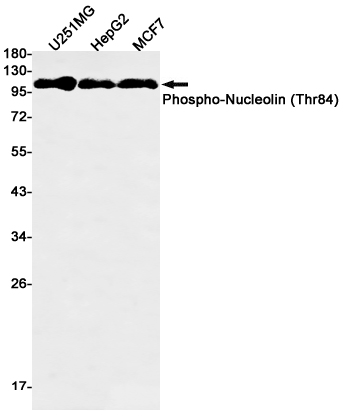

Anti-Phospho-Nucleolin-Thr84 antibody [R06-4D0] (STJA0034656)
SPECIFICATIONS
ClonalityMonoclonal
HostRabbit
ConjugationUnconjugated
IsotypeIgG
ImmunogenA synthetic phosphopeptide corresponding to residues surrounding Thr84 of human Nucleolin
General Information
| Short Description | Rabbit monoclonal anti-Phospho-Nucleolin-Thr84 for use in WB in Human samples. Datasheet included with dilution recommendations, and related reagents. |
| Applications | WB |
| Host | Rabbit |
| Reactivity | Human |
| Note | STRICTLY FOR FURTHER SCIENTIFIC RESEARCH USE ONLY (RUO). MUST NOT TO BE USED IN DIAGNOSTIC OR THERAPEUTIC APPLICATIONS. |
Product Properties
| Clonality | Monoclonal |
| Clone ID | R06-4D0 |
| Isotype | IgG |
| Conjugation | Unconjugated |
| Concentration | 0.3 mg/mL |
| Purification | Affinity Purified |
| Dilution Range | WB 1:500-1:1000 |
| Formulation | 50mM Tris-Glycine (pH 7.4) , 0.15M NaCl, 40% Glycerol, 0.01% Sodium azide and 0.05% BSA |
| Storage Instruction | Store at 4°C short term. Aliquot and store at-20°C long term. Avoid freeze/thaw cycles. |
Target Information
| Gene Symbol | NCL |
| Gene ID | 4691 |
| Uniprot ID | NUCL_HUMAN |
| Immunogen | A synthetic phosphopeptide corresponding to residues surrounding Thr84 of human Nucleolin |
Additional Info
| Post Translational Modifications | Some glutamate residues are glycylated by TTLL8. This modification occurs exclusively on glutamate residues and results in a glycine chain on the gamma-carboxyl group. Symmetrically methylated by PRMT5. |
| Function | Nucleolin is the major nucleolar protein of growing eukaryotic cells. It is found associated with intranucleolar chromatin and pre-ribosomal particles. It induces chromatin decondensation by binding to histone H1. It is thought to play a role in pre-rRNA transcription and ribosome assembly. May play a role in the process of transcriptional elongation. Binds RNA oligonucleotides with 5'-UUAGGG-3' repeats more tightly than the telomeric single-stranded DNA 5'-TTAGGG-3' repeats. |
| Protein Name | NucleolinProtein C23 |
| Database Links | Reactome: R-HSA-6791226Reactome: R-HSA-9820960 |
| Cellular Localisation | NucleusNucleolusCytoplasmLocalized In Cytoplasmic Mrnp Granules Containing Untranslated Mrnas |
| Alternative Antibody Names | Anti-Nucleolin antibodyAnti-Protein C23 antibodyAnti-NCL antibody |
Information sourced from Uniprot.org