






Anti-Phospho-MerTK-Tyr749/753/754 antibody (STJA0004902)
SPECIFICATIONS
ClonalityPolyclonal
HostRabbit
ConjugationUnconjugated
IsotypeIgG
ImmunogenSynthetic phospho-peptide corresponding to amino acid residues surrounding Tyr749/753/754 of human MerTK, conjugated to keyhole limpet hemocyanin (KLH).
General Information
| Short Description | Rabbit polyclonal anti-Phospho-MerTK-Tyr749/753/754 for use in WB in Human, Mouse, Rat, Bovine, Canine, Chicken, Finch, Guinea Pig and Non-Human Primates samples. Datasheet included with dilution recommendations, and related reagents. |
| Applications | WB |
| Host | Rabbit |
| Reactivity | Human/Mouse/Rat/Bovine/Canine/Chicken/Finch/Guinea Pig/Non-Human Primates |
| Note | STRICTLY FOR FURTHER SCIENTIFIC RESEARCH USE ONLY (RUO). MUST NOT TO BE USED IN DIAGNOSTIC OR THERAPEUTIC APPLICATIONS. |
Product Properties
| Clonality | Polyclonal |
| Isotype | IgG |
| Conjugation | Unconjugated |
| Purification | Antigen Affinity Purified from Pooled Serum |
| Dilution Range | WB 1:1000 |
| Formulation | 10 mM HEPES (pH 7.5) , 150 mM NaCl, 100 µg per ml BSA and 50% glycerol. |
| Storage Instruction | Store at-20°C for up to 1 year from the date of receipt, and avoid repeat freeze-thaw cycles. |
Target Information
| Gene Symbol | MERTK |
| Gene ID | 10461 |
| Uniprot ID | MERTK_HUMAN |
| Immunogen | Synthetic phospho-peptide corresponding to amino acid residues surrounding Tyr749/753/754 of human MerTK, conjugated to keyhole limpet hemocyanin (KLH). |
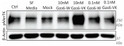
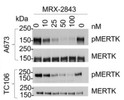
| Specificity | Specific for the ~160 kDa MerTK protein phosphorylated at Tyr749/753/754. The immunolabeling is completely eliminated by treatment with Lambda-phosphatase. Due to post-translational modifications of the Mer protein, a significant shift in molecular w |
Additional Info
| Tissue Specificity | Not expressed in normal B- and T-lymphocytes but is expressed in numerous neoplastic B- and T-cell lines. Highly expressed in testis, ovary, prostate, lung, and kidney, with lower expression in spleen, small intestine, colon, and liver. |
| Post Translational Modifications | Autophosphorylated on Tyr-749, Tyr-753 and Tyr-754 in the activation loop allowing full activity. Autophosphorylated on Tyr-872 leading to recruitment of downstream partners of the signaling cascade such as PLCG2. |
| Function | Receptor tyrosine kinase that transduces signals from the extracellular matrix into the cytoplasm by binding to several ligands including LGALS3, TUB, TULP1 or GAS6. Regulates many physiological processes including cell survival, migration, differentiation, and phagocytosis of apoptotic cells (efferocytosis). Ligand binding at the cell surface induces autophosphorylation of MERTK on its intracellular domain that provides docking sites for downstream signaling molecules. Following activation by ligand, interacts with GRB2 or PLCG2 and induces phosphorylation of MAPK1, MAPK2, FAK/PTK2 or RAC1. MERTK signaling plays a role in various processes such as macrophage clearance of apoptotic cells, platelet aggregation, cytoskeleton reorganization and engulfment. Functions in the retinal pigment epithelium (RPE) as a regulator of rod outer segments fragments phagocytosis. Also plays an important role in inhibition of Toll-like receptors (TLRs)-mediated innate immune response by activating STAT1, which selectively induces production of suppressors of cytokine signaling SOCS1 and SOCS3. |
| Protein Name | Tyrosine-Protein Kinase MerProto-Oncogene C-MerReceptor Tyrosine Kinase Mertk |
| Database Links | Reactome: R-HSA-202733 |
| Cellular Localisation | Cell MembraneSingle-Pass Type I Membrane Protein |
| Alternative Antibody Names | Anti-Tyrosine-Protein Kinase Mer antibodyAnti-Proto-Oncogene C-Mer antibodyAnti-Receptor Tyrosine Kinase Mertk antibodyAnti-MERTK antibodyAnti-MER antibody |
Information sourced from Uniprot.org