

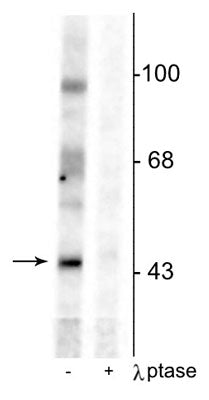

Anti-Phospho-EPHB2-Tyr331 antibody (STJA0003629)
SPECIFICATIONS
ClonalityPolyclonal
HostRabbit
ConjugationUnconjugated
IsotypeIgG
ImmunogenSynthetic phospho-peptide corresponding to amino acid residues surrounding Tyr331 conjugated to KLH.
General Information
| Short Description | Rabbit polyclonal anti-Phospho-EphrinB-Tyr331 for use in WB in Mouse, Rat, Bovine, Chicken, Human, Xenopus and Zebrafish samples. Datasheet included with dilution recommendations, and related reagents. |
| Applications | WB |
| Host | Rabbit |
| Reactivity | Mouse/Rat/Bovine/Chicken/Human/Xenopus/Zebrafish |
| Note | STRICTLY FOR FURTHER SCIENTIFIC RESEARCH USE ONLY (RUO). MUST NOT TO BE USED IN DIAGNOSTIC OR THERAPEUTIC APPLICATIONS. |
Product Properties
| Clonality | Polyclonal |
| Isotype | IgG |
| Conjugation | Unconjugated |
| Purification | This antibody was antigen affinity purified from pooled serum. |
| Dilution Range | WB 1:1000 |
| Formulation | 100 µl in 10 mM HEPES (pH 7.5) , 150 mM NaCl, 100 µg per ml BSA and 50% Glycerol. |
| Storage Instruction | Store at-20°C for up to 1 year from the date of receipt, and avoid repeat freeze-thaw cycles. |
Target Information
| Immunogen | Synthetic phospho-peptide corresponding to amino acid residues surrounding Tyr331 conjugated to KLH. |
Additional Info
| Background | EphrinB proteins are thought to play key roles in cellular functions as diverse as neuronal migration and blood vessel development (Flanagan and Vanderhaeghen, 1998; Dufour et al., 2003; Oike et al., 2002). EphrinB molecules expressed at the membrane surface bind to the EphB family receptors on target cells during cell-to cell contact. This interaction leads to cell signaling in the target cell but also generates a reverse signal in the cell expressing EphrinB on its surface. This reverse signaling event is thought to be critical for vessel maturation and neuronal development. Importantly, tyrosine phosphorylation of EphrinB is thought to be a critical component of this reverse signaling event (Palmer et al., 2002). 331 Recent work demonstrated that Tyr of EphrinB was phosphorylated in HEK293 cells after stimulation by the soluble EphB2 receptor tyrosine kinase (Kalo et al., 2001). |
Information sourced from Uniprot.org