

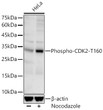


Anti-Phospho-CDK2-T160 antibody [S5902RM] (STJ11105902)
SPECIFICATIONS
ClonalityMonoclonal
HostRabbit
ConjugationUnconjugated
IsotypeIgG
General Information
| Short Description | Rabbit monoclonal Phospho-Cyclin-Dependent Kinase 2-T160 antibody for use in WB and ELISA in human and rat samples. Datasheet included with dilution recommendations, and related reagents. |
| Applications | WB/ELISA |
| Host | Rabbit |
| Reactivity | Human/Rat |
| Note | STRICTLY FOR FURTHER SCIENTIFIC RESEARCH USE ONLY (RUO). MUST NOT TO BE USED IN DIAGNOSTIC OR THERAPEUTIC APPLICATIONS. |
Product Properties
| Clonality | Monoclonal |
| Clone ID | S5902RM |
| Isotype | IgG |
| Conjugation | Unconjugated |
| Concentration | Lot specific |
| Purification | Affinity purification |
| Dilution Range | WB:1:500-1:1000ELISA:Recommended starting concentration is 1 Mu g/mL. Please optimize the concentration based on your specific assay requirements. |
| Formulation | PBS with 0.05% Proclin300, 0.05% BSA, 50% Glycerol, pH 7.3. |
| Storage Instruction | Store at-20°C for up to 1 year from the date of receipt, and avoid repeat freeze-thaw cycles. |
Target Information
| Gene Symbol | CDK2 |
| Gene ID | 1017 |
| Uniprot ID | CDK2_HUMAN |
| Immunogen Sequence | TYTHE |
| Specificity | A synthetic phosphorylated peptide around T160 of human CDK2 (NP_001789.2). |
Additional Info
| Post Translational Modifications | Phosphorylated at Thr-160 by CDK7 in a CAK complex. Phosphorylation at Thr-160 promotes kinase activity, whereas phosphorylation at Tyr-15 by WEE1 reduces slightly kinase activity. Phosphorylated on Thr-14 and Tyr-15 during S and G2 phases before being dephosphorylated by CDC25A. Nitrosylated after treatment with nitric oxide (DETA-NO). |
| Function | Serine/threonine-protein kinase involved in the control of the cell cycle.essential for meiosis, but dispensable for mitosis. Phosphorylates CABLES1, CTNNB1, CDK2AP2, ERCC6, NBN, USP37, p53/TP53, NPM1, CDK7, RB1, BRCA2, MYC, NPAT, EZH2. Triggers duplication of centrosomes and DNA. Acts at the G1-S transition to promote the E2F transcriptional program and the initiation of DNA synthesis, and modulates G2 progression.controls the timing of entry into mitosis/meiosis by controlling the subsequent activation of cyclin B/CDK1 by phosphorylation, and coordinates the activation of cyclin B/CDK1 at the centrosome and in the nucleus. Crucial role in orchestrating a fine balance between cellular proliferation, cell death, and DNA repair in embryonic stem cells (ESCs). Activity of CDK2 is maximal during S phase and G2.activated by interaction with cyclin E during the early stages of DNA synthesis to permit G1-S transition, and subsequently activated by cyclin A2 (cyclin A1 in germ cells) during the late stages of DNA replication to drive the transition from S phase to mitosis, the G2 phase. EZH2 phosphorylation promotes H3K27me3 maintenance and epigenetic gene silencing. Cyclin E/CDK2 prevents oxidative stress-mediated Ras-induced senescence by phosphorylating MYC. Involved in G1-S phase DNA damage checkpoint that prevents cells with damaged DNA from initiating mitosis.regulates homologous recombination-dependent repair by phosphorylating BRCA2, this phosphorylation is low in S phase when recombination is active, but increases as cells progress towards mitosis. In response to DNA damage, double-strand break repair by homologous recombination a reduction of CDK2-mediated BRCA2 phosphorylation. Involved in regulation of telomere repair by mediating phosphorylation of NBN. Phosphorylation of RB1 disturbs its interaction with E2F1. NPM1 phosphorylation by cyclin E/CDK2 promotes its dissociates from unduplicated centrosomes, thus initiating centrosome duplication. Cyclin E/CDK2-mediated phosphorylation of NPAT at G1-S transition and until prophase stimulates the NPAT-mediated activation of histone gene transcription during S phase. Required for vitamin D-mediated growth inhibition by being itself inactivated. Involved in the nitric oxide- (NO) mediated signaling in a nitrosylation/activation-dependent manner. USP37 is activated by phosphorylation and thus triggers G1-S transition. CTNNB1 phosphorylation regulates insulin internalization. Phosphorylates FOXP3 and negatively regulates its transcriptional activity and protein stability. Phosphorylates ERCC6 which is essential for its chromatin remodeling activity at DNA double-strand breaks. Acts as a regulator of the phosphatidylinositol 3-kinase/protein kinase B signal transduction by mediating phosphorylation of the C-terminus of protein kinase B (PKB/AKT1 and PKB/AKT2), promoting its activation. |
| Protein Name | Cyclin-Dependent Kinase 2Cell Division Protein Kinase 2P33 Protein Kinase |
| Database Links | Reactome: R-HSA-1538133Reactome: R-HSA-171319Reactome: R-HSA-176187Reactome: R-HSA-176408Reactome: R-HSA-187577Reactome: R-HSA-2559582Reactome: R-HSA-2559586Reactome: R-HSA-5693607Reactome: R-HSA-6804116Reactome: R-HSA-6804756Reactome: R-HSA-6804757Reactome: R-HSA-68911Reactome: R-HSA-68949Reactome: R-HSA-68962Reactome: R-HSA-69017Reactome: R-HSA-69200Reactome: R-HSA-69202Reactome: R-HSA-69231Reactome: R-HSA-69273Reactome: R-HSA-69563Reactome: R-HSA-69656Reactome: R-HSA-8849470Reactome: R-HSA-912446Reactome: R-HSA-9616222Reactome: R-HSA-9661069Reactome: R-HSA-9825892Reactome: R-HSA-983231 |
| Cellular Localisation | CytoplasmCytoskeletonMicrotubule Organizing CenterCentrosomeNucleusCajal BodyEndosomeLocalized At The Centrosomes In Late G2 Phase After Separation Of The Centrosomes But Before The Start Of ProphaseNuclear-Cytoplasmic Trafficking Is Mediated During The Inhibition By 125-(Oh)(2)D(3) |
| Alternative Antibody Names | Anti-Cyclin-Dependent Kinase 2 antibodyAnti-Cell Division Protein Kinase 2 antibodyAnti-P33 Protein Kinase antibodyAnti-CDK2 antibodyAnti-CDKN2 antibody |
Information sourced from Uniprot.org