



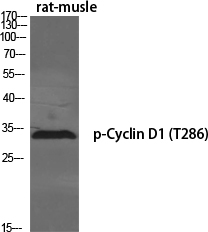
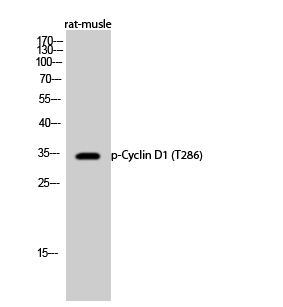
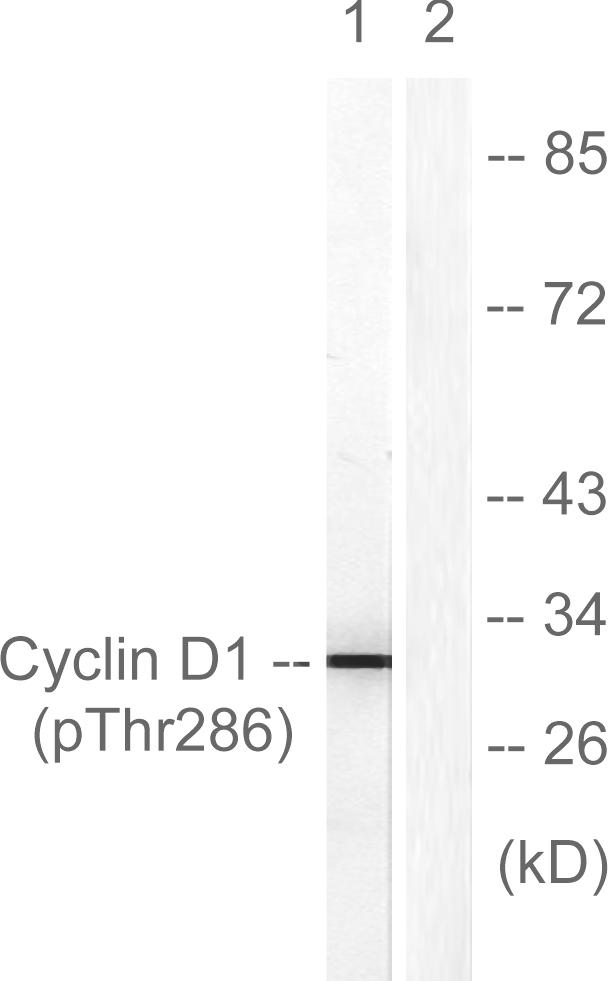
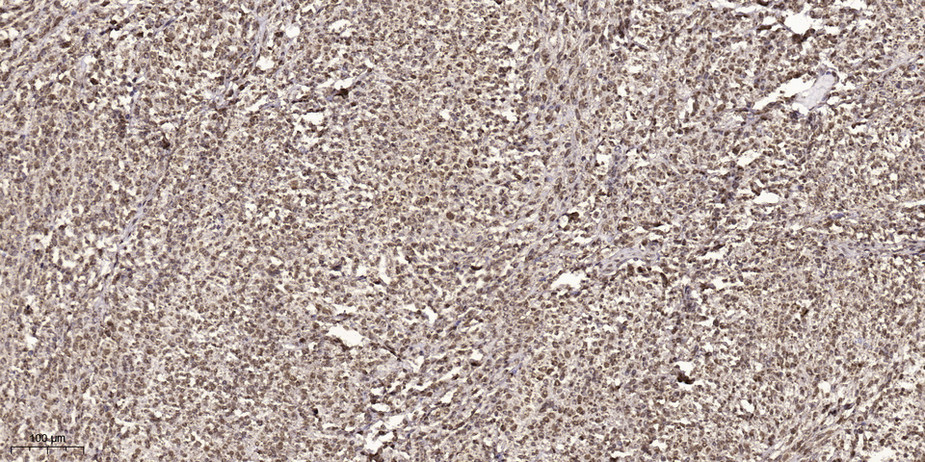

Anti-Phospho-CCND1-Thr286 antibody (246-295 aa) (STJ90457)
SPECIFICATIONS
ClonalityPolyclonal
HostRabbit
ConjugationUnconjugated
IsotypeIgG
ImmunogenThe antiserum was produced against synthesized peptide derived from the human Cyclin D1 around the phosphorylation site of Thr286 at the amino acid range 246-295
General Information
| Short Description | Rabbit polyclonal anti-Phospho-G1/S-specific cyclin-D1-Thr286 (246-295 aa) for use in WB, IHC, IF and ELISA in Human, Mouse and Rat samples. Datasheet included with dilution recommendations, and related reagents. |
| Applications | WB/IHC/IF/ELISA |
| Host | Rabbit |
| Reactivity | Human/Mouse/Rat |
| Note | STRICTLY FOR FURTHER SCIENTIFIC RESEARCH USE ONLY (RUO). MUST NOT TO BE USED IN DIAGNOSTIC OR THERAPEUTIC APPLICATIONS. |
Product Properties
| Clonality | Polyclonal |
| Isotype | IgG |
| Conjugation | Unconjugated |
| Concentration | 1 mg/mL |
| Purification | The antibody was affinity-purified from rabbit antiserum by affinity-chromatography using epitope-specific immunogen. |
| Dilution Range | WB 1:500-1:2000IHC 1:100-1:300ELISA 1:10000IF 1:50-200 |
| Formulation | Liquid in PBS containing 50% Glycerol, 0.5% BSA and 0.02% Sodium Azide. |
| Storage Instruction | Store at-20°C for up to 1 year from the date of receipt, and avoid repeat freeze-thaw cycles. |
Target Information
| Gene Symbol | CCND1 |
| Gene ID | 595 |
| Uniprot ID | CCND1_HUMAN |
| Immunogen | The antiserum was produced against synthesized peptide derived from the human Cyclin D1 around the phosphorylation site of Thr286 at the amino acid range 246-295 |
| Immunogen Region | 246-295 aa |
| Specificity | Phospho-Cyclin D1 (T286) Polyclonal Antibody detects endogenous levels of Cyclin D1 protein only when phosphorylated at T286. |
Additional Info
| Function | Regulatory component of the cyclin D1-CDK4 (DC) complex that phosphorylates and inhibits members of the retinoblastoma (RB) protein family including RB1 and regulates the cell-cycle during G(1)/S transition. Phosphorylation of RB1 allows dissociation of the transcription factor E2F from the RB/E2F complex and the subsequent transcription of E2F target genes which are responsible for the progression through the G(1) phase. Hypophosphorylates RB1 in early G(1) phase. Cyclin D-CDK4 complexes are major integrators of various mitogenenic and antimitogenic signals. Also a substrate for SMAD3, phosphorylating SMAD3 in a cell-cycle-dependent manner and repressing its transcriptional activity. Component of the ternary complex, cyclin D1/CDK4/CDKN1B, required for nuclear translocation and activity of the cyclin D-CDK4 complex. Exhibits transcriptional corepressor activity with INSM1 on the NEUROD1 and INS promoters in a cell cycle-independent manner. |
| Protein Name | G1/S-Specific Cyclin-D1B-Cell Lymphoma 1 ProteinBcl-1Bcl-1 OncogenePrad1 Oncogene |
| Database Links | Reactome: R-HSA-187577Reactome: R-HSA-1912408Reactome: R-HSA-3214858Reactome: R-HSA-6785807Reactome: R-HSA-69231Reactome: R-HSA-75815Reactome: R-HSA-8849470Reactome: R-HSA-8853884Reactome: R-HSA-8878166Reactome: R-HSA-8934593Reactome: R-HSA-8951430Reactome: R-HSA-8951936Reactome: R-HSA-9018519Reactome: R-HSA-9634638Reactome: R-HSA-9661069Reactome: R-HSA-9754119Reactome: R-HSA-9825892 |
| Cellular Localisation | NucleusCytoplasmNucleus MembraneCyclin D-Cdk4 Complexes Accumulate At The Nuclear Membrane And Are Then Translocated To The Nucleus Through Interaction With Kip/Cip Family Members |
| Alternative Antibody Names | Anti-G1/S-Specific Cyclin-D1 antibodyAnti-B-Cell Lymphoma 1 Protein antibodyAnti-Bcl-1 antibodyAnti-Bcl-1 Oncogene antibodyAnti-Prad1 Oncogene antibodyAnti-CCND1 antibodyAnti-BCL1 antibodyAnti-PRAD1 antibody |
Information sourced from Uniprot.org