

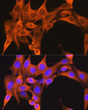


| Applications: | WB/IF/ICC/ELISA |
| Host: | Rabbit |
| Reactivity: | Human/Mouse/Rat |
| Note: | STRICTLY FOR FURTHER SCIENTIFIC RESEARCH USE ONLY (RUO). MUST NOT TO BE USED IN DIAGNOSTIC OR THERAPEUTIC APPLICATIONS. |
| Clonality : | Polyclonal |
| Isotype: | IgG |
| Conjugation: | Unconjugated |
| Concentration: | Lot specific |
| Purification: | Affinity purification |
| Dilution Range: | WB:1:500-1:1000IF/ICC:1:50-1:200ELISA:Recommended starting concentration is 1 Mu g/mL. Please optimize the concentration based on your specific assay requirements. |
| Formulation: | PBS with 0.02% Sodium Azide, 50% Glycerol, pH 7.3. |
| Storage Instruction: | Store at-20°C for up to 1 year from the date of receipt, and avoid repeat freeze-thaw cycles. |
| Gene Symbol: | PFKM |
| Gene ID: | 5213 |
| Uniprot ID: | PFKAM_HUMAN |
| Immunogen Region: | 501-780 |
| Immunogen Sequence: | AYTGGLELMEGRKQFDELCI PFVVIPATVSNNVPGSDFSV GADTALNTICTTCDRIKQSA AGTKRRVFIIETMGGYCGYL ATMAGLAAGADAAYIFEEPF TIRDLQANVEHLVQKMKTTV KRGLVLRNEKCNENYTTDFI FNLYSEEGKGIFDSRKNVLG HMQQGGSPTPFDRNFATKMG AKAMNWMSGKIKESYRNGRI FANTPDSGCVLGMRKRALVF QPVAELKDQTDFEHRIPKE |
| Specificity: | Recombinant fusion protein containing a sequence corresponding to amino acids 501-780 of human PFKM (NP_001160160.1). |
| Post Translational Modifications | GlcNAcylation decreases enzyme activity. |
| Function | Catalyzes the phosphorylation of D-fructose 6-phosphate to fructose 1,6-bisphosphate by ATP, the first committing step of glycolysis. |
| Protein Name | Atp-Dependent 6-Phosphofructokinase - Muscle TypeAtp-PfkPfk-M6-Phosphofructokinase Type APhosphofructo-1-Kinase Isozyme APfk-APhosphohexokinase |
| Database Links | Reactome: R-HSA-70171 |
| Cellular Localisation | Cytoplasm |
| Alternative Antibody Names | Anti-Atp-Dependent 6-Phosphofructokinase - Muscle Type antibodyAnti-Atp-Pfk antibodyAnti-Pfk-M antibodyAnti-6-Phosphofructokinase Type A antibodyAnti-Phosphofructo-1-Kinase Isozyme A antibodyAnti-Pfk-A antibodyAnti-Phosphohexokinase antibodyAnti-PFKM antibodyAnti-PFKX antibody |
Information sourced from Uniprot.org


