




Anti-PECAM1 antibody (690aa C-Term) (STJ140082)
SPECIFICATIONS
ClonalityPolyclonal
HostGoat
ConjugationUnconjugated
IsotypeIgG
ImmunogenPurified recombinant peptide within residues 690 aa to the C-terminus of human CD31 produced in E. coli.
General Information
| Short Description | Goat polyclonal Platelet/endothelial Cell Adhesion Molecule (690aa C-Term) antibody for use in WB, IHC-P and IHC-F in human, mouse, rat, bovine, canine, chicken, avian, donkey, feline, goat, guinea pig, hamster, horse, porcine, rabbit, sheep and simi |
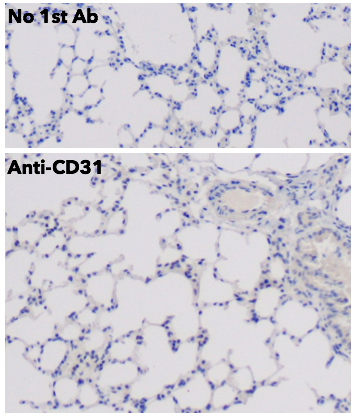
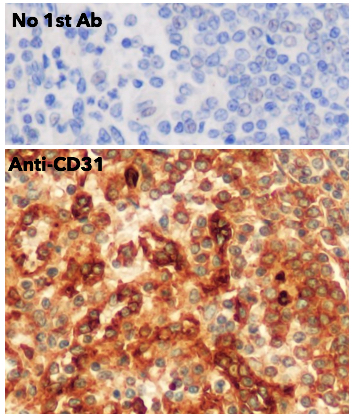
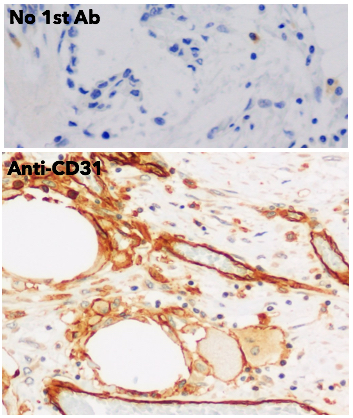
| Applications | WB/IHC-P/IHC-F |
| Host | Goat |
| Reactivity | Human/Mouse/Rat/Bovine/Canine/Chicken/Avian/Donkey/Feline/Goat/Guinea Pig/Hamster/Horse/Porcine/Rabbit/Sheep/Simian |
| Note | STRICTLY FOR FURTHER SCIENTIFIC RESEARCH USE ONLY (RUO). MUST NOT TO BE USED IN DIAGNOSTIC OR THERAPEUTIC APPLICATIONS. |
Product Properties
| Clonality | Polyclonal |
| Isotype | IgG |
| Conjugation | Unconjugated |
| Concentration | 3 mg/mL |
| Purification | This antibody is epitope-affinity purified from goat antiserum. |
| Dilution Range | WB 1:500-1:2000IHC-F 1:250-1:1000IHC-P 1:250-1:1000Martins FO Sacramento JF Olea E et al. Antioxidants-Basel 2021 Aug PMID: 34439481Rodrigues T Borges P Mar L et al. Pharmacol Res 2020 Sep. PMID: 32942016Rodrigues TDA PhD The |
| Formulation | PBS, 20% Glycerol and 0.05% Sodium Azide. |
| Storage Instruction | For continuous use, store at 2-8 C for one-two days. For extended storage, store in-20 C freezer. Working dilution samples should be discarded if not used within 12 hours. |
Target Information
| Gene Symbol | PECAM1 |
| Gene ID | 5175 |
| Uniprot ID | PECA1_HUMAN |
| Accession Number | ENSG00000261371 |
| Immunogen | Purified recombinant peptide within residues 690 aa to the C-terminus of human CD31 produced in E. coli. |
| Immunogen Region | 690aa C-Term |
| Immunogen Sequence | TEVQVSSAESHKDLGKKDTE EVQVSSAESHKDLGKKDTET VQVSSAESHKDLGKKDTETV |
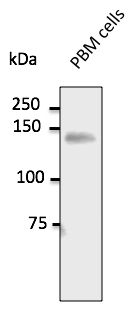
| Specificity | Using PBM cell lysates detects a 130-140 kDa band by Western blot. |
Additional Info
| Tissue Specificity | Expressed on platelets and leukocytes and is primarily concentrated at the borders between endothelial cells. Expressed in human umbilical vein endothelial cells (HUVECs) (at protein level). Expressed on neutrophils (at protein level). Isoform Long predominates in all tissues examined. Isoform Delta12 is detected only in trachea. Isoform Delta14-15 is only detected in lung. Isoform Delta14 is detected in all tissues examined with the strongest expression in heart. Isoform Delta15 is expressed in brain, testis, ovary, cell surface of platelets, human umbilical vein endothelial cells (HUVECs), Jurkat T-cell leukemia, human erythroleukemia (HEL) and U-937 histiocytic lymphoma cell lines (at protein level). |
| Post Translational Modifications | Phosphorylated on Ser and Tyr residues after cellular activation by src kinases. Upon activation, phosphorylated on Ser-729 which probably initiates the dissociation of the membrane-interaction segment (residues 709-729) from the cell membrane allowing the sequential phosphorylation of Tyr-713 and Tyr-690. Constitutively phosphorylated on Ser-734 in resting platelets. Phosphorylated on tyrosine residues by FER and FES in response to FCER1 activation. In endothelial cells Fyn mediates mechanical-force (stretch or pull) induced tyrosine phosphorylation. Palmitoylation by ZDHHC21 is necessary for cell surface expression in endothelial cells and enrichment in membrane rafts. |
| Function | Cell adhesion molecule which is required for leukocyte transendothelial migration (TEM) under most inflammatory conditions. Tyr-690 plays a critical role in TEM and is required for efficient trafficking of PECAM1 to and from the lateral border recycling compartment (LBRC) and is also essential for the LBRC membrane to be targeted around migrating leukocytes. Trans-homophilic interaction may play a role in endothelial cell-cell adhesion via cell junctions. Heterophilic interaction with CD177 plays a role in transendothelial migration of neutrophils. Homophilic ligation of PECAM1 prevents macrophage-mediated phagocytosis of neighboring viable leukocytes by transmitting a detachment signal. Promotes macrophage-mediated phagocytosis of apoptotic leukocytes by tethering them to the phagocytic cells.PECAM1-mediated detachment signal appears to be disabled in apoptotic leukocytes. Modulates bradykinin receptor BDKRB2 activation. Regulates bradykinin- and hyperosmotic shock-induced ERK1/2 activation in endothelial cells. Induces susceptibility to atherosclerosis. Isoform Delta15: Does not protect against apoptosis. |
| Protein Name | Platelet Endothelial Cell Adhesion MoleculePecam-1EndocamGpiia'Peca1Cd Antigen Cd31 |
| Database Links | Reactome: R-HSA-114608Reactome: R-HSA-202733Reactome: R-HSA-210990Reactome: R-HSA-216083Reactome: R-HSA-432142Reactome: R-HSA-6798695Reactome: R-HSA-9856530 |
| Cellular Localisation | Cell MembraneSingle-Pass Type I Membrane ProteinCell Surface Expression On Neutrophils Is Down-Regulated Upon Fmlp Or Cxcl8/Il8-Mediated StimulationIsoform Long: Cell MembraneMembrane RaftCell JunctionLocalizes To The Lateral Border Recycling Compartment (Lbrc) And Recycles From The Lbrc To The Junction In Resting Endothelial CellsIsoform Delta15: Cell Junction |
| Alternative Antibody Names | Anti-Platelet Endothelial Cell Adhesion Molecule antibodyAnti-Pecam-1 antibodyAnti-Endocam antibodyAnti-Gpiia' antibodyAnti-Peca1 antibodyAnti-Cd Antigen Cd31 antibodyAnti-PECAM1 antibody |
Information sourced from Uniprot.org