

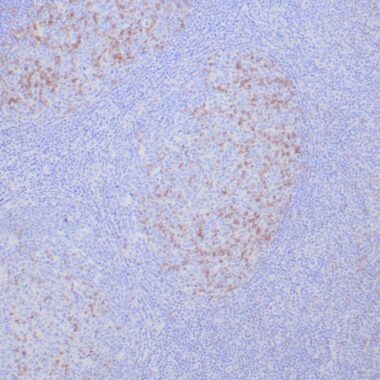

Anti-PDCD1 antibody (ECD) [ZR408] (STJ180618)
SPECIFICATIONS
ClonalityMonoclonal
HostRabbit
ConjugationUnconjugated
IsotypeIgG
ImmunogenRecombinant fragment corresponding to extracellular domain of human PDCD1 protein
General Information
| Short Description | Rabbit monoclonal PD-1 (ECD) antibody for use in IHC-P in human samples. Datasheet included with dilution recommendations, and related reagents. |
| Applications | IHC-P |
| Host | Rabbit |
| Reactivity | Human |
| Note | STRICTLY FOR FURTHER SCIENTIFIC RESEARCH USE ONLY (RUO). MUST NOT TO BE USED IN DIAGNOSTIC OR THERAPEUTIC APPLICATIONS. |
Product Properties
| Clonality | Monoclonal |
| Clone ID | ZR408 |
| Isotype | IgG |
| Conjugation | Unconjugated |
| Purification | Affinity purified |
| Dilution Range | 1:100-200 |
| Formulation | Tris-HCI buffer containing stabilizing protein (BSA) and <0.1% ProClin |
| Storage Instruction | Store at 2‐8°C for up to 24 months. Predilute: Ready to use, no reconstitution necessary. Concentrate: Use dilution range and appropriate lab‐standardized diluent. Stability after dilution: 7 days at 24°C, 3 months at 2‐8°C, 6months at ‐20°C. |
Target Information
| Gene Symbol | PDCD1 |
| Gene ID | 5133 |
| Uniprot ID | PDCD1_HUMAN |
| Immunogen | Recombinant fragment corresponding to extracellular domain of human PDCD1 protein |
| Immunogen Region | ECD |
| Specificity | Positive Control: Lymph node |
Additional Info
| Post Translational Modifications | Ubiquitinated at Lys-233 by the SCF(FBXO38) complex, leading to its proteasomal degradation. Ubiquitinated via 'Lys-48'-linked polyubiquitin chains. Deubiquitinated and thus stabilized by USP5. Tyrosine phosphorylated at Tyr-223 (within ITIM motif) and Tyr-248 (ITSM motif) upon ligand binding. Phosphorylation at Tyr-248 promotes the recruitment of the protein tyrosine phosphatase PTPN11/SHP-2 that mediates dephosphorylation of key TCR proximal signaling molecules, such as ZAP70, PRKCQ/PKCtheta and CD247/CD3zeta. Phosphorylation at Thr-234 promotes the recruitment of the deubiquitinase USP5. N-glycosylation at Asn-58 contains at least two N-acetylglucosamine units and one fucose. N-glycosylation does not affect binding to nivolumab drug. |
| Function | Inhibitory receptor on antigen activated T-cells that plays a critical role in induction and maintenance of immune tolerance to self. Delivers inhibitory signals upon binding to ligands CD274/PDCD1L1 and CD273/PDCD1LG2. Following T-cell receptor (TCR) engagement, PDCD1 associates with CD3-TCR in the immunological synapse and directly inhibits T-cell activation. Suppresses T-cell activation through the recruitment of PTPN11/SHP-2: following ligand-binding, PDCD1 is phosphorylated within the ITSM motif, leading to the recruitment of the protein tyrosine phosphatase PTPN11/SHP-2 that mediates dephosphorylation of key TCR proximal signaling molecules, such as ZAP70, PRKCQ/PKCtheta and CD247/CD3zeta. The PDCD1-mediated inhibitory pathway is exploited by tumors to attenuate anti-tumor immunity and escape destruction by the immune system, thereby facilitating tumor survival. The interaction with CD274/PDCD1L1 inhibits cytotoxic T lymphocytes (CTLs) effector function. The blockage of the PDCD1-mediated pathway results in the reversal of the exhausted T-cell phenotype and the normalization of the anti-tumor response, providing a rationale for cancer immunotherapy. |
| Protein Name | Programmed Cell Death Protein 1Protein Pd-1Hpd-1Cd Antigen Cd279 |
| Database Links | Reactome: R-HSA-389948Reactome: R-HSA-9679191 |
| Cellular Localisation | Cell MembraneSingle-Pass Type I Membrane Protein |
| Alternative Antibody Names | Anti-Programmed Cell Death Protein 1 antibodyAnti-Protein Pd-1 antibodyAnti-Hpd-1 antibodyAnti-Cd Antigen Cd279 antibodyAnti-PDCD1 antibodyAnti-PD1 antibody |
Information sourced from Uniprot.org