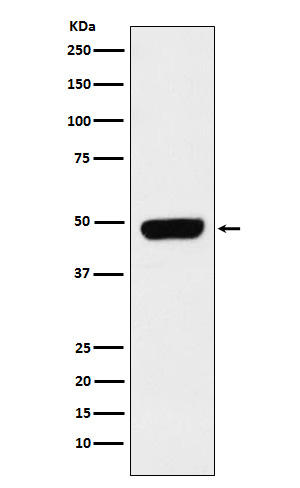
| Tissue Specificity | Widely expressed. Highest expression is observed in oocytes and brain. Detected at very low levels in sperm cells. |
| Post Translational Modifications | S-nitrosylation inhibits channel currents and ATP release. N-glycosylation plays a role in cell surface targeting. Glycosylation at its extracellular surface makes unlikely that two oligomers could dock to form an intercellular channel such as in gap junctions. Exists in three glycosylation states: non-glycosylated (GLY0), high-mannose glycosylated (GLY1), and fully mature glycosylated (GLY2). Cleaved by CASP3 and CASP7 during apoptosis. Cleavage opens the channel for the release of metabolites and induces plasma membrane permeability during apoptosis. Phosphorylated at Tyr-199 by SRC. Phosphorylation activates ATP release. Constitutively phosphorylated in vascular smooth muscle cells. |
| Function | Ion channel involved in a variety of physiological functions such as blood pressure regulation, apoptotic cell clearance and oogenesis. Forms anion-selective channels with relatively low conductance and an order of permeabilities: nitrate>iodide>chlroride>>aspartate=glutamate=gluconate. Can release ATP upon activation through phosphorylation or cleavage at C-terminus. May play a role as a Ca(2+)-leak channel to regulate ER Ca(2+) homeostasis. Caspase-activated pannexin-1: During apoptosis, the C terminal tail is cleaved by caspases, which opens the main pore acting as a large-pore ATP efflux channel with a broad distribution, which allows the regulated release of molecules and ions smaller than 1 kDa, such as nucleotides ATP and UTP, and selective plasma membrane permeability to attract phagocytes that engulf the dying cells. |
| Protein Name | Pannexin-1Panx1 Cleaved Into - Caspase-Activated Pannexin-1Caspase-Activated Panx1 |
| Database Links | Reactome: R-HSA-112303Reactome: R-HSA-844456Reactome: R-HSA-9856530Reactome: R-HSA-9856532 |
| Cellular Localisation | Cell MembraneMulti-Pass Membrane ProteinEndoplasmic Reticulum Membrane |
| Alternative Antibody Names | Anti-Pannexin-1 antibodyAnti-Panx1 Cleaved Into - Caspase-Activated Pannexin-1 antibodyAnti-Caspase-Activated Panx1 antibodyAnti-PANX1 antibodyAnti-MRS1 antibodyAnti-UNQ2529 antibodyAnti-PRO6028 antibody |
Information sourced from Uniprot.org