

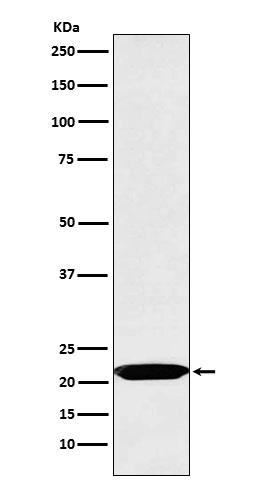

Anti-Oncostatin M antibody [R05-5K8] (STJA0037354)
SPECIFICATIONS
ClonalityMonoclonal
HostRabbit
ConjugationUnconjugated
IsotypeIgG
ImmunogenA synthesized peptide derived from human Oncostatin M
General Information
| Short Description | Rabbit monoclonal anti-Oncostatin M for use in WB in Human, Mouse and Rat samples. Datasheet included with dilution recommendations, and related reagents. |
| Applications | WB |
| Host | Rabbit |
| Reactivity | Human/Mouse/Rat |
| Note | STRICTLY FOR FURTHER SCIENTIFIC RESEARCH USE ONLY (RUO). MUST NOT TO BE USED IN DIAGNOSTIC OR THERAPEUTIC APPLICATIONS. |
Product Properties
| Clonality | Monoclonal |
| Clone ID | R05-5K8 |
| Isotype | IgG |
| Conjugation | Unconjugated |
| Purification | Affinity Purified |
| Dilution Range | WB 1:500-1:1000 |
| Formulation | Rabbit IgG in phosphate buffered saline, pH 7.4, 150mM NaCl, 0.02% sodium azide and 50% glycerol. |
| Storage Instruction | Store at 4°C short term. Aliquot and store at-20°C long term. Avoid freeze/thaw cycles. |
Target Information
| Gene Symbol | OSM |
| Gene ID | 5008 |
| Uniprot ID | ONCM_HUMAN |
| Immunogen | A synthesized peptide derived from human Oncostatin M |
Additional Info
| Post Translational Modifications | Propeptide processing is not important for receptor binding activity but may be important growth-inhibitory activity. |
| Function | Growth regulator. Inhibits the proliferation of a number of tumor cell lines. Stimulates proliferation of AIDS-KS cells. It regulates cytokine production, including IL-6, G-CSF and GM-CSF from endothelial cells. Uses both type I OSM receptor (heterodimers composed of LIFR and IL6ST) and type II OSM receptor (heterodimers composed of OSMR and IL6ST). Involved in the maturation of fetal hepatocytes, thereby promoting liver development and regeneration. |
| Protein Name | Oncostatin-MOsm |
| Database Links | Reactome: R-HSA-6785807Reactome: R-HSA-6788467 |
| Cellular Localisation | Secreted |
| Alternative Antibody Names | Anti-Oncostatin-M antibodyAnti-Osm antibodyAnti-OSM antibody |
Information sourced from Uniprot.org