

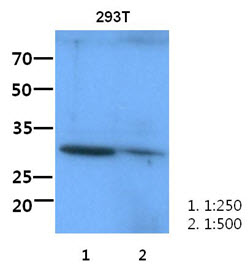

Anti-Omentin/ITLN1 antibody (17-313aa) [AT6C11] (STJA0041674)
SPECIFICATIONS
ClonalityMonoclonal
HostMouse
ConjugationUnconjugated
IsotypeIgG1k
ImmunogenRecombinant human ITLN1 (17-313aa) purified from E. coli
General Information
| Short Description | Mouse monoclonal anti-Omentin/ITLN1 (17-313aa) for use in ELISA and WB in Human samples. Datasheet included with dilution recommendations, and related reagents. |
| Applications | ELISA/WB |
| Host | Mouse |
| Reactivity | Human |
| Note | STRICTLY FOR FURTHER SCIENTIFIC RESEARCH USE ONLY (RUO). MUST NOT TO BE USED IN DIAGNOSTIC OR THERAPEUTIC APPLICATIONS. |
Product Properties
| Clonality | Monoclonal |
| Clone ID | AT6C11 |
| Isotype | IgG1k |
| Conjugation | Unconjugated |
| Concentration | 1 mg/mL |
| Purification | By protein-A affinity chromatography |
| Formulation | Liquid in phosphate-Buffered Saline (pH 7.4) with 0.02% Sodium Azide, 10% Glycerol |
| Storage Instruction | For short term storage, keep at +2C to +8C for up to 1 week. For long term storage, aliquot and store at-20C, and avoid repeat freeze-thaw cycles. |
Target Information
| Gene Symbol | ITLN1 |
| Gene ID | 55600 |
| Uniprot ID | ITLN1_HUMAN |
| Accession Number | NP_060095 |
| Immunogen | Recombinant human ITLN1 (17-313aa) purified from E. coli |
| Immunogen Region | 17-313aa |
Additional Info
| Tissue Specificity | Highly expressed in omental adipose tissue where it is found in stromal vascular cells but not in fat cells but is barely detectable in subcutaneous adipose tissue (at protein level). Highly expressed in the small intestine. Also found in the heart, testis, colon, salivary gland, skeletal muscle, pancreas and thyroid and, to a lesser degree, in the uterus, spleen, prostate, lymph node and thymus. |
| Post Translational Modifications | N-glycosylated. |
| Function | Lectin that specifically recognizes microbial carbohydrate chains in a calcium-dependent manner. Binds to microbial glycans that contain a terminal acyclic 1,2-diol moiety, including beta-linked D-galactofuranose (beta-Galf), D-phosphoglycerol-modified glycans, D-glycero-D-talo-oct-2-ulosonic acid (KO) and 3-deoxy-D-manno-oct-2-ulosonic acid (KDO). Binds to glycans from Gram-positive and Gram-negative bacteria, including K.pneumoniae, S.pneumoniae, Y.pestis, P.mirabilis and P.vulgaris. Does not bind human glycans. Probably plays a role in the defense system against microorganisms (Probable). May function as adipokine that has no effect on basal glucose uptake but enhances insulin-stimulated glucose uptake in adipocytes. Increases AKT phosphorylation in the absence and presence of insulin. May interact with lactoferrin/LTF and increase its uptake, and may thereby play a role in iron absorption. |
| Protein Name | Intelectin-1Itln-1Endothelial Lectin Hl-1Galactofuranose-Binding LectinIntestinal Lactoferrin ReceptorOmentin |
| Database Links | Reactome: R-HSA-6803157 |
| Cellular Localisation | Cell MembraneLipid-AnchorGpi-AnchorSecretedEnriched In Lipid Rafts |
| Alternative Antibody Names | Anti-Intelectin-1 antibodyAnti-Itln-1 antibodyAnti-Endothelial Lectin Hl-1 antibodyAnti-Galactofuranose-Binding Lectin antibodyAnti-Intestinal Lactoferrin Receptor antibodyAnti-Omentin antibodyAnti-ITLN1 antibodyAnti-INTL antibodyAnti-ITLN antibodyAnti-LFR antibodyAnti-UNQ640 antibodyAnti-PRO1270 antibody |
Information sourced from Uniprot.org