



Anti-nSMase2 antibody (C-Term) (STJA0041404)
SPECIFICATIONS
ClonalityPolyclonal
HostRabbit
ConjugationUnconjugated
IsotypeIgG
ImmunogennSMase2 synthetic peptide corresponds to amino acids in the C-terminal region of human nSMase2. This sequence is highly conserved in rat and mouse nSMase2, and has low homology to other nSMase family members.
General Information
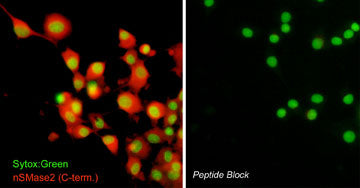
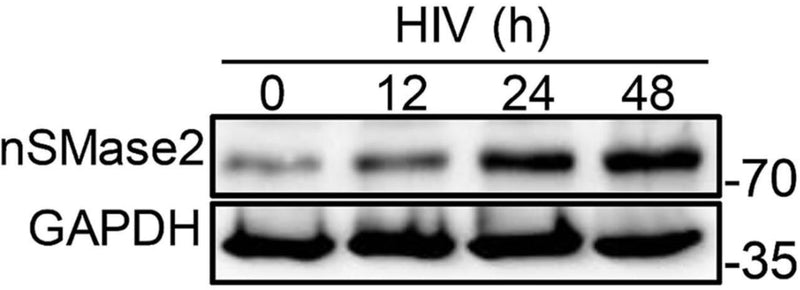
| Short Description | Rabbit polyclonal anti-nSMase2 (C-Term) for use in ELISA, WB and ICC in Human, Mouse and Rat samples. Datasheet included with dilution recommendations, and related reagents. |
| Applications | ELISA/WB/ICC |
| Host | Rabbit |
| Reactivity | Human/Mouse/Rat |
| Note | STRICTLY FOR FURTHER SCIENTIFIC RESEARCH USE ONLY (RUO). MUST NOT TO BE USED IN DIAGNOSTIC OR THERAPEUTIC APPLICATIONS. |
Product Properties
| Clonality | Polyclonal |
| Isotype | IgG |
| Conjugation | Unconjugated |
| Purification | Antigen Affinity Purified |
| Dilution Range | WB 1:1000ICC 1:100 |
| Formulation | PBS + 1 mg/ml BSA, 0.05% NaN3 and 50% glycerol |
| Storage Instruction | Storage at-20°C is recommended, as aliquots may be taken without freeze/thawing due to presence of 50% glycerol. Stable for at least 1 year at-20°C. |
Target Information
| Gene Symbol | SMPD3 |
| Gene ID | 55512 |
| Uniprot ID | NSMA2_HUMAN |
| Immunogen | nSMase2 synthetic peptide corresponds to amino acids in the C-terminal region of human nSMase2. This sequence is highly conserved in rat and mouse nSMase2, and has low homology to other nSMase family members. |
| Immunogen Region | C-Term |
| Immunogen Sequence | Human |
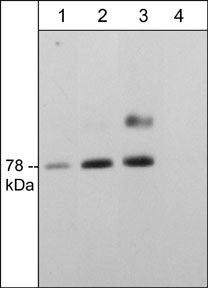
| Specificity | The antibody detects a 78 kDa* band corresponding to nSMase2 on SDS-PAGE immunoblots of adult mouse brain and rat PC12 cells. |
Additional Info
| Tissue Specificity | Predominantly expressed in brain. |
| Post Translational Modifications | Palmitoylated, palmitoylation-deficient proteins are targeted for lysosomal degradation. |
| Function | Catalyzes the hydrolysis of sphingomyelin to form ceramide and phosphocholine. Ceramide mediates numerous cellular functions, such as apoptosis and growth arrest, and is capable of regulating these 2 cellular events independently. Also hydrolyzes sphingosylphosphocholine. Regulates the cell cycle by acting as a growth suppressor in confluent cells. Probably acts as a regulator of postnatal development and participates in bone and dentin mineralization. Binds to anionic phospholipids (APLs) such as phosphatidylserine (PS) and phosphatidic acid (PA) that modulate enzymatic activity and subcellular location. May be involved in IL-1-beta-induced JNK activation in hepatocytes. May act as a mediator in transcriptional regulation of NOS2/iNOS via the NF-kappa-B activation under inflammatory conditions. |
| Protein Name | Sphingomyelin Phosphodiesterase 3Neutral Sphingomyelinase 2Nsmase-2Nsmase2Neutral Sphingomyelinase Ii |
| Database Links | Reactome: R-HSA-5626978Reactome: R-HSA-9840310 |
| Cellular Localisation | Golgi Apparatus MembraneLipid-AnchorCell MembraneMay Localize To Detergent-Resistant Subdomains Of Golgi Membranes Of Hypothalamic Neurosecretory NeuronsLocalizes To Plasma Membrane In Confluent Contact-Inhaibited Cells |
| Alternative Antibody Names | Anti-Sphingomyelin Phosphodiesterase 3 antibodyAnti-Neutral Sphingomyelinase 2 antibodyAnti-Nsmase-2 antibodyAnti-Nsmase2 antibodyAnti-Neutral Sphingomyelinase Ii antibodyAnti-SMPD3 antibody |
Information sourced from Uniprot.org