




Anti-NOP1 antibody [38F3] (STJA0003634)
SPECIFICATIONS
ClonalityMonoclonal
HostMouse
ConjugationUnconjugated
IsotypeIgG1
ImmunogenYeast nuclear preparations.
General Information
| Short Description | Mouse monoclonal anti-Fibrillarin for use in WB, IHC and ICC in Bovine, Chicken, D.melanogaster, Human, Mouse, Pig, Rat, Canine, Feline, Goat, Guinea Pig, Hamster, Horse, Non-Human Primates, Rabbit, Sheep and Vole samples. Datasheet included with dil |
| Applications | WB/IHC/ICC |
| Host | Mouse |
| Reactivity | Bovine/Chicken/D.melanogaster/Human/Mouse/Pig/Rat/Canine/Feline/Goat/Guinea Pig/Hamster/Horse/Non-Human Primates/Rabbit/Sheep/Vole |
| Note | STRICTLY FOR FURTHER SCIENTIFIC RESEARCH USE ONLY (RUO). MUST NOT TO BE USED IN DIAGNOSTIC OR THERAPEUTIC APPLICATIONS. |
Product Properties
| Clonality | Monoclonal |
| Clone ID | 38F3 |
| Isotype | IgG1 |
| Conjugation | Unconjugated |
| Purification | This antibody was protein g purified culture from supernatant. |
| Dilution Range | WB 1:1000IHC 1:100-1:500ICC 1:100-1:500 |
| Formulation | 100 ul in PBS + 50% Glycerol and 5 mm Sodium Azide |
| Storage Instruction | Store at-20°C for up to 1 year from the date of receipt, and avoid repeat freeze-thaw cycles. |
Target Information
| Immunogen | Yeast nuclear preparations. |
Additional Info
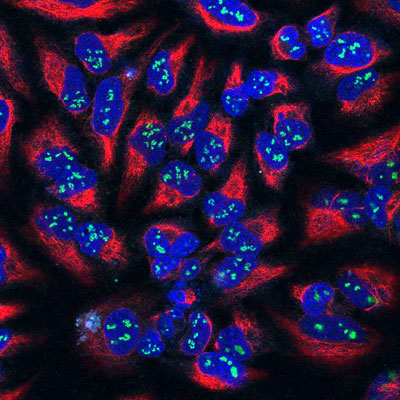
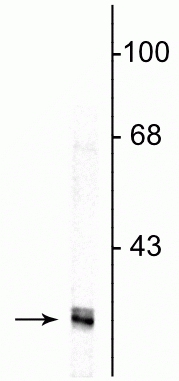
| Background | Nop1p was originally identified as a nucleolar protein of bakers yeast, Saccharomyces cerevisiae. The Nop1p protein is 327 amino acids in size (34.5kDa) , is essential for yeast viability, and is localized in the nucleoli (1). The systematic name for S. cerevisiae Nop1 is YDL014W, and it is now known to be part of the small subunit processome complex, involved in the processing of pre-18S ribosomal RNA. Nop1p is the yeast homologue of a protein found in all eukaryotes and archea generally called fibrillarin (2). Fibrillarin/Nop1p is extraordinarily conserved, so that the yeast and human proteins are 67% identical, and the human protein can functionally replace the yeast protein. Patients with the autoimmune disease scleroderma often have strong circulating autoantibodies to a ~34kDa protein which was subsequently found to be fibrillarin. Recent studies show that knock-out of the fibrillarin gene in mice results in embryonic lethality, although Western blot of HeLa cell lysate showing specific mice with only one functional fibrillarin/Nop1p gene were viable immunolabeling of the ~34 kDa fibrillarin protein. (3). This antibody is becoming widely used as a convenient marker for nucleoli in a wide variety of species (e.g. 4-6). |
Information sourced from Uniprot.org