


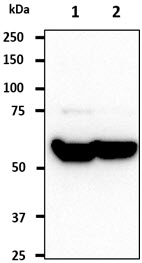
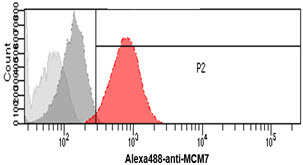

Anti-MCM7 antibody (1-414aa) [AT1G8] (STJA0041862)
SPECIFICATIONS
ClonalityMonoclonal
HostMouse
ConjugationUnconjugated
IsotypeIgG2bk
ImmunogenRecombinant human MCM7 (1-414aa) purified from E. coli.
General Information
| Short Description | Mouse monoclonal anti-MCM7 (1-414aa) for use in ELISA, WB and FACS in Human samples. Datasheet included with dilution recommendations, and related reagents. |
| Applications | ELISA/WB/FACS |
| Host | Mouse |
| Reactivity | Human |
| Note | STRICTLY FOR FURTHER SCIENTIFIC RESEARCH USE ONLY (RUO). MUST NOT TO BE USED IN DIAGNOSTIC OR THERAPEUTIC APPLICATIONS. |
Product Properties
| Clonality | Monoclonal |
| Clone ID | AT1G8 |
| Isotype | IgG2bk |
| Conjugation | Unconjugated |
| Concentration | 1 mg/mL |
| Purification | By protein-A affinity chromatography |
| Formulation | Liquid in phosphate-Buffered Saline (pH 7.4) with 0.02% Sodium Azide, 10% Glycerol |
| Storage Instruction | For short term storage, keep at +2C to +8C for up to 1 week. For long term storage, aliquot and store at-20C, and avoid repeat freeze-thaw cycles. |
Target Information
| Gene Symbol | MCM7 |
| Gene ID | 4176 |
| Uniprot ID | MCM7_HUMAN |
| Accession Number | NP_877577 |
| Immunogen | Recombinant human MCM7 (1-414aa) purified from E. coli. |
| Immunogen Region | 1-414aa |
Additional Info
| Post Translational Modifications | O-glycosylated (O-GlcNAcylated), in a cell cycle-dependent manner. Ubiquitinated by ECS(LRR1) E3 ubiquitin-protein ligase complex when forks converge following formation of DNA interstrand cross-links. During mitosis, ubiquitinated by TRAIP when forks converge following formation of DNA interstrand cross-links. Short ubiquitin chains on MCM7 promote recruitment of DNA glycosylase NEIL3. If the interstrand cross-link cannot be cleaved by NEIL3, the ubiquitin chains continue to grow on MCM7, promoting the unloading of the CMG helicase complex by the VCP/p97 ATPase. |
| Function | Acts as a component of the MCM2-7 complex (MCM complex) which is the replicative helicase essential for 'once per cell cycle' DNA replication initiation and elongation in eukaryotic cells. Core component of CDC45-MCM-GINS (CMG) helicase, the molecular machine that unwinds template DNA during replication, and around which the replisome is built. The active ATPase sites in the MCM2-7 ring are formed through the interaction surfaces of two neighboring subunits such that a critical structure of a conserved arginine finger motif is provided in trans relative to the ATP-binding site of the Walker A box of the adjacent subunit. The six ATPase active sites, however, are likely to contribute differentially to the complex helicase activity. Required for S-phase checkpoint activation upon UV-induced damage. |
| Protein Name | Dna Replication Licensing Factor Mcm7Cdc47 HomologP1.1-Mcm3 |
| Database Links | Reactome: R-HSA-176187Reactome: R-HSA-176974Reactome: R-HSA-68867Reactome: R-HSA-68949Reactome: R-HSA-68962Reactome: R-HSA-69052 |
| Cellular Localisation | NucleusChromosomeAssociated With Chromatin Before The Formation Of Nuclei And Detaches From It As Dna Replication Progresses |
| Alternative Antibody Names | Anti-Dna Replication Licensing Factor Mcm7 antibodyAnti-Cdc47 Homolog antibodyAnti-P1.1-Mcm3 antibodyAnti-MCM7 antibodyAnti-CDC47 antibodyAnti-MCM2 antibody |
Information sourced from Uniprot.org