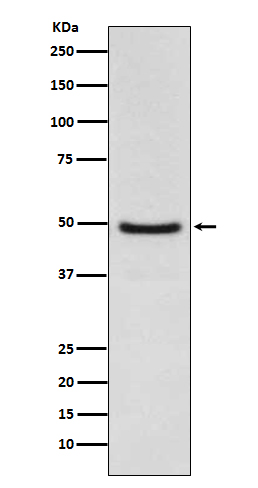
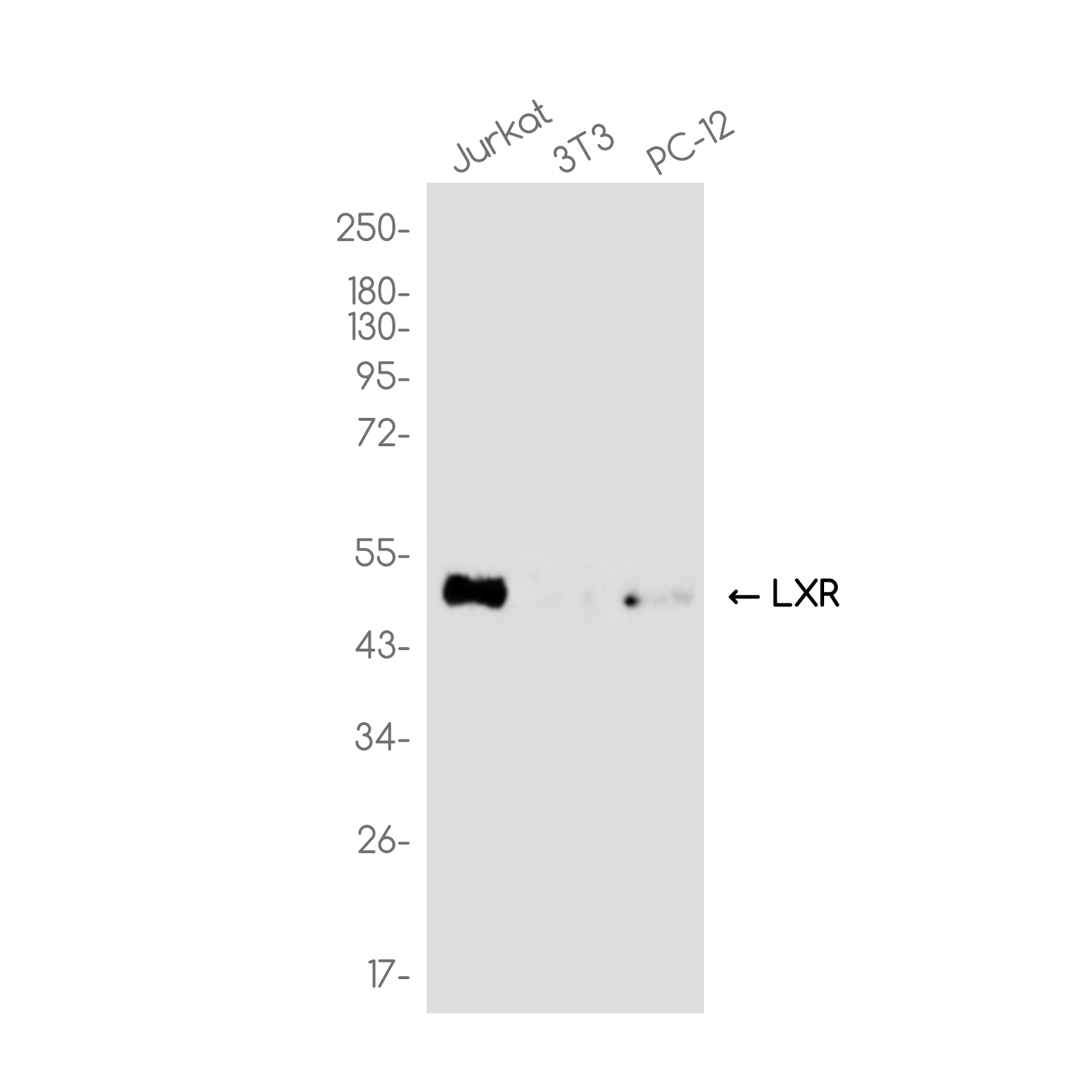
| Tissue Specificity | Visceral organs specific expression. Strong expression was found in liver, kidney and intestine followed by spleen and to a lesser extent the adrenals. |
| Post Translational Modifications | Ubiquitinated by UBR5, leading to its degradation: UBR5 specifically recognizes and binds ligand-bound NR1H3 when it is not associated with coactivators (NCOAs). In presence of NCOAs, the UBR5-degron is not accessible, preventing its ubiquitination and degradation. |
| Function | Nuclear receptor that exhibits a ligand-dependent transcriptional activation activity. Interaction with retinoic acid receptor (RXR) shifts RXR from its role as a silent DNA-binding partner to an active ligand-binding subunit in mediating retinoid responses through target genes defined by LXRES. LXRES are DR4-type response elements characterized by direct repeats of two similar hexanuclotide half-sites spaced by four nucleotides. Plays an important role in the regulation of cholesterol homeostasis, regulating cholesterol uptake through MYLIP-dependent ubiquitination of LDLR, VLDLR and LRP8. Interplays functionally with RORA for the regulation of genes involved in liver metabolism. Induces LPCAT3-dependent phospholipid remodeling in endoplasmic reticulum (ER) membranes of hepatocytes, driving SREBF1 processing and lipogenesis. Via LPCAT3, triggers the incorporation of arachidonate into phosphatidylcholines of ER membranes, increasing membrane dynamics and enabling triacylglycerols transfer to nascent very low-density lipoprotein (VLDL) particles. Via LPCAT3 also counteracts lipid-induced ER stress response and inflammation, likely by modulating SRC kinase membrane compartmentalization and limiting the synthesis of lipid inflammatory mediators. |
| Protein Name | Oxysterols Receptor Lxr-AlphaLiver X Receptor AlphaNuclear Receptor Subfamily 1 Group H Member 3 |
| Database Links | Reactome: R-HSA-1989781Reactome: R-HSA-383280Reactome: R-HSA-4090294 Q13133-1Reactome: R-HSA-8866427Reactome: R-HSA-9029558Reactome: R-HSA-9029569Reactome: R-HSA-9031525Reactome: R-HSA-9031528Reactome: R-HSA-9623433Reactome: R-HSA-9632974 |
| Cellular Localisation | NucleusCytoplasm |
| Alternative Antibody Names | Anti-Oxysterols Receptor Lxr-Alpha antibodyAnti-Liver X Receptor Alpha antibodyAnti-Nuclear Receptor Subfamily 1 Group H Member 3 antibodyAnti-NR1H3 antibodyAnti-LXRA antibody |
Information sourced from Uniprot.org