

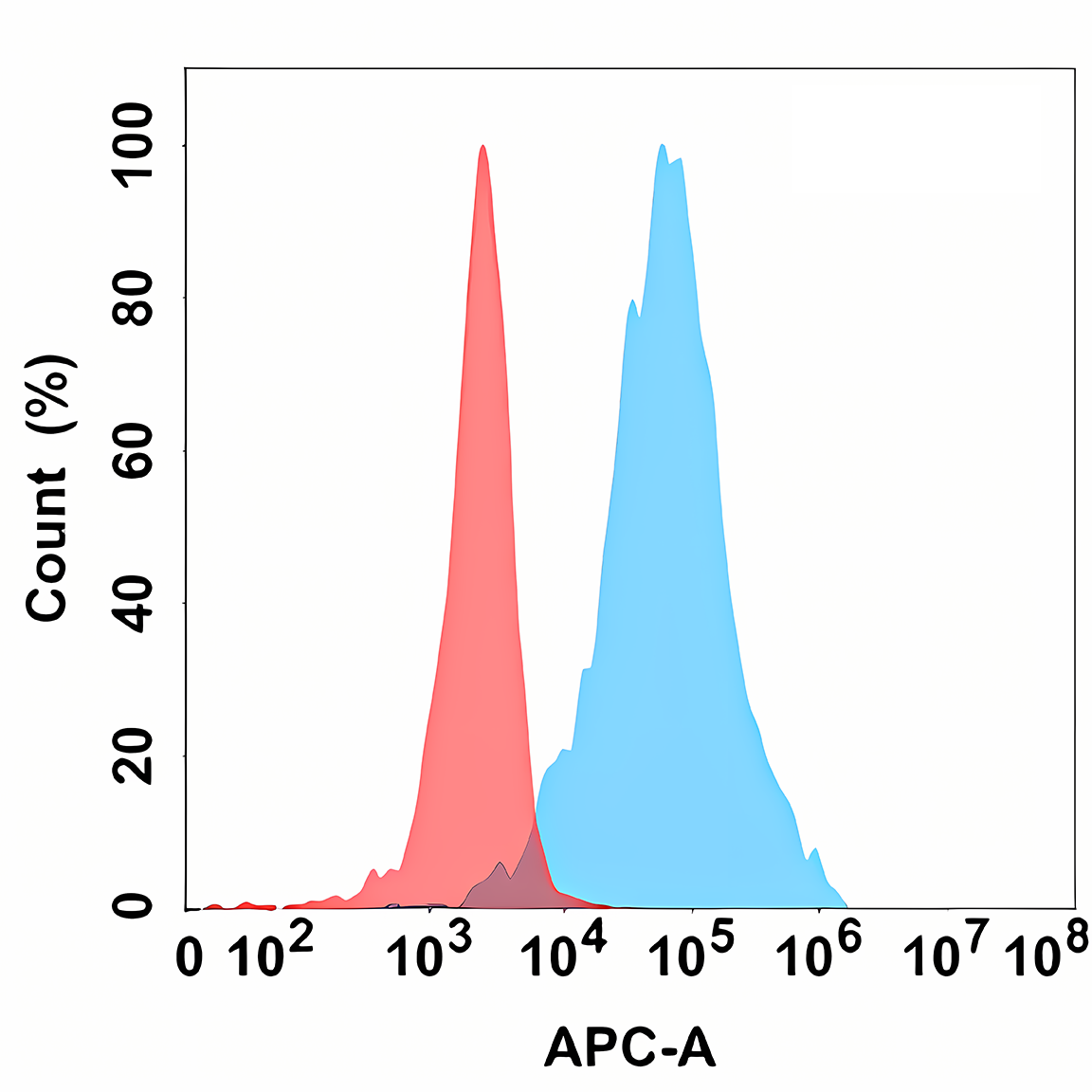

Anti-LAG3 antibody [DM160] (STJA0038172)
SPECIFICATIONS
ClonalityMonoclonal
HostRabbit
ConjugationUnconjugated
IsotypeIgG
ImmunogenRecombinant human LAG3 protein
General Information
| Short Description | Rabbit monoclonal anti-LAG3 for use in FC and ELISA in Human samples. Datasheet included with dilution recommendations, and related reagents. |
| Applications | FC/ELISA |
| Host | Rabbit |
| Reactivity | Human |
| Note | STRICTLY FOR FURTHER SCIENTIFIC RESEARCH USE ONLY (RUO). MUST NOT TO BE USED IN DIAGNOSTIC OR THERAPEUTIC APPLICATIONS. |
Product Properties
| Clonality | Monoclonal |
| Clone ID | DM160 |
| Isotype | IgG |
| Conjugation | Unconjugated |
| Purification | Affinity Chromatography |
| Dilution Range | FC 1:50-1:100ELISA 1:10000 |
| Formulation | Liquid in PBS containing 50% glycerol, 0.5% BSA and 0.02% sodium azide, pH 7.3. |
| Storage Instruction | Store at 4°C short term. Aliquot and store at-20°C long term. Avoid freeze/thaw cycles. |
Target Information
| Gene Symbol | LAG3 |
| Gene ID | 3902 |
| Uniprot ID | LAG3_HUMAN |
| Immunogen | Recombinant human LAG3 protein |
Additional Info
| Tissue Specificity | Primarily expressed in activated T-cells and a subset of natural killer (NK) cells. |
| Post Translational Modifications | Lymphocyte activation gene 3 protein: Proteolytically cleaved by ADAM10 and ADAM17 within the connecting peptide region, leading to release of Secreted lymphocyte activation gene 3 protein (sLAG-3). ADAM10 mediates constitutive cleavage, but cleavage increases following T-cell activation, whereas shedding by ADAM17 is induced by TCR signaling in a PRKCQ-dependent manner. |
| Function | Lymphocyte activation gene 3 protein: Inhibitory receptor on antigen activated T-cells. Delivers inhibitory signals upon binding to ligands, such as FGL1. FGL1 constitutes a major ligand of LAG3 and is responsible for LAG3 T-cell inhibitory function. Following TCR engagement, LAG3 associates with CD3-TCR in the immunological synapse and directly inhibits T-cell activation. May inhibit antigen-specific T-cell activation in synergy with PDCD1/PD-1, possibly by acting as a coreceptor for PDCD1/PD-1. Negatively regulates the proliferation, activation, effector function and homeostasis of both CD8(+) and CD4(+) T-cells. Also mediates immune tolerance: constitutively expressed on a subset of regulatory T-cells (Tregs) and contributes to their suppressive function. Also acts as a negative regulator of plasmacytoid dendritic cell (pDCs) activation. Binds MHC class II (MHC-II).the precise role of MHC-II-binding is however unclear. Secreted lymphocyte activation gene 3 protein: May function as a ligand for MHC class II (MHC-II) on antigen-presenting cells (APC), promoting APC activation/maturation and driving Th1 immune response. |
| Protein Name | Lymphocyte Activation Gene 3 ProteinLag-3Cd Antigen Cd223 Cleaved Into - Secreted Lymphocyte Activation Gene 3 ProteinSlag-3 |
| Database Links | Reactome: R-HSA-2132295 |
| Cellular Localisation | Lymphocyte Activation Gene 3 Protein: Cell MembraneSingle-Pass Type I Membrane ProteinSecreted Lymphocyte Activation Gene 3 Protein: SecretedProduced Following Cleavage Of The Main Chain |
| Alternative Antibody Names | Anti-Lymphocyte Activation Gene 3 Protein antibodyAnti-Lag-3 antibodyAnti-Cd Antigen Cd223 Cleaved Into - Secreted Lymphocyte Activation Gene 3 Protein antibodyAnti-Slag-3 antibodyAnti-LAG3 antibodyAnti-FDC antibody |
Information sourced from Uniprot.org