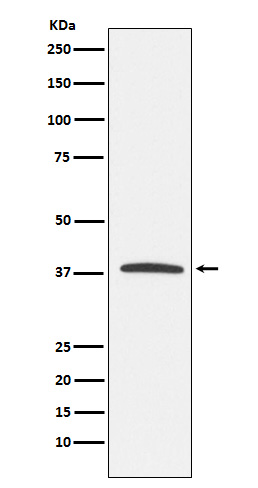
| Tissue Specificity | Expressed specifically on natural killer (NK) cells and T-cells, mainly CD8 T-cells. |
| Function | Plays an inhibitory role on natural killer (NK) cells and T-cell functions upon binding to their non-MHC ligands. May mediate missing self recognition by binding to a highly conserved site on classical cadherins, enabling it to monitor expression of E-cadherin/CDH1, N-cadherin/CDH2 and R-cadherin/CDH4 on target cells. |
| Protein Name | Killer Cell Lectin-Like Receptor Subfamily G Member 1C-Type Lectin Domain Family 15 Member AItim-Containing Receptor Mafa-LMafa-Like ReceptorMast Cell Function-Associated Antigen |
| Database Links | Reactome: R-HSA-198933 |
| Cellular Localisation | Cell MembraneSingle-Pass Type Ii Membrane Protein |
| Alternative Antibody Names | Anti-Killer Cell Lectin-Like Receptor Subfamily G Member 1 antibodyAnti-C-Type Lectin Domain Family 15 Member A antibodyAnti-Itim-Containing Receptor Mafa-L antibodyAnti-Mafa-Like Receptor antibodyAnti-Mast Cell Function-Associated Antigen antibodyAnti-KLRG1 antibodyAnti-CLEC15A antibodyAnti-MAFA antibodyAnti-MAFAL antibody |
Information sourced from Uniprot.org