


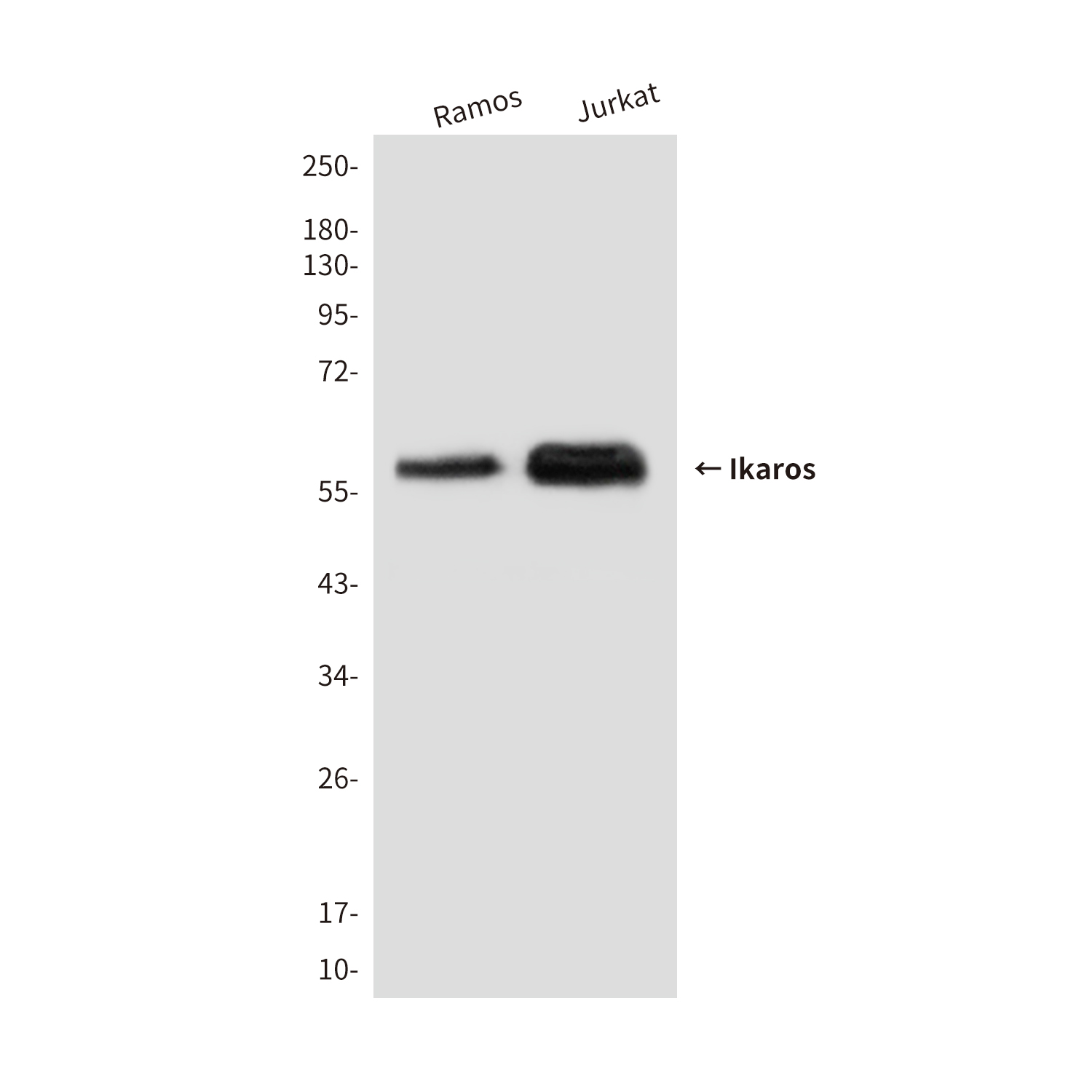
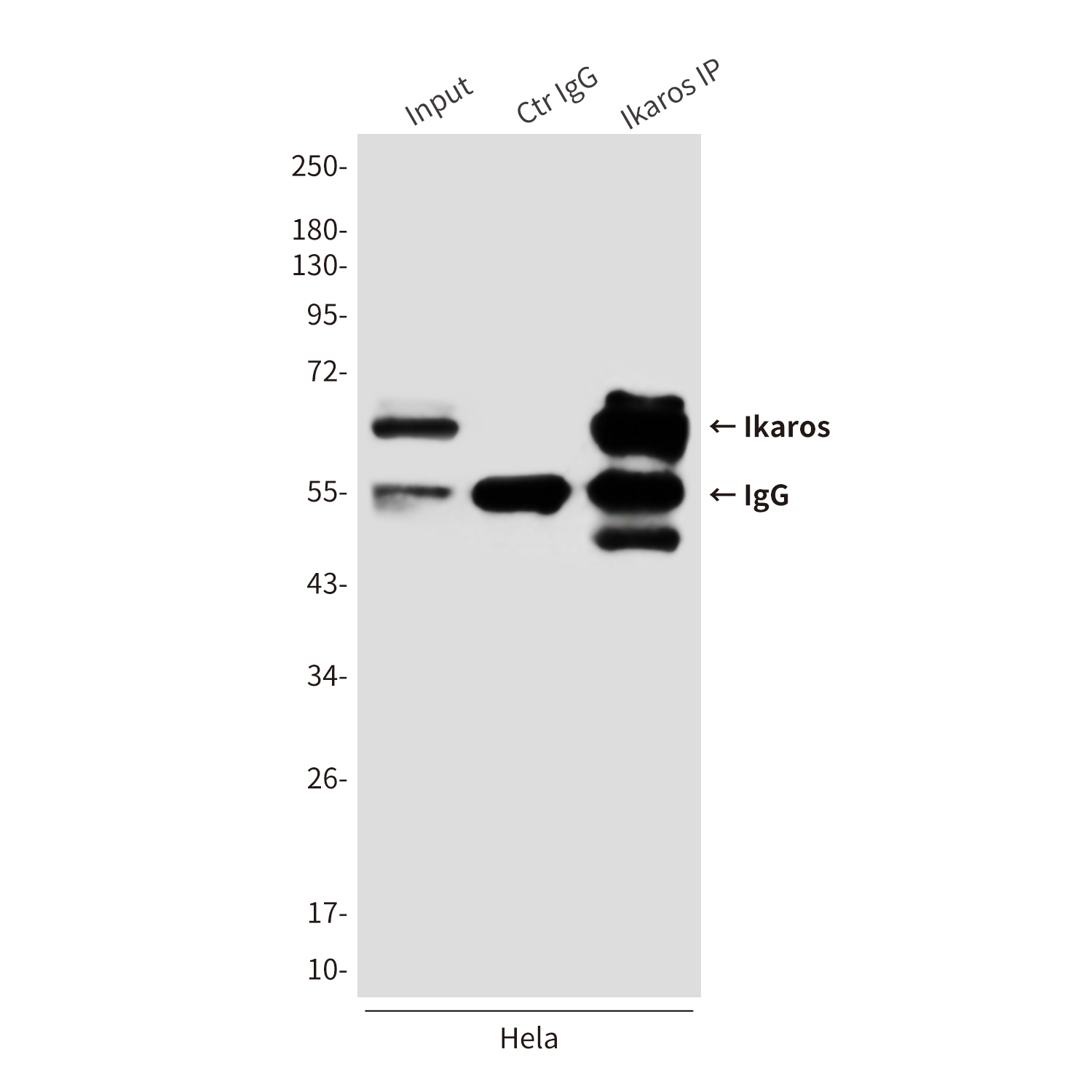

Anti-Ikaros antibody [1A12-F2-D8] (STJA0032380)
SPECIFICATIONS
ClonalityMonoclonal
HostMouse
ConjugationUnconjugated
IsotypeIgG1
ImmunogenPurified recombinant human Ikaros (C-terminus) protein fragments expressed in E.coli.
General Information
| Short Description | Mouse monoclonal anti-Ikaros for use in WB and IP in Human samples. Datasheet included with dilution recommendations, and related reagents. |
| Applications | WB/IP |
| Host | Mouse |
| Reactivity | Human |
| Note | STRICTLY FOR FURTHER SCIENTIFIC RESEARCH USE ONLY (RUO). MUST NOT TO BE USED IN DIAGNOSTIC OR THERAPEUTIC APPLICATIONS. |
Product Properties
| Clonality | Monoclonal |
| Clone ID | 1A12-F2-D8 |
| Isotype | IgG1 |
| Conjugation | Unconjugated |
| Concentration | 1 mg/mL |
| Purification | Affinity Purified |
| Dilution Range | WB 1:500-1:1000IP 1:20 |
| Formulation | Liquid in PBS containing 50% glycerol, 0.5% BSA and 0.02% sodium azide, pH 7.3. |
| Storage Instruction | Store at 4°C short term. Aliquot and store at-20°C long term. Avoid freeze/thaw cycles. |
Target Information
| Gene Symbol | IKZF1 |
| Gene ID | 10320 |
| Uniprot ID | IKZF1_HUMAN |
| Immunogen | Purified recombinant human Ikaros (C-terminus) protein fragments expressed in E.coli. |
Additional Info
| Tissue Specificity | Abundantly expressed in thymus, spleen and peripheral blood Leukocytes and lymph nodes. Lower expression in bone marrow and small intestine. |
| Post Translational Modifications | Phosphorylation controls cell-cycle progression from late G(1) stage to S stage. Hyperphosphorylated during G2/M phase. Dephosphorylated state during late G(1) phase. Phosphorylation on Thr-140 is required for DNA and pericentromeric location during mitosis. CK2 is the main kinase, in vitro. GSK3 and CDK may also contribute to phosphorylation of the C-terminal serine and threonine residues. Phosphorylation on these C-terminal residues reduces the DNA-binding ability. Phosphorylation/dephosphorylation events on Ser-13 and Ser-295 regulate TDT expression during thymocyte differentiation. Dephosphorylation by protein phosphatase 1 regulates stability and pericentromeric heterochromatin location. Phosphorylated in both lymphoid and non-lymphoid tissues. Phosphorylation at Ser-361 and Ser-364 downstream of SYK induces nuclear translocation. Sumoylated. Simultaneous sumoylation on the 2 sites results in a loss of both HDAC-dependent and HDAC-independent repression. Has no effect on pericentromeric heterochromatin location. Desumoylated by SENP1. Polyubiquitinated. |
| Function | Transcription regulator of hematopoietic cell differentiation. Binds gamma-satellite DNA. Plays a role in the development of lymphocytes, B- and T-cells. Binds and activates the enhancer (delta-A element) of the CD3-delta gene. Repressor of the TDT (fikzfterminal deoxynucleotidyltransferase) gene during thymocyte differentiation. Regulates transcription through association with both HDAC-dependent and HDAC-independent complexes. Targets the 2 chromatin-remodeling complexes, NuRD and BAF (SWI/SNF), in a single complex (PYR complex), to the beta-globin locus in adult erythrocytes. Increases normal apoptosis in adult erythroid cells. Confers early temporal competence to retinal progenitor cells (RPCs). Function is isoform-specific and is modulated by dominant-negative inactive isoforms. |
| Protein Name | Dna-Binding Protein IkarosIkaros Family Zinc Finger Protein 1Lymphoid Transcription Factor Lyf-1 |
| Database Links | Reactome: R-HSA-9013508 Q13422-1 |
| Cellular Localisation | NucleusIn Resting LymphocytesDistributed Diffusely Throughout The NucleusLocalizes To Pericentromeric Heterochromatin In Proliferating CellsThis Localization Requires Dna Binding Which Is Regulated By Phosphorylation / Dephosphorylation EventsIsoform Ik2: NucleusIsoform Ik6: Cytoplasm |
| Alternative Antibody Names | Anti-Dna-Binding Protein Ikaros antibodyAnti-Ikaros Family Zinc Finger Protein 1 antibodyAnti-Lymphoid Transcription Factor Lyf-1 antibodyAnti-IKZF1 antibodyAnti-IK1 antibodyAnti-IKAROS antibodyAnti-LYF1 antibodyAnti-ZNFN1A1 antibody |
Information sourced from Uniprot.org