

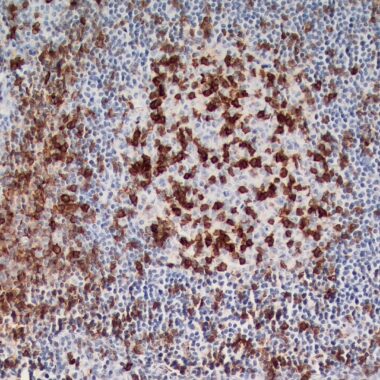

Anti-ICOS antibody [ZR476] (STJ180687)
SPECIFICATIONS
ClonalityMonoclonal
HostRabbit
ConjugationUnconjugated
IsotypeIgG
ImmunogenSynthetic ICOS protein
General Information
| Short Description | Rabbit monoclonal ICOS antibody for use in IHC-P in human samples. Datasheet included with dilution recommendations, and related reagents. |
| Applications | IHC-P |
| Host | Rabbit |
| Reactivity | Human |
| Note | STRICTLY FOR FURTHER SCIENTIFIC RESEARCH USE ONLY (RUO). MUST NOT TO BE USED IN DIAGNOSTIC OR THERAPEUTIC APPLICATIONS. |
Product Properties
| Clonality | Monoclonal |
| Clone ID | ZR476 |
| Isotype | IgG |
| Conjugation | Unconjugated |
| Purification | Affinity purified |
| Dilution Range | 1:100-200 |
| Formulation | Tris-HCI buffer containing stabilizing protein (BSA) and <0.1% ProClin |
| Storage Instruction | Store at 2‐8°C for up to 24 months. Predilute: Ready to use, no reconstitution necessary. Concentrate: Use dilution range and appropriate lab‐standardized diluent. Stability after dilution: 7 days at 24°C, 3 months at 2‐8°C, 6months at ‐20°C. |
Target Information
| Gene Symbol | ICOS |
| Gene ID | 29851 |
| Uniprot ID | ICOS_HUMAN |
| Immunogen | Synthetic ICOS protein |
| Specificity | Positive Control: Lymph node |
Additional Info
| Tissue Specificity | Activated T-cells. Highly expressed on tonsillar T-cells, which are closely associated with B-cells in the apical light zone of germinal centers, the site of terminal B-cell maturation. Expressed at lower levels in thymus, lung, lymph node and peripheral blood leukocytes. Expressed in the medulla of fetal and newborn thymus. |
| Post Translational Modifications | N-glycosylated. |
| Function | Stimulatory receptor expressed in activated or antigen-experienced T-cells that plays an important role in the immune response. Upon binding to its ligand ICOSL expressed on antigen presenting cells (APCs), delivers costimulatory signals that enhances all basic T-cell responses to a foreign antigen, namely proliferation, secretion of lymphokines including IL10, up-regulation of molecules that mediate cell-cell interaction, and effective help for antibody secretion by B-cells. Also acts as a costimulatory receptor critical for the differentiation of T follicular regulatory cells upon immune challenges such as viral infection. Mechanistically, potentiates TCR-induced calcium flux by augmenting PLCG1 activation and actin remodeling. In addition, activates PI3K signaling pathways independently of calcium flux. Essential both for efficient interaction between T and B-cells and for normal antibody responses to T-cell dependent antigens. Prevents the apoptosis of pre-activated T-cells. Plays a critical role in CD40-mediated class switching of immunoglobin isotypes. |
| Protein Name | Inducible T-Cell CostimulatorActivation-Inducible Lymphocyte Immunomediatory MoleculeCd Antigen Cd278 |
| Database Links | Reactome: R-HSA-1257604 Q9Y6W8-1Reactome: R-HSA-2219530 Q9Y6W8-1Reactome: R-HSA-6811558 Q9Y6W8-1Reactome: R-HSA-9725371Reactome: R-HSA-9927354 Q9Y6W8-1 |
| Cellular Localisation | Isoform 1: Cell MembraneSingle-Pass Type I Membrane ProteinIsoform 2: Secreted |
| Alternative Antibody Names | Anti-Inducible T-Cell Costimulator antibodyAnti-Activation-Inducible Lymphocyte Immunomediatory Molecule antibodyAnti-Cd Antigen Cd278 antibodyAnti-ICOS antibodyAnti-AILIM antibody |
Information sourced from Uniprot.org