

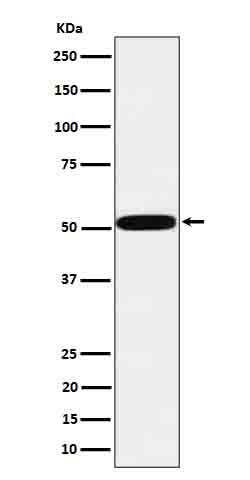

Anti-HTRA1 antibody [R22-3C-3] (STJA0035612)
SPECIFICATIONS
ClonalityMonoclonal
HostRabbit
ConjugationUnconjugated
IsotypeIgG
ImmunogenA synthesized peptide derived from human htrA1
General Information
| Short Description | Rabbit monoclonal anti-HTRA1 for use in WB, ICC and IF in Human samples. Datasheet included with dilution recommendations, and related reagents. |
| Applications | WB/ICC/IF |
| Host | Rabbit |
| Reactivity | Human |
| Note | STRICTLY FOR FURTHER SCIENTIFIC RESEARCH USE ONLY (RUO). MUST NOT TO BE USED IN DIAGNOSTIC OR THERAPEUTIC APPLICATIONS. |
Product Properties
| Clonality | Monoclonal |
| Clone ID | R22-3C-3 |
| Isotype | IgG |
| Conjugation | Unconjugated |
| Purification | Affinity Chromatography |
| Dilution Range | WB 1:500-1:1000IF 1:50-1:200 |
| Formulation | Liquid in PBS, pH 7.4, 150mM NaCl, 0.02% sodium azide and 50% glycerol. |
| Storage Instruction | Store at 4°C short term. Aliquot and store at-20°C long term. Avoid freeze/thaw cycles. |
Target Information
| Gene Symbol | HTRA1 |
| Gene ID | 5654 |
| Uniprot ID | HTRA1_HUMAN |
| Immunogen | A synthesized peptide derived from human htrA1 |
Additional Info
| Tissue Specificity | Widely expressed, with strongest expression in placenta (at protein level). Secreted by synovial fibroblasts. Up-regulated in osteoarthritis and rheumatoid arthritis synovial fluids and cartilage as compared with non-arthritic (at protein level). |
| Function | Serine protease with a variety of targets, including extracellular matrix proteins such as fibronectin. HTRA1-generated fibronectin fragments further induce synovial cells to up-regulate MMP1 and MMP3 production. May also degrade proteoglycans, such as aggrecan, decorin and fibromodulin. Through cleavage of proteoglycans, may release soluble FGF-glycosaminoglycan complexes that promote the range and intensity of FGF signals in the extracellular space. Regulates the availability of insulin-like growth factors (IGFs) by cleaving IGF-binding proteins. Inhibits signaling mediated by TGF-beta family members. This activity requires the integrity of the catalytic site, although it is unclear whether TGF-beta proteins are themselves degraded. By acting on TGF-beta signaling, may regulate many physiological processes, including retinal angiogenesis and neuronal survival and maturation during development. Intracellularly, degrades TSC2, leading to the activation of TSC2 downstream targets. |
| Protein Name | Serine Protease Htra1High-Temperature Requirement A Serine Peptidase 1L56Serine Protease 11 |
| Database Links | Reactome: R-HSA-1474228 |
| Cellular Localisation | Cell MembraneSecretedCytoplasmCytosolPredominantly SecretedAlso Found Associated With The Plasma Membrane |
| Alternative Antibody Names | Anti-Serine Protease Htra1 antibodyAnti-High-Temperature Requirement A Serine Peptidase 1 antibodyAnti-L56 antibodyAnti-Serine Protease 11 antibodyAnti-HTRA1 antibodyAnti-HTRA antibodyAnti-PRSS11 antibody |
Information sourced from Uniprot.org