
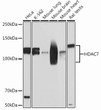


Anti-HDAC7 antibody (24-198) [S1MR] (STJ11101421)
SPECIFICATIONS
ClonalityMonoclonal
HostRabbit
ConjugationUnconjugated
IsotypeIgG
General Information
| Short Description | Rabbit monoclonal HDAC7 (24-198) antibody for use in WB and ELISA in human, mouse and rat samples. Datasheet included with dilution recommendations, and related reagents. |
| Applications | WB/ELISA |
| Host | Rabbit |
| Reactivity | Human/Mouse/Rat |
| Note | STRICTLY FOR FURTHER SCIENTIFIC RESEARCH USE ONLY (RUO). MUST NOT TO BE USED IN DIAGNOSTIC OR THERAPEUTIC APPLICATIONS. |
Product Properties
| Clonality | Monoclonal |
| Clone ID | S1MR |
| Isotype | IgG |
| Conjugation | Unconjugated |
| Concentration | Lot specific |
| Purification | Affinity purification |
| Dilution Range | WB:1:500-1:1000ELISA:Recommended starting concentration is 1 Mu g/mL. Please optimize the concentration based on your specific assay requirements. |
| Formulation | PBS with 0.02% Sodium Azide, 0.05% BSA, 50% Glycerol, pH 7.3. |
| Storage Instruction | Store at-20°C for up to 1 year from the date of receipt, and avoid repeat freeze-thaw cycles. |
Target Information
| Gene Symbol | HDAC7 |
| Gene ID | 51564 |
| Uniprot ID | HDAC7_HUMAN |
| Immunogen Region | 24-198 |
| Immunogen Sequence | RPQRLHHHLFLAGLQQQRSV EPMRLSMDTPMPELQVGPQE QELRQLLHKDKSKRSAVASS VVKQKLAEVILKKQQAALER TVHPNSPGIPYRTLEPLETE GATRSMLSSFLPPVPSLPSD PPEHFPLRKTVSEPNLKLRY KPKKSLERRKNPLLRKESAP PSLRRRPAETLGDSS |
| Specificity | Recombinant fusion protein containing a sequence corresponding to amino acids 24-198 of human HDAC7 (Q8WUI4). |
Additional Info
| Post Translational Modifications | May be phosphorylated by CaMK1. Phosphorylated by the PKC kinases PKN1 and PKN2, impairing nuclear import. Phosphorylation at Ser-155 by MARK2, MARK3 and PRKD1 promotes interaction with 14-3-3 proteins and export from the nucleus. Phosphorylation at Ser-155 is a prerequisite for phosphorylation at Ser-181. |
| Function | Responsible for the deacetylation of lysine residues on the N-terminal part of the core histones (H2A, H2B, H3 and H4). Histone deacetylation gives a tag for epigenetic repression and plays an important role in transcriptional regulation, cell cycle progression and developmental events. Histone deacetylases act via the formation of large multiprotein complexes. Involved in muscle maturation by repressing transcription of myocyte enhancer factors such as MEF2A, MEF2B and MEF2C. During muscle differentiation, it shuttles into the cytoplasm, allowing the expression of myocyte enhancer factors. May be involved in Epstein-Barr virus (EBV) latency, possibly by repressing the viral BZLF1 gene. Positively regulates the transcriptional repressor activity of FOXP3. Serves as a corepressor of RARA, causing its deacetylation and inhibition of RARE DNA element binding. In association with RARA, plays a role in the repression of microRNA-10a and thereby in the inflammatory response. Also acetylates non-histone proteins, such as ALKBH5. |
| Protein Name | Histone Deacetylase 7Hd7Histone Deacetylase 7aHd7aProtein Deacetylase Hdac7 |
| Database Links | Reactome: R-HSA-2122947Reactome: R-HSA-2644606Reactome: R-HSA-2894862Reactome: R-HSA-3108214Reactome: R-HSA-350054Reactome: R-HSA-8943724 |
| Cellular Localisation | NucleusCytoplasmIn The NucleusIt Associates With Distinct Subnuclear Dot-Like StructuresShuttles Between The Nucleus And The CytoplasmIn Muscle CellsIt Shuttles Into The Cytoplasm During Myocyte DifferentiationThe Export To Cytoplasm Depends On The Interaction With The 14-3-3 Protein Ywhae And Is Due To Its Phosphorylation |
| Alternative Antibody Names | Anti-Histone Deacetylase 7 antibodyAnti-Hd7 antibodyAnti-Histone Deacetylase 7a antibodyAnti-Hd7a antibodyAnti-Protein Deacetylase Hdac7 antibodyAnti-HDAC7 antibodyAnti-HDAC7A antibody |
Information sourced from Uniprot.org