

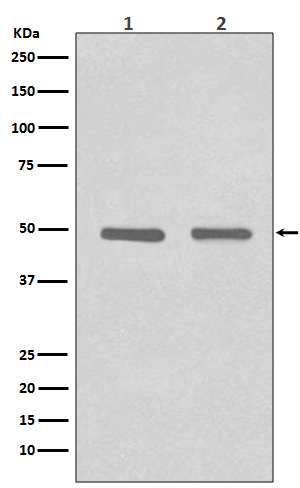

Anti-HDAC3 antibody (400-428 aa) [R07-8E9] (STJA0014653)
SPECIFICATIONS
ClonalityMonoclonal
HostRabbit
ConjugationUnconjugated
IsotypeIgG
ImmunogenA synthesized peptide derived from human HDAC3
General Information
| Short Description | Rabbit monoclonal anti-HDAC3 (400-428 aa) for use in WB, IHC-P, ICC, IF and IP in Human, Mouse and Rat samples. Datasheet included with dilution recommendations, and related reagents. |
| Applications | WB/IHC-P/ICC/IF/IP |
| Host | Rabbit |
| Reactivity | Human/Mouse/Rat |
| Note | STRICTLY FOR FURTHER SCIENTIFIC RESEARCH USE ONLY (RUO). MUST NOT TO BE USED IN DIAGNOSTIC OR THERAPEUTIC APPLICATIONS. |
Product Properties
| Clonality | Monoclonal |
| Clone ID | R07-8E9 |
| Isotype | IgG |
| Conjugation | Unconjugated |
| Purification | Affinity Chromatography |
| Dilution Range | WB 1:500-1:1000IHC 1:50-1:100IF 1:50-1:200IP 1:30 |
| Formulation | Liquid in PBS pH7.4, 150mM NaCl, 0.02% Sodium Azide and 50% Glycerol. |
| Storage Instruction | Store at 4°C short term. Aliquot and store at-20°C long term. Avoid freeze/thaw cycles. |
Target Information
| Gene Symbol | HDAC3 |
| Gene ID | 8841 |
| Uniprot ID | HDAC3_HUMAN |
| Immunogen | A synthesized peptide derived from human HDAC3 |
| Immunogen Region | 400-428 aa |
Additional Info
| Tissue Specificity | Widely expressed. |
| Post Translational Modifications | Sumoylated in vitro. Deubiquitinated on 'Lys-63'-linked ubiquitin chains by USP38.leading to a decreased level of histone acetylation. |
| Function | Histone deacetylase that catalyzes the deacetylation of lysine residues on the N-terminal part of the core histones (H2A, H2B, H3 and H4), and some other non-histone substrates. Histone deacetylation gives a tag for epigenetic repression and plays an important role in transcriptional regulation, cell cycle progression and developmental events. Histone deacetylases act via the formation of large multiprotein complexes, such as N-Cor repressor complex, which activate the histone deacetylase activity. Participates in the BCL6 transcriptional repressor activity by deacetylating the H3 'Lys-27' (H3K27) on enhancer elements, antagonizing EP300 acetyltransferase activity and repressing proximal gene expression. Acts as a molecular chaperone for shuttling phosphorylated NR2C1 to PML bodies for sumoylation. Contributes, together with XBP1 isoform 1, to the activation of NFE2L2-mediated HMOX1 transcription factor gene expression in a PI(3)K/mTORC2/Akt-dependent signaling pathway leading to endothelial cell (EC) survival under disturbed flow/oxidative stress. Regulates both the transcriptional activation and repression phases of the circadian clock in a deacetylase activity-independent manner. During the activation phase, promotes the accumulation of ubiquitinated BMAL1 at the E-boxes and during the repression phase, blocks FBXL3-mediated CRY1/2 ubiquitination and promotes the interaction of CRY1 and BMAL1. The NCOR1-HDAC3 complex regulates the circadian expression of the core clock gene BMAL1 and the genes involved in lipid metabolism in the liver. Also functions as a deacetylase for non-histone targets, such as KAT5, MEF2D, MAPK14, RARA and STAT3. Serves as a corepressor of RARA, mediating its deacetylation and repression, leading to inhibition of RARE DNA element binding. In association with RARA, plays a role in the repression of microRNA-10a and thereby in the inflammatory response. In addition to protein deacetylase activity, also acts as a protein-lysine deacylase by recognizing other acyl groups: catalyzes removal of (2E)-butenoyl (crotonyl), lactoyl (lactyl) and 2-hydroxyisobutanoyl (2-hydroxyisobutyryl) acyl groups from lysine residues, leading to protein decrotonylation, delactylation and de-2-hydroxyisobutyrylation, respectively. Catalyzes decrotonylation of MAPRE1/EB1. Mediates delactylation NBN/NBS1, thereby inhibiting DNA double-strand breaks (DSBs) via homologous recombination (HR). |
| Protein Name | Histone Deacetylase 3Hd3Protein Deacetylase Hdac3Protein Deacylase Hdac3Rpd3-2Smap45 |
| Database Links | Reactome: R-HSA-1368071Reactome: R-HSA-193670Reactome: R-HSA-1989781Reactome: R-HSA-2122947Reactome: R-HSA-2151201Reactome: R-HSA-2644606Reactome: R-HSA-2894862Reactome: R-HSA-3214815Reactome: R-HSA-350054Reactome: R-HSA-381340Reactome: R-HSA-390471Reactome: R-HSA-400206Reactome: R-HSA-400253Reactome: R-HSA-5617472Reactome: R-HSA-8940973Reactome: R-HSA-8943724Reactome: R-HSA-9022537Reactome: R-HSA-9022692Reactome: R-HSA-9029569Reactome: R-HSA-9609690Reactome: R-HSA-9701898Reactome: R-HSA-9707564Reactome: R-HSA-9707616Reactome: R-HSA-9841922 |
| Cellular Localisation | NucleusChromosomeCytoplasmCytosolColocalizes With Xbp1 And Akt1 In The CytoplasmPredominantly Expressed In The Nucleus In The Presence Of Ccar2 |
| Alternative Antibody Names | Anti-Histone Deacetylase 3 antibodyAnti-Hd3 antibodyAnti-Protein Deacetylase Hdac3 antibodyAnti-Protein Deacylase Hdac3 antibodyAnti-Rpd3-2 antibodyAnti-Smap45 antibodyAnti-HDAC3 antibody |
Information sourced from Uniprot.org