


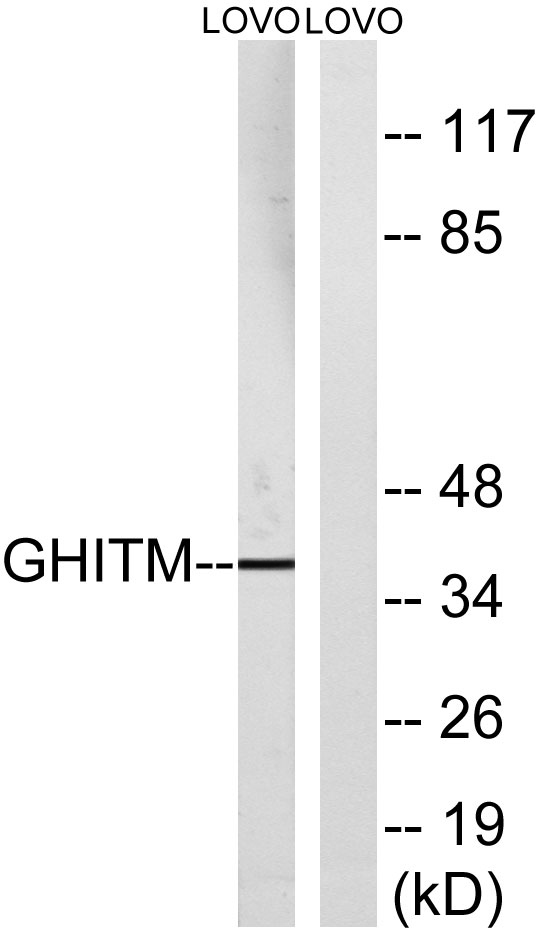
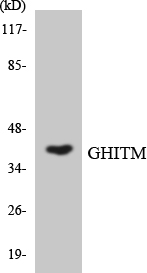
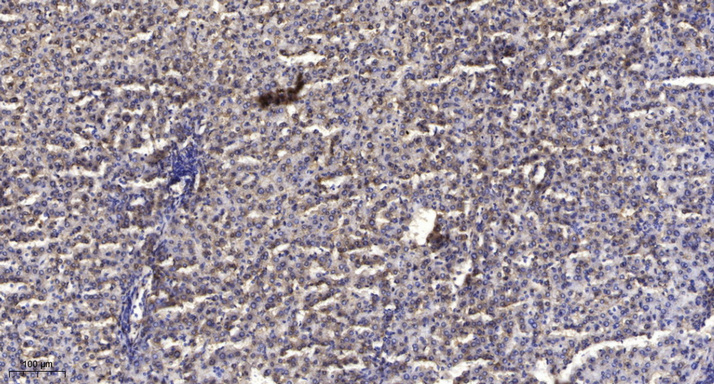

Anti-GHITM antibody (31-80 aa) (STJ93264)
SPECIFICATIONS
ClonalityPolyclonal
HostRabbit
ConjugationUnconjugated
IsotypeIgG
ImmunogenThe antiserum was produced against synthesized peptide derived from the human GHITM at the amino acid range 31-80
General Information
| Short Description | Rabbit polyclonal anti-Growth hormone-inducible transmembrane protein (31-80 aa) for use in WB, IHC, IF and ELISA in Human, Rat and Mouse samples. Datasheet included with dilution recommendations, and related reagents. |
| Applications | WB/IHC/IF/ELISA |
| Host | Rabbit |
| Reactivity | Human/Rat/Mouse |
| Note | STRICTLY FOR FURTHER SCIENTIFIC RESEARCH USE ONLY (RUO). MUST NOT TO BE USED IN DIAGNOSTIC OR THERAPEUTIC APPLICATIONS. |
Product Properties
| Clonality | Polyclonal |
| Isotype | IgG |
| Conjugation | Unconjugated |
| Concentration | 1 mg/mL |
| Purification | The antibody was affinity-purified from rabbit antiserum by affinity-chromatography using epitope-specific immunogen. |
| Dilution Range | WB 1:500-1:2000IHC 1:100-1:300ELISA 1:10000IF 1:50-200 |
| Formulation | Liquid in PBS containing 50% Glycerol, 0.5% BSA and 0.02% Sodium Azide. |
| Storage Instruction | Store at-20°C for up to 1 year from the date of receipt, and avoid repeat freeze-thaw cycles. |
Target Information
| Gene Symbol | GHITM |
| Gene ID | 27069 |
| Uniprot ID | GHITM_HUMAN |
| Immunogen | The antiserum was produced against synthesized peptide derived from the human GHITM at the amino acid range 31-80 |
| Immunogen Region | 31-80 aa |
| Specificity | GHITM Polyclonal Antibody detects endogenous levels of GHITM protein. |
Additional Info
| Function | Plays an important role in maintenance of mitochondrial morphology and in mediating either calcium or potassium/proton antiport. Mediates proton-dependent calcium efflux from mitochondrion. Also functions as an electroneutral mitochondrial proton/potassium exchanger. Required for the mitochondrial tubular network and cristae organization. Involved in apoptotic release of cytochrome c. Inhibits the proteolytic activity of AFG3L2, stimulating respiration and stabilizing respiratory enzymes in actively respiring mitochondria. However, when mitochondria become hyperpolarized, GHITM loses its inhibitory activity toward AFG3L2 and the now the active AFG3L2 turns first on GHITM and, if hyperpolarization persists, on other proteins of the mitochondria, leading to a broad remodeling of the mitochondrial proteome. |
| Protein Name | Growth Hormone-Inducible Transmembrane ProteinDermal Papilla-Derived Protein 2Mitochondrial Morphology And Cristae Structure 1Mics1Transmembrane Bax Inhibitor Motif-Containing Protein 5 |
| Database Links | |
| Cellular Localisation | Mitochondrion Inner MembraneMulti-Pass Membrane Protein |
| Alternative Antibody Names | Anti-Growth Hormone-Inducible Transmembrane Protein antibodyAnti-Dermal Papilla-Derived Protein 2 antibodyAnti-Mitochondrial Morphology And Cristae Structure 1 antibodyAnti-Mics1 antibodyAnti-Transmembrane Bax Inhibitor Motif-Containing Protein 5 antibodyAnti-GHITM antibodyAnti-DERP2 antibodyAnti-MICS1 antibodyAnti-TMBIM5 antibodyAnti-My021 antibodyAnti-UNQ244 antibodyAnti-PRO281 antibody |
Information sourced from Uniprot.org