

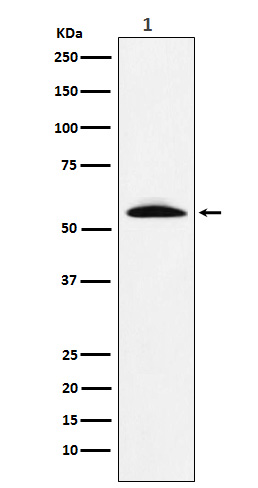

Anti-GGT1 antibody [R08-7T3] (STJA0037259)
SPECIFICATIONS
ClonalityMonoclonal
HostRabbit
ConjugationUnconjugated
IsotypeIgG
ImmunogenA synthesized peptide derived from human GGT1
General Information
| Short Description | Rabbit monoclonal anti-GGT1 for use in WB and IHC-P in Human samples. Datasheet included with dilution recommendations, and related reagents. |
| Applications | WB/IHC-P |
| Host | Rabbit |
| Reactivity | Human |
| Note | STRICTLY FOR FURTHER SCIENTIFIC RESEARCH USE ONLY (RUO). MUST NOT TO BE USED IN DIAGNOSTIC OR THERAPEUTIC APPLICATIONS. |
Product Properties
| Clonality | Monoclonal |
| Clone ID | R08-7T3 |
| Isotype | IgG |
| Conjugation | Unconjugated |
| Purification | Affinity Purified |
| Dilution Range | WB 1:500-1:1000IHC 1:50-1:100 |
| Formulation | Rabbit IgG in phosphate buffered saline, pH 7.4, 150mM NaCl, 0.02% sodium azide and 50% glycerol. |
| Storage Instruction | Store at 4°C short term. Aliquot and store at-20°C long term. Avoid freeze/thaw cycles. |
Target Information
| Gene Symbol | GGT1 |
| Gene ID | 2678 |
| Uniprot ID | GGT1_HUMAN |
| Immunogen | A synthesized peptide derived from human GGT1 |
Additional Info
| Tissue Specificity | Detected in fetal and adult kidney and liver, adult pancreas, stomach, intestine, placenta and lung. There are several other tissue-specific forms that arise from alternative promoter usage but that produce the same protein. Isoform 3: Lung-specific. |
| Post Translational Modifications | N-glycosylated on both chains. Contains hexoses, hexosamines and sialic acid residues. Glycosylation profiles tested in kidney and liver tissues reveal the presence of tissue-specific and site-specific glycan composition, despite the overlap in composition among the N-glycans. A total of 36 glycan compositions, with 40 unique structures are observed. Up to 15 different glycans are observed at a single site, with site-specific variation in glycan composition. The difference in glycosylation profiles in the 2 tissues do not affect the enzyme activity. Cleaved by autocatalysis into a large and a small subunit and the autocatalytic cleavage is essential to the functional activation of the enzyme. |
| Function | Cleaves the gamma-glutamyl bond of extracellular glutathione (gamma-Glu-Cys-Gly), glutathione conjugates (such as maresin conjugate (13R)-S-glutathionyl-(14S)-hydroxy-(4Z,7Z,9E,11E,16Z,19Z)-docosahexaenoate, MCTR1) and other gamma-glutamyl compounds (such as leukotriene C4, LTC4). The metabolism of glutathione by GGT1 releases free glutamate and the dipeptide cysteinyl-glycine, which is hydrolyzed to cysteine and glycine by dipeptidases. In the presence of high concentrations of dipeptides and some amino acids, can also catalyze a transpeptidation reaction, transferring the gamma-glutamyl moiety to an acceptor amino acid to form a new gamma-glutamyl compound. Contributes to cysteine homeostasis, glutathione homeostasis and in the conversion of the leukotriene LTC4 to LTD4. Isoform 3: Seems to be catalytically inactive. |
| Protein Name | Glutathione Hydrolase 1 ProenzymeGamma-Glutamyltransferase 1Gamma-Glutamyltranspeptidase 1Ggt 1Leukotriene-C4 HydrolaseCd Antigen Cd224 Cleaved Into - Glutathione Hydrolase 1 Heavy Chain - Glutathione Hydrolase 1 Light Chain |
| Database Links | Reactome: R-HSA-174403Reactome: R-HSA-2142691Reactome: R-HSA-5423646Reactome: R-HSA-5579022Reactome: R-HSA-9035968Reactome: R-HSA-9664535Reactome: R-HSA-9753281 |
| Cellular Localisation | Cell MembraneSingle-Pass Type Ii Membrane Protein |
| Alternative Antibody Names | Anti-Glutathione Hydrolase 1 Proenzyme antibodyAnti-Gamma-Glutamyltransferase 1 antibodyAnti-Gamma-Glutamyltranspeptidase 1 antibodyAnti-Ggt 1 antibodyAnti-Leukotriene-C4 Hydrolase antibodyAnti-Cd Antigen Cd224 Cleaved Into - Glutathione Hydrolase 1 Heavy Chain - Glutathione Hydrolase 1 Light Chain antibodyAnti-GGT1 antibodyAnti-GGT antibody |
Information sourced from Uniprot.org