


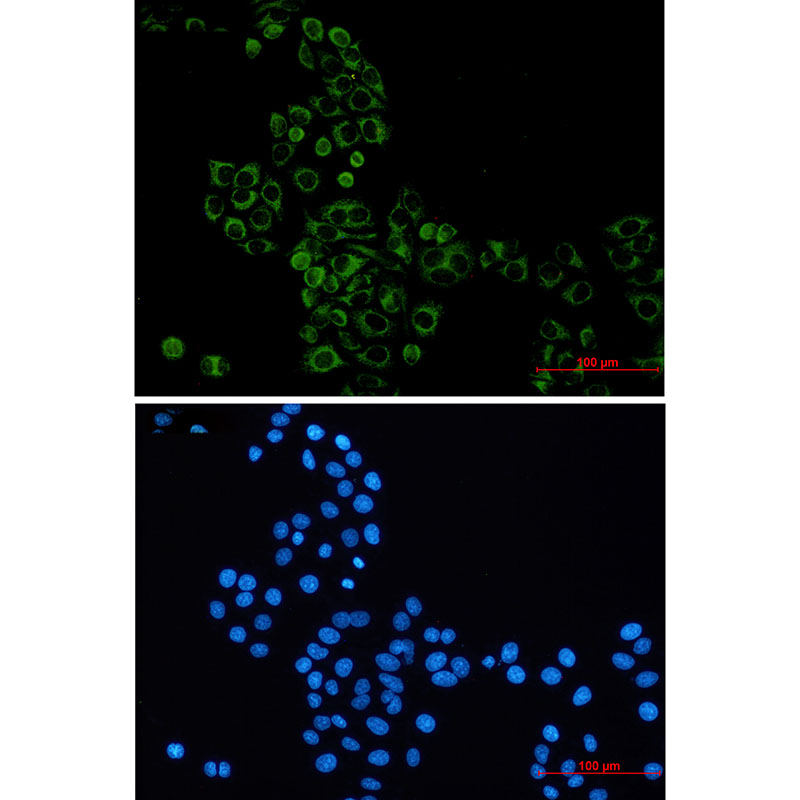


Anti-GBP1 antibody (560-573 aa) [R02-7B6] (STJA0012387)
SPECIFICATIONS
ClonalityMonoclonal
HostRabbit
ConjugationUnconjugated
IsotypeIgG
ImmunogenA synthetic peptide of human GBP1
General Information
| Short Description | Rabbit monoclonal anti-GBP1 (560-573 aa) for use in WB, IHC-F, IHC-P, ICC and IF in Human samples. Datasheet included with dilution recommendations, and related reagents. |
| Applications | WB/IHC-F/IHC-P/ICC/IF |
| Host | Rabbit |
| Reactivity | Human |
| Note | STRICTLY FOR FURTHER SCIENTIFIC RESEARCH USE ONLY (RUO). MUST NOT TO BE USED IN DIAGNOSTIC OR THERAPEUTIC APPLICATIONS. |
Product Properties
| Clonality | Monoclonal |
| Clone ID | R02-7B6 |
| Isotype | IgG |
| Conjugation | Unconjugated |
| Concentration | 0.3 mg/mL |
| Purification | Affinity Purified |
| Dilution Range | WB 1:500-1:1000IHC 1:50-1:100IF 1:50-1:200 |
| Formulation | 50mM Tris-Glycine (pH7.4) , 0.15M NaCl, 40% Glycerol, 0.01% Sodium azide and 0.05% BSA |
| Storage Instruction | Store at 4°C short term. Aliquot and store at-20°C long term. Avoid freeze/thaw cycles. |
Target Information
| Gene Symbol | GBP1 |
| Gene ID | 2633 |
| Uniprot ID | GBP1_HUMAN |
| Immunogen | A synthetic peptide of human GBP1 |
| Immunogen Region | 560-573 aa |
Additional Info
| Post Translational Modifications | Isoprenylation is required for proper subcellular location. Phosphorylated at Ser-156 by PIM1 in absence of infection, inhibits GBP1: phosphorylation promotes interaction with 14-3-3 protein sigma (SFN), leading to GBP1 retention in the cytosol. Dephosphorylated in response to infection, liberating GBP1. (Microbial infection) Ubiquitinated by S.flexneri IpaH9.8, leading to its degradation by the proteasome, thereby preventing its ability to promote host defense against bacterial infection. |
| Function | Interferon (IFN)-inducible GTPase that plays important roles in innate immunity against a diverse range of bacterial, viral and protozoan pathogens. Hydrolyzes GTP to GMP in two consecutive cleavage reactions: GTP is first hydrolyzed to GDP and then to GMP in a processive manner. Following infection, recruited to the pathogen-containing vacuoles or vacuole-escaped bacteria and promotes both inflammasome assembly and autophagy. Acts as a positive regulator of inflammasome assembly by facilitating the detection of inflammasome ligands from pathogens. Involved in the lysis of pathogen-containing vacuoles, releasing pathogens into the cytosol. Following pathogen release in the cytosol, forms a protein coat in a GTPase-dependent manner that encapsulates pathogens and promotes the detection of ligands by pattern recognition receptors. Plays a key role in inflammasome assembly in response to infection by Gram-negative bacteria: following pathogen release in the cytosol, forms a protein coat that encapsulates Gram-negative bacteria and directly binds to lipopolysaccharide (LPS), disrupting the O-antigen barrier and unmasking lipid A that is that detected by the non-canonical inflammasome effector CASP4/CASP11. Also promotes recruitment of proteins that mediate bacterial cytolysis, leading to release double-stranded DNA (dsDNA) that activates the AIM2 inflammasome. Involved in autophagy by regulating bacteriolytic peptide generation via its interaction with ubiquitin-binding protein SQSTM1, which delivers monoubiquitinated proteins to autolysosomes for the generation of bacteriolytic peptides. Confers protection to several pathogens, including the bacterial pathogens L.monocytogenes and M.bovis BCG as well as the protozoan pathogen T.gondii. Exhibits antiviral activity against influenza virus. |
| Protein Name | Guanylate-Binding Protein 1Gtp-Binding Protein 1Gbp-1Hugbp-1Hgbp1Guanine Nucleotide-Binding Protein 1Interferon-Induced Guanylate-Binding Protein 1 |
| Database Links | Reactome: R-HSA-877300 |
| Cellular Localisation | Cytoplasmic Vesicle MembraneLipid-AnchorCytoplasmic SideGolgi Apparatus MembraneCell MembraneCytoplasmCytosolSecretedLocalizes To Pathogen-Containing Vacuoles Or To The Cell Surface Of Bacteria That Escaped VacuolesSecreted From Endothelial Cells In The Cerebrospinal FluidUpon Bacterial Challenge And Independently Of Ifng InductionGolgi Membrane Localization Requires Isoprenylation And The Presence Of Another Ifng-Induced FactorSequestered In The Cytosol Following Phosphorylation By Pim1 And Subsequent Interaction With 14-3-3 Protein Sigma (Sfn) |
| Alternative Antibody Names | Anti-Guanylate-Binding Protein 1 antibodyAnti-Gtp-Binding Protein 1 antibodyAnti-Gbp-1 antibodyAnti-Hugbp-1 antibodyAnti-Hgbp1 antibodyAnti-Guanine Nucleotide-Binding Protein 1 antibodyAnti-Interferon-Induced Guanylate-Binding Protein 1 antibodyAnti-GBP1 antibody |
Information sourced from Uniprot.org