

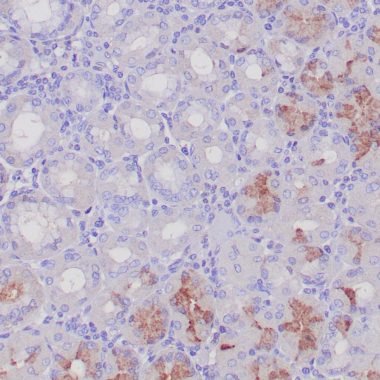

Anti-Gastrin antibody (Full Length) [ZM359] (STJ180512)
SPECIFICATIONS
ClonalityMonoclonal
HostMouse
ConjugationUnconjugated
IsotypeIgG1k
ImmunogenRecombinant full-length human GAST protein
General Information
| Short Description | Mouse monoclonal Gastrin (Full Length) antibody for use in IHC-P in human samples. Datasheet included with dilution recommendations, and related reagents. |
| Applications | IHC-P |
| Host | Mouse |
| Reactivity | Human |
| Note | STRICTLY FOR FURTHER SCIENTIFIC RESEARCH USE ONLY (RUO). MUST NOT TO BE USED IN DIAGNOSTIC OR THERAPEUTIC APPLICATIONS. |
Product Properties
| Clonality | Monoclonal |
| Clone ID | ZM359 |
| Isotype | IgG1k |
| Conjugation | Unconjugated |
| Purification | Affinity purified |
| Dilution Range | 1:100-200 |
| Formulation | Tris-HCI buffer containing stabilizing protein (BSA) and <0.1% ProClin |
| Storage Instruction | Store at 2‐8°C for up to 24 months. Predilute: Ready to use, no reconstitution necessary. Concentrate: Use dilution range and appropriate lab‐standardized diluent. Stability after dilution: 7 days at 24°C, 3 months at 2‐8°C, 6months at ‐20°C. |
Target Information
| Gene Symbol | GAST |
| Gene ID | 2520 |
| Uniprot ID | GAST_HUMAN |
| Immunogen | Recombinant full-length human GAST protein |
| Immunogen Region | Full Length |
| Specificity | Positive Control: Normal gastric mucosa |
Additional Info
| Post Translational Modifications | Two different processing pathways probably exist in antral G-cells. In the dominant pathway progastrin is cleaved at three sites resulting in two major bioactive gastrins, gastrin-34 and gastrin-17. In the putative alternative pathway, progastrin may be processed only at the most C-terminal dibasic site resulting in the synthesis of gastrin-71. Sulfation enhances proteolytic processing, and blocks peptide degradation. Levels of sulfation differ between proteolytically-cleaved gastrins. Thus, gastrin-6 is almost 73% sulfated, whereas the larger gastrins are less than 50% sulfated. Sulfation levels are also tissue-specific. |
| Function | Gastrin stimulates the stomach mucosa to produce and secrete hydrochloric acid and the pancreas to secrete its digestive enzymes. It also stimulates smooth muscle contraction and increases blood circulation and water secretion in the stomach and intestine. |
| Protein Name | Gastrin Cleaved Into - Gastrin-71Gastrin Component I - Gastrin-52G52 - Big GastrinGastrin Component IiGastrin-34G34 - GastrinGastrin Component IiiGastrin-17G17 - Gastrin-14G14 - Gastrin-6G6 |
| Database Links | Reactome: R-HSA-416476Reactome: R-HSA-881907 |
| Cellular Localisation | Secreted |
| Alternative Antibody Names | Anti-Gastrin Cleaved Into - Gastrin-71 antibodyAnti-Gastrin Component I - Gastrin-52 antibodyAnti-G52 - Big Gastrin antibodyAnti-Gastrin Component Ii antibodyAnti-Gastrin-34 antibodyAnti-G34 - Gastrin antibodyAnti-Gastrin Component Iii antibodyAnti-Gastrin-17 antibodyAnti-G17 - Gastrin-14 antibodyAnti-G14 - Gastrin-6 antibodyAnti-G6 antibodyAnti-GAST antibodyAnti-GAS antibody |
Information sourced from Uniprot.org