


Anti-FUS antibody (N-Term) (STJ140320)
SPECIFICATIONS
ClonalityPolyclonal
HostGoat
ConjugationUnconjugated
IsotypeIgG
ImmunogenPurified recombinant peptide derived from within residues 100 aa to the N-terminus of human FUS produced in E. coli.
General Information
| Short Description | Goat polyclonal FUS (N-Term) antibody for use in WB in human, rat, mouse, canine and monkey samples. Datasheet included with dilution recommendations, and related reagents. |
| Applications | WB |
| Host | Goat |
| Reactivity | Human/Rat/Mouse/Canine/Monkey |
| Note | STRICTLY FOR FURTHER SCIENTIFIC RESEARCH USE ONLY (RUO). MUST NOT TO BE USED IN DIAGNOSTIC OR THERAPEUTIC APPLICATIONS. |
Product Properties
| Clonality | Polyclonal |
| Isotype | IgG |
| Conjugation | Unconjugated |
| Concentration | 3 mg/mL |
| Purification | Epitope affinity purified |
| Dilution Range | WB:1:500-1:5, 000 |
| Formulation | PBS, 20% Glycerol and 0.05% Sodium Azide. |
| Storage Instruction | For continuous use, store at 2-8 C for one-two days. For extended storage, store in-20 C freezer. Working dilution samples should be discarded if not used within 12 hours. |
Target Information
| Immunogen | Purified recombinant peptide derived from within residues 100 aa to the N-terminus of human FUS produced in E. coli. |
| Immunogen Region | N-Term |
| Immunogen Sequence | MASNDYTQQATQSYGAYPTQ ASNDYTQQATQSYGAYPTQP SNDYTQQATQSYGAYPTQPG NDYTQQATQSYGAYPTQPGQ DYTQQATQSYGAYPTQPGQG |
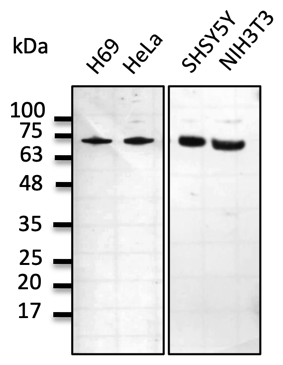
| Specificity | Detects endogenous levels of FUS by Western blot in the whole cell lysates (H69, HeLa, MCF7, AtT20, LS174T, 293HEK, IMCD3, Jurkat, COS7, SHSY5Y, NIH3T3, etc.). |
Additional Info
| Background | Goat polyclonal antibody to FUS. FUS (Fused in Sarcoma) , also known as TLS (Translocated in Liposarcoma) , is a multifunctional RNA-binding protein encoded by the FUS gene. It is a member of the FET protein family, which also includes EWSR1 and TAF15. FUS plays a critical role in various cellular processes, including transcription regulation, RNA splicing, RNA transport, and DNA repair. |
Information sourced from Uniprot.org