

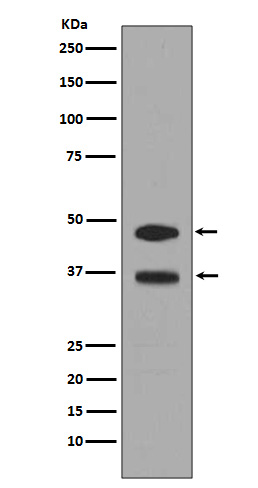
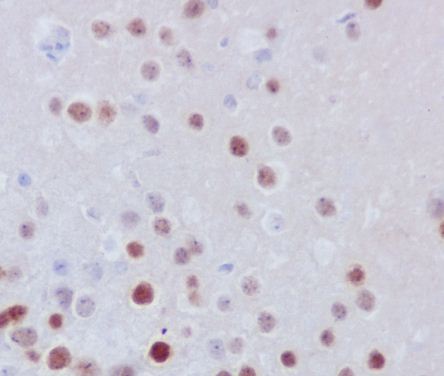

Anti-Fos B antibody [R05-9H2] (STJA0035933)
SPECIFICATIONS
ClonalityMonoclonal
HostRabbit
ConjugationUnconjugated
IsotypeIgG
ImmunogenA synthesized peptide derived from human Fos B
General Information
| Short Description | Rabbit monoclonal anti-Fos B for use in WB, IHC-P, ICC, IF and IP in Human, Mouse and Rat samples. Datasheet included with dilution recommendations, and related reagents. |
| Applications | WB/IHC-P/ICC/IF/IP |
| Host | Rabbit |
| Reactivity | Human/Mouse/Rat |
| Note | STRICTLY FOR FURTHER SCIENTIFIC RESEARCH USE ONLY (RUO). MUST NOT TO BE USED IN DIAGNOSTIC OR THERAPEUTIC APPLICATIONS. |
Product Properties
| Clonality | Monoclonal |
| Clone ID | R05-9H2 |
| Isotype | IgG |
| Conjugation | Unconjugated |
| Purification | Affinity Chromatography |
| Dilution Range | WB 1:500-1:1000IHC 1:50-1:100IF 1:50-1:200IP 1:20 |
| Formulation | Rabbit IgG in phosphate buffered saline, pH 7.4, 150mM NaCl, 0.02% sodium azide and 50% glycerol. |
| Storage Instruction | Store at 4°C short term. Aliquot and store at-20°C long term. Avoid freeze/thaw cycles. |
Target Information
| Gene Symbol | FOSB |
| Gene ID | 2354 |
| Uniprot ID | FOSB_HUMAN |
| Immunogen | A synthesized peptide derived from human Fos B |
Additional Info
| Tissue Specificity | Isoform 11: Expressed in the nucleus accumbens of the striatum (at protein level). |
| Post Translational Modifications | Phosphorylated. Isoform 11: Phosphorylated at Ser-27 by CSNK2A1.phosphorylation increases protein stability and transactivation potential. |
| Function | Heterodimerizes with proteins of the JUN family to form an AP-1 transcription factor complex, thereby enhancing their DNA binding activity to gene promoters containing an AP-1 consensus sequence 5'-TGAGCTCA-3' and enhancing their transcriptional activity. As part of the AP-1 complex, facilitates enhancer selection together with cell-type-specific transcription factors by collaboratively binding to nucleosomal enhancers and recruiting the SWI/SNF (BAF) chromatin remodeling complex to establish accessible chromatin. Together with JUN, plays a role in activation-induced cell death of T cells by binding to the AP-1 promoter site of FASLG/CD95L, and inducing its transcription in response to activation of the TCR/CD3 signaling pathway. Exhibits transactivation activity in vitro. Involved in the display of nurturing behavior towards newborns. May play a role in neurogenesis in the hippocampus and in learning and memory-related tasks by regulating the expression of various genes involved in neurogenesis, depression and epilepsy. Implicated in behavioral responses related to morphine reward and spatial memory. Isoform 11: Exhibits lower transactivation activity than isoform 1 in vitro. The heterodimer with JUN does not display any transcriptional activity, and may thereby act as an transcriptional inhibitor. May be involved in the regulation of neurogenesis in the hippocampus. May play a role in synaptic modifications in nucleus accumbens medium spiny neurons and thereby play a role in adaptive and pathological reward-dependent learning, including maladaptive responses involved in drug addiction. Seems to be more stably expressed with a half-life of ~9.5 hours in cell culture as compared to 1.5 hours half-life of isoform 1. |
| Protein Name | Protein FosbFosb Proto-Oncogene - Ap-1 Transcription Factor SubunitG0/G1 Switch Regulatory Protein 3Transcription Factor Ap-1 Subunit Fosb |
| Database Links | Reactome: R-HSA-9018519Reactome: R-HSA-9031628 |
| Cellular Localisation | Nucleus |
| Alternative Antibody Names | Anti-Protein Fosb antibodyAnti-Fosb Proto-Oncogene - Ap-1 Transcription Factor Subunit antibodyAnti-G0/G1 Switch Regulatory Protein 3 antibodyAnti-Transcription Factor Ap-1 Subunit Fosb antibodyAnti-FOSB antibodyAnti-G0S3 antibody |
Information sourced from Uniprot.org