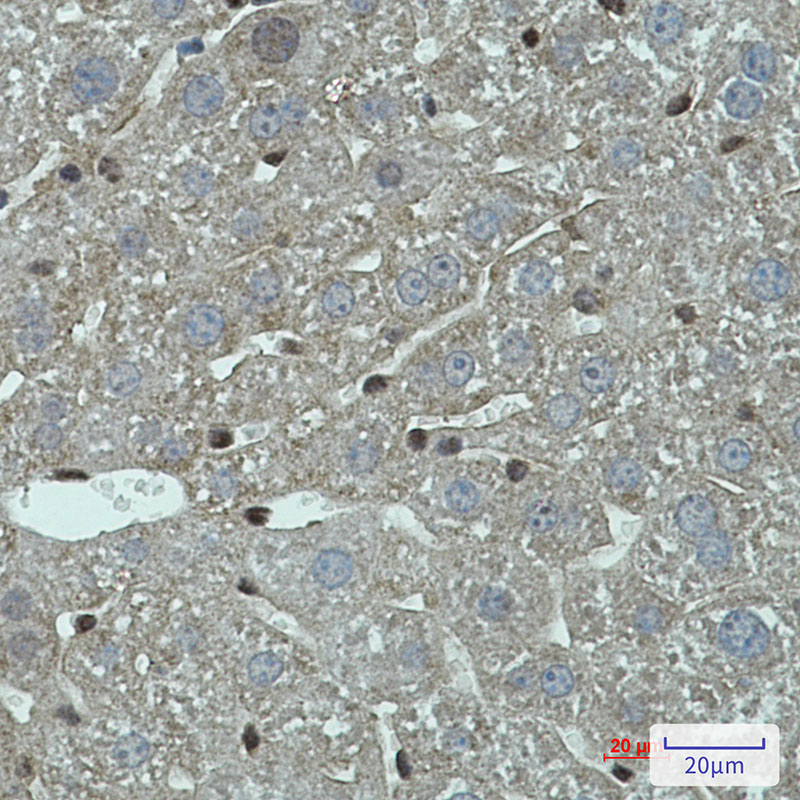
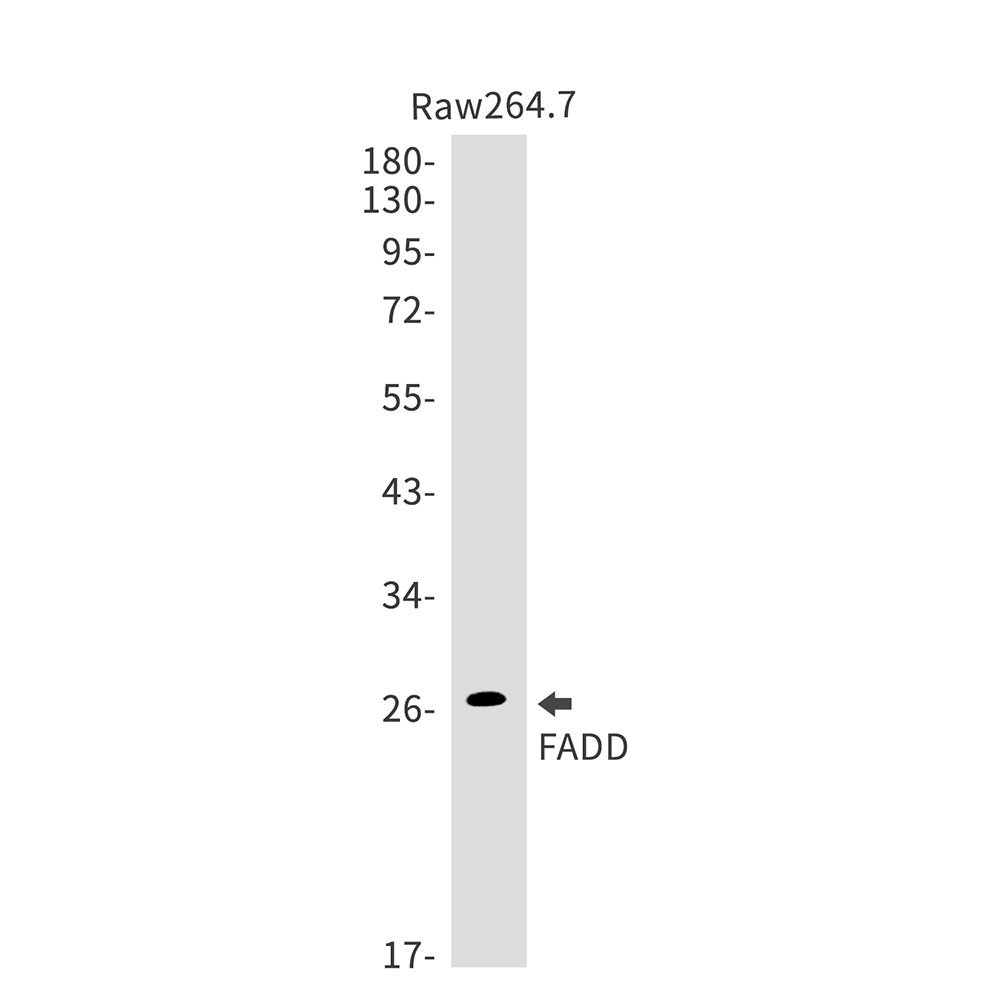
| Short Description : | Rabbit monoclonal anti-FADD for use in WB and IHC-P in Human and Mouse samples. Datasheet included with dilution recommendations, and related reagents. |
| Applications: | WB/IHC-P |
| Host: | Rabbit |
| Reactivity: | Human/Mouse |
| Note: | STRICTLY FOR FURTHER SCIENTIFIC RESEARCH USE ONLY (RUO). MUST NOT TO BE USED IN DIAGNOSTIC OR THERAPEUTIC APPLICATIONS. |
| Clonality : | Monoclonal |
| Clone ID : | R05-1K1 |
| Isotype: | IgG |
| Conjugation: | Unconjugated |
| Concentration: | 0.3 mg/mL |
| Purification: | Affinity Purified |
| Dilution Range: | WB 1:500-1:1000IHC 1:50-1:100 |
| Formulation: | 50mM Tris-Glycine (pH 7.4) , 0.15M NaCl, 40% Glycerol, 0.01% Sodium azide and 0.05% BSA |
| Storage Instruction: | Store at 4°C short term. Aliquot and store at-20°C long term. Avoid freeze/thaw cycles. |
| Gene Symbol: | Fadd |
| Gene ID: | 14082 |
| Uniprot ID: | FADD_MOUSE |
| Immunogen: | A synthetic peptide of mouse FADD |
| Function | Apoptotic adapter molecule that recruits caspases CASP8 or CASP10 to the activated FAS/CD95 or TNFRSF1A/TNFR-1 receptors. The resulting aggregate called the death-inducing signaling complex (DISC) performs CASP8 proteolytic activation. Active CASP8 initiates the subsequent cascade of caspases mediating apoptosis. Involved in interferon-mediated antiviral immune response, playing a role in the positive regulation of interferon signaling. |
| Protein Name | Fas-Associated Death Domain ProteinFas-Associating Death Domain-Containing ProteinMediator Of Receptor Induced Toxicity |
| Database Links | Reactome: R-MMU-140534Reactome: -MMU-2562578Reactome: -MMU-3371378Reactome: -MMU-5218900Reactome: -MMU-5357786Reactome: -MMU-5357905Reactome: -MMU-5675482Reactome: -MMU-69416Reactome: -MMU-75157Reactome: -MMU-75158 |
| Cellular Localisation | Cytoplasm |
| Alternative Antibody Names | Anti-Fas-Associated Death Domain Protein antibodyAnti-Fas-Associating Death Domain-Containing Protein antibodyAnti-Mediator Of Receptor Induced Toxicity antibodyAnti-Fadd antibodyAnti-Mort1 antibody |
Information sourced from Uniprot.org