

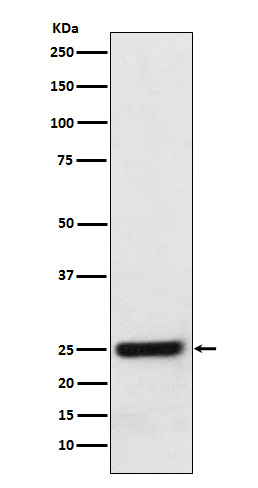

Anti-ERAB antibody [R02-5I5] (STJA0036470)
SPECIFICATIONS
ClonalityMonoclonal
HostRabbit
ConjugationUnconjugated
IsotypeIgG
ImmunogenA synthesized peptide derived from human ERAB
General Information
| Short Description | Rabbit monoclonal anti-ERAB for use in WB, IHC-P, ICC, IF and FC in Human, Mouse and Rat samples. Datasheet included with dilution recommendations, and related reagents. |
| Applications | WB/IHC-P/ICC/IF/FC |
| Host | Rabbit |
| Reactivity | Human/Mouse/Rat |
| Note | STRICTLY FOR FURTHER SCIENTIFIC RESEARCH USE ONLY (RUO). MUST NOT TO BE USED IN DIAGNOSTIC OR THERAPEUTIC APPLICATIONS. |
Product Properties
| Clonality | Monoclonal |
| Clone ID | R02-5I5 |
| Isotype | IgG |
| Conjugation | Unconjugated |
| Purification | Affinity Chromatography |
| Dilution Range | WB 1:500-1:1000IHC 1:50-1:100IF 1:50-1:200FC 1:50-1:100 |
| Formulation | Rabbit IgG in phosphate buffered saline, pH 7.4, 150mM NaCl, 0.02% sodium azide and 50% glycerol. |
| Storage Instruction | Store at 4°C short term. Aliquot and store at-20°C long term. Avoid freeze/thaw cycles. |
Target Information
| Gene Symbol | HSD17B10 |
| Gene ID | 3028 |
| Uniprot ID | HCD2_HUMAN |
| Immunogen | A synthesized peptide derived from human ERAB |
Additional Info
| Tissue Specificity | Ubiquitously expressed in normal tissues but is overexpressed in neurons affected in AD. |
| Function | Mitochondrial dehydrogenase involved in pathways of fatty acid, branched-chain amino acid and steroid metabolism. Acts as (S)-3-hydroxyacyl-CoA dehydrogenase in mitochondrial fatty acid beta-oxidation, a major degradation pathway of fatty acids. Catalyzes the third step in the beta-oxidation cycle, namely the reversible conversion of (S)-3-hydroxyacyl-CoA to 3-ketoacyl-CoA. Preferentially accepts straight medium- and short-chain acyl-CoA substrates with highest efficiency for (3S)-hydroxybutanoyl-CoA. Acts as 3-hydroxy-2-methylbutyryl-CoA dehydrogenase in branched-chain amino acid catabolic pathway. Catalyzes the oxidation of 3-hydroxy-2-methylbutanoyl-CoA into 2-methyl-3-oxobutanoyl-CoA, a step in isoleucine degradation pathway. Has hydroxysteroid dehydrogenase activity toward steroid hormones and bile acids. Catalyzes the oxidation of 3alpha-, 17beta-, 20beta- and 21-hydroxysteroids and 7alpha- and 7beta-hydroxy bile acids. Oxidizes allopregnanolone/brexanolone at the 3alpha-hydroxyl group, which is known to be critical for the activation of gamma-aminobutyric acid receptors (GABAARs) chloride channel. Has phospholipase C-like activity toward cardiolipin and its oxidized species. Likely oxidizes the 2'-hydroxyl in the head group of cardiolipin to form a ketone intermediate that undergoes nucleophilic attack by water and fragments into diacylglycerol, dihydroxyacetone and orthophosphate. Has higher affinity for cardiolipin with oxidized fatty acids and may degrade these species during the oxidative stress response to protect cells from apoptosis. By interacting with intracellular amyloid-beta, it may contribute to the neuronal dysfunction associated with Alzheimer disease (AD). Essential for structural and functional integrity of mitochondria. In addition to mitochondrial dehydrogenase activity, moonlights as a component of mitochondrial ribonuclease P, a complex that cleaves tRNA molecules in their 5'-ends. Together with TRMT10C/MRPP1, forms a subcomplex of the mitochondrial ribonuclease P, named MRPP1-MRPP2 subcomplex, which displays functions that are independent of the ribonuclease P activity. The MRPP1-MRPP2 subcomplex catalyzes the formation of N(1)-methylguanine and N(1)-methyladenine at position 9 (m1G9 and m1A9, respectively) in tRNAs.HSD17B10/MRPP2 acting as a non-catalytic subunit. The MRPP1-MRPP2 subcomplex also acts as a tRNA maturation platform: following 5'-end cleavage by the mitochondrial ribonuclease P complex, the MRPP1-MRPP2 subcomplex enhances the efficiency of 3'-processing catalyzed by ELAC2, retains the tRNA product after ELAC2 processing and presents the nascent tRNA to the mitochondrial CCA tRNA nucleotidyltransferase TRNT1 enzyme. Associates with mitochondrial DNA complexes at the nucleoids to initiate RNA processing and ribosome assembly. |
| Protein Name | 3-Hydroxyacyl-Coa Dehydrogenase Type-217-Beta-Estradiol 17-Dehydrogenase2-Methyl-3-Hydroxybutyryl-Coa DehydrogenaseMhbd3-Alpha-(17-Beta-Hydroxysteroid DehydrogenaseNad(+3-Hydroxy-2-Methylbutyryl-Coa Dehydrogenase3-Hydroxyacyl-Coa Dehydrogenase Type Ii3alpha(Or 20beta-Hydroxysteroid Dehydrogenase7-Alpha-Hydroxysteroid DehydrogenaseEndoplasmic Reticulum-Associated Amyloid Beta-Peptide-Binding ProteinMitochondrial Ribonuclease P Protein 2Mitochondrial Rnase P Protein 2Short Chain Dehydrogenase/Reductase Family 5c Member 1Short-Chain Type Dehydrogenase/Reductase Xh98g2Type Ii Hadh |
| Database Links | Reactome: R-HSA-6785470Reactome: R-HSA-6787450Reactome: R-HSA-70895Reactome: R-HSA-8868766Reactome: R-HSA-9837999 |
| Cellular Localisation | MitochondrionMitochondrion MatrixMitochondrion Nucleoid |
| Alternative Antibody Names | Anti-3-Hydroxyacyl-Coa Dehydrogenase Type-2 antibodyAnti-17-Beta-Estradiol 17-Dehydrogenase antibodyAnti-2-Methyl-3-Hydroxybutyryl-Coa Dehydrogenase antibodyAnti-Mhbd antibodyAnti-3-Alpha-(17-Beta-Hydroxysteroid Dehydrogenase antibodyAnti-Nad(+ antibodyAnti-3-Hydroxy-2-Methylbutyryl-Coa Dehydrogenase antibodyAnti-3-Hydroxyacyl-Coa Dehydrogenase Type Ii antibodyAnti-3alpha(Or 20beta-Hydroxysteroid Dehydrogenase antibodyAnti-7-Alpha-Hydroxysteroid Dehydrogenase antibodyAnti-Endoplasmic Reticulum-Associated Amyloid Beta-Peptide-Binding Protein antibodyAnti-Mitochondrial Ribonuclease P Protein 2 antibodyAnti-Mitochondrial Rnase P Protein 2 antibodyAnti-Short Chain Dehydrogenase/Reductase Family 5c Member 1 antibodyAnti-Short-Chain Type Dehydrogenase/Reductase Xh98g2 antibodyAnti-Type Ii Hadh antibodyAnti-HSD17B10 antibodyAnti-ERAB antibodyAnti-HADH2 antibodyAnti-MRPP2 antibodyAnti-SCHAD antibodyAnti-SDR5C1 antibodyAnti-XH98G2 antibody |
Information sourced from Uniprot.org