

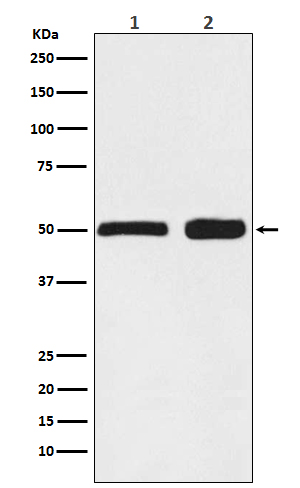

Anti-Ephrin B2 antibody [R06-7D1] (STJA0036571)
SPECIFICATIONS
ClonalityMonoclonal
HostRabbit
ConjugationUnconjugated
IsotypeIgG
ImmunogenA synthesized peptide derived from human Ephrin B2
General Information
| Short Description | Rabbit monoclonal anti-Ephrin B2 for use in WB, ICC and IF in Human, Mouse and Rat samples. Datasheet included with dilution recommendations, and related reagents. |
| Applications | WB/ICC/IF |
| Host | Rabbit |
| Reactivity | Human/Mouse/Rat |
| Note | STRICTLY FOR FURTHER SCIENTIFIC RESEARCH USE ONLY (RUO). MUST NOT TO BE USED IN DIAGNOSTIC OR THERAPEUTIC APPLICATIONS. |
Product Properties
| Clonality | Monoclonal |
| Clone ID | R06-7D1 |
| Isotype | IgG |
| Conjugation | Unconjugated |
| Purification | Affinity Chromatography |
| Dilution Range | WB 1:500-1:1000IF 1:50-1:200 |
| Formulation | Rabbit IgG in phosphate buffered saline, pH 7.4, 150mM NaCl, 0.02% sodium azide and 50% glycerol. |
| Storage Instruction | Store at 4°C short term. Aliquot and store at-20°C long term. Avoid freeze/thaw cycles. |
Target Information
| Gene Symbol | EFNB2 |
| Gene ID | 1948 |
| Uniprot ID | EFNB2_HUMAN |
| Immunogen | A synthesized peptide derived from human Ephrin B2 |
Additional Info
| Tissue Specificity | Lung and kidney. |
| Post Translational Modifications | Inducible phosphorylation of tyrosine residues in the cytoplasmic domain. |
| Function | Cell surface transmembrane ligand for Eph receptors, a family of receptor tyrosine kinases which are crucial for migration, repulsion and adhesion during neuronal, vascular and epithelial development. Binds promiscuously Eph receptors residing on adjacent cells, leading to contact-dependent bidirectional signaling into neighboring cells. The signaling pathway downstream of the receptor is referred to as forward signaling while the signaling pathway downstream of the ephrin ligand is referred to as reverse signaling. Binds to receptor tyrosine kinase including EPHA4, EPHA3 and EPHB4. Together with EPHB4 plays a central role in heart morphogenesis and angiogenesis through regulation of cell adhesion and cell migration. EPHB4-mediated forward signaling controls cellular repulsion and segregation from EFNB2-expressing cells. May play a role in constraining the orientation of longitudinally projecting axons. (Microbial infection) Acts as a receptor for Hendra virus and Nipah virus. |
| Protein Name | Ephrin-B2Eph-Related Receptor Tyrosine Kinase Ligand 5Lerk-5Htk LigandHtk-L |
| Database Links | Reactome: R-HSA-2682334Reactome: R-HSA-3928662Reactome: R-HSA-3928664Reactome: R-HSA-3928665 |
| Cellular Localisation | Cell MembraneSingle-Pass Type I Membrane ProteinCell JunctionAdherens Junction |
| Alternative Antibody Names | Anti-Ephrin-B2 antibodyAnti-Eph-Related Receptor Tyrosine Kinase Ligand 5 antibodyAnti-Lerk-5 antibodyAnti-Htk Ligand antibodyAnti-Htk-L antibodyAnti-EFNB2 antibodyAnti-EPLG5 antibodyAnti-HTKL antibodyAnti-LERK5 antibody |
Information sourced from Uniprot.org