


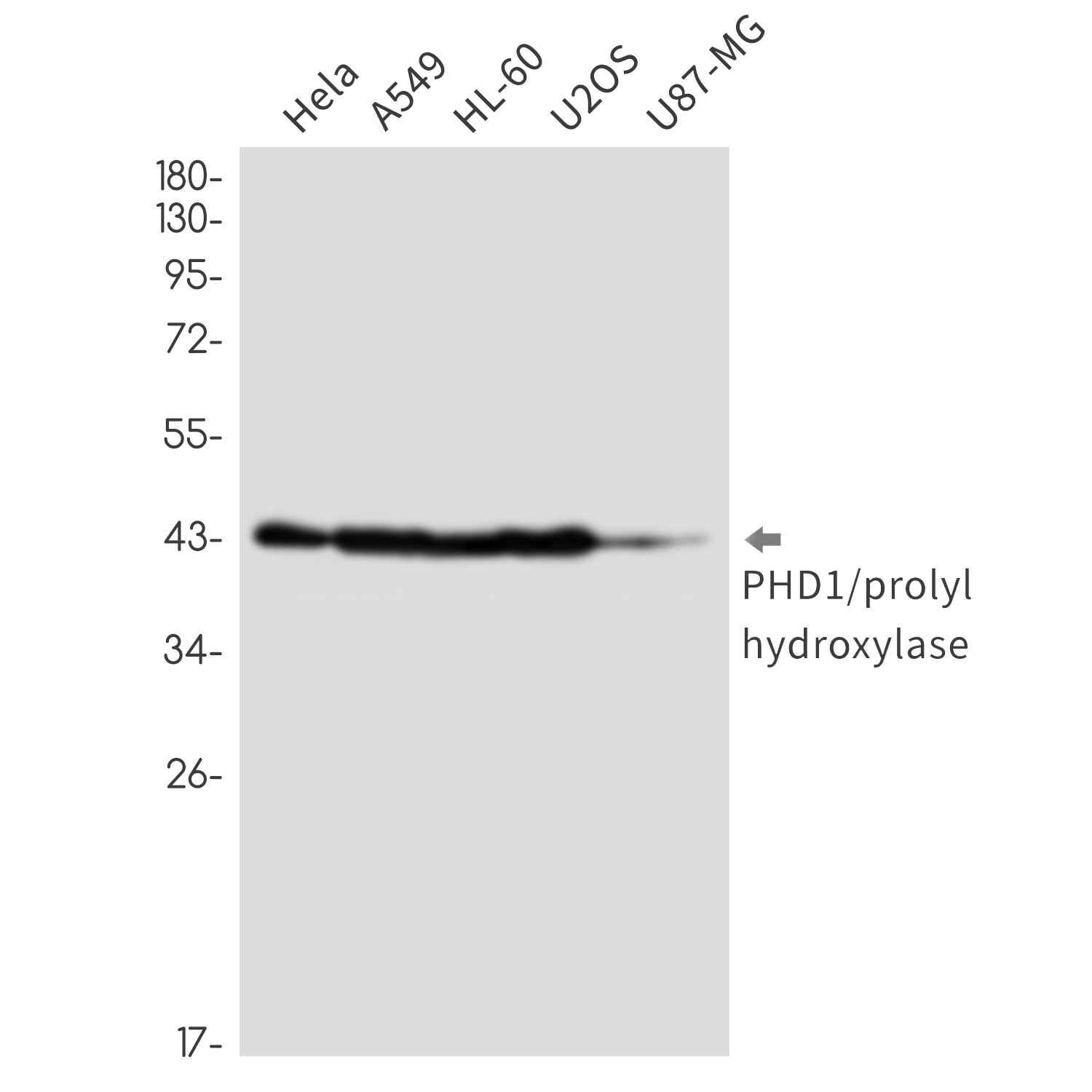

Anti-EGLN2 antibody (21-34 aa) [R01-7G1] (STJA0012658)
SPECIFICATIONS
ClonalityMonoclonal
HostRabbit
ConjugationUnconjugated
IsotypeIgG
ImmunogenA synthesized peptide derived from human PHD1/prolyl hydroxylase
General Information
| Short Description | Rabbit monoclonal anti-PHD1 (21-34 aa) for use in WB in Human and Rat samples. Datasheet included with dilution recommendations, and related reagents. |
| Applications | WB |
| Host | Rabbit |
| Reactivity | Human/Rat |
| Note | STRICTLY FOR FURTHER SCIENTIFIC RESEARCH USE ONLY (RUO). MUST NOT TO BE USED IN DIAGNOSTIC OR THERAPEUTIC APPLICATIONS. |
Product Properties
| Clonality | Monoclonal |
| Clone ID | R01-7G1 |
| Isotype | IgG |
| Conjugation | Unconjugated |
| Concentration | 0.3 mg/mL |
| Purification | Affinity Purified |
| Dilution Range | WB 1:500-1:1000 |
| Formulation | 50mM Tris-Glycine (pH7.4) , 0.15M NaCl, 40% Glycerol, 0.01% Sodium azide and 0.05% BSA |
| Storage Instruction | Store at 4°C short term. Aliquot and store at-20°C long term. Avoid freeze/thaw cycles. |
Target Information
| Gene Symbol | EGLN2 |
| Gene ID | 112398 |
| Uniprot ID | EGLN2_HUMAN |
| Immunogen | A synthesized peptide derived from human PHD1/prolyl hydroxylase |
| Immunogen Region | 21-34 aa |
Additional Info
| Tissue Specificity | Expressed in adult and fetal heart, brain, liver, lung, skeletal muscle, and kidney. Also expressed in testis and placenta. Highest levels in adult brain, placenta, lung, kidney, and testis. Expressed in hormone responsive tissues, including normal and cancerous mammary, ovarian and prostate epithelium. |
| Post Translational Modifications | Ubiquitinated by SIAH1 and/or SIAH2 in response to the unfolded protein response (UPR), leading to its degradation. |
| Function | Prolyl hydroxylase that mediates hydroxylation of proline residues in target proteins, such as ATF4, IKBKB, CEP192 and HIF1A. Target proteins are preferentially recognized via a LXXLAP motif. Cellular oxygen sensor that catalyzes, under normoxic conditions, the post-translational formation of 4-hydroxyproline in hypoxia-inducible factor (HIF) alpha proteins. Hydroxylates a specific proline found in each of the oxygen-dependent degradation (ODD) domains (N-terminal, NODD, and C-terminal, CODD) of HIF1A. Also hydroxylates HIF2A. Has a preference for the CODD site for both HIF1A and HIF2A. Hydroxylated HIFs are then targeted for proteasomal degradation via the von Hippel-Lindau ubiquitination complex. Under hypoxic conditions, the hydroxylation reaction is attenuated allowing HIFs to escape degradation resulting in their translocation to the nucleus, heterodimerization with HIF1B, and increased expression of hypoxy-inducible genes. EGLN2 is involved in regulating hypoxia tolerance and apoptosis in cardiac and skeletal muscle. Also regulates susceptibility to normoxic oxidative neuronal death. Links oxygen sensing to cell cycle and primary cilia formation by hydroxylating the critical centrosome component CEP192 which promotes its ubiquitination and subsequent proteasomal degradation. Hydroxylates IKBKB, mediating NF-kappa-B activation in hypoxic conditions. Also mediates hydroxylation of ATF4, leading to decreased protein stability of ATF4. |
| Protein Name | Prolyl Hydroxylase Egln2Egl Nine Homolog 2Estrogen-Induced Tag 6Eit-6Hph-3Hypoxia-Inducible Factor Prolyl Hydroxylase 1Hif-Ph1Hif-Prolyl Hydroxylase 1Hph-1Prolyl Hydroxylase Domain-Containing Protein 1Phd1 |
| Database Links | Reactome: R-HSA-1234176 |
| Cellular Localisation | Nucleus |
| Alternative Antibody Names | Anti-Prolyl Hydroxylase Egln2 antibodyAnti-Egl Nine Homolog 2 antibodyAnti-Estrogen-Induced Tag 6 antibodyAnti-Eit-6 antibodyAnti-Hph-3 antibodyAnti-Hypoxia-Inducible Factor Prolyl Hydroxylase 1 antibodyAnti-Hif-Ph1 antibodyAnti-Hif-Prolyl Hydroxylase 1 antibodyAnti-Hph-1 antibodyAnti-Prolyl Hydroxylase Domain-Containing Protein 1 antibodyAnti-Phd1 antibodyAnti-EGLN2 antibodyAnti-EIT6 antibody |
Information sourced from Uniprot.org