
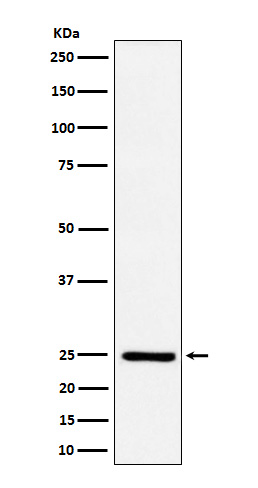

Anti-EFNA1 antibody (23-45 aa) [R09-5N5] (STJA0015508)
SPECIFICATIONS
ClonalityMonoclonal
HostRabbit
ConjugationUnconjugated
IsotypeIgG
ImmunogenA synthesized peptide derived from human Ephrin A1
General Information
| Short Description | Rabbit monoclonal anti-Ephrin A1 (23-45 aa) for use in WB in Human samples. Datasheet included with dilution recommendations, and related reagents. |
| Applications | WB |
| Host | Rabbit |
| Reactivity | Human |
| Note | STRICTLY FOR FURTHER SCIENTIFIC RESEARCH USE ONLY (RUO). MUST NOT TO BE USED IN DIAGNOSTIC OR THERAPEUTIC APPLICATIONS. |
Product Properties
| Clonality | Monoclonal |
| Clone ID | R09-5N5 |
| Isotype | IgG |
| Conjugation | Unconjugated |
| Purification | Affinity Purified |
| Dilution Range | WB 1:500-1:1000 |
| Formulation | Liquid in PBS pH7.4, 150mM NaCl, 0.02% Sodium Azide and 50% Glycerol. |
| Storage Instruction | Store at 4°C short term. Aliquot and store at-20°C long term. Avoid freeze/thaw cycles. |
Target Information
| Gene Symbol | EFNA1 |
| Gene ID | 1942 |
| Uniprot ID | EFNA1_HUMAN |
| Immunogen | A synthesized peptide derived from human Ephrin A1 |
| Immunogen Region | 23-45 aa |
Additional Info
| Tissue Specificity | Brain. Down-regulated in primary glioma tissues compared to the normal tissues. The soluble monomeric form is expressed in the glioblastoma multiforme (GBM) and breast cancer cells (at protein level). |
| Post Translational Modifications | Undergoes proteolysis by a metalloprotease to give rise to a soluble monomeric form. N-Glycosylation is required for binding to EPHA2 receptor and inducing its internalization. |
| Function | Cell surface GPI-bound ligand for Eph receptors, a family of receptor tyrosine kinases which are crucial for migration, repulsion and adhesion during neuronal, vascular and epithelial development. Binds promiscuously Eph receptors residing on adjacent cells, leading to contact-dependent bidirectional signaling into neighboring cells. Plays an important role in angiogenesis and tumor neovascularization. The recruitment of VAV2, VAV3 and PI3-kinase p85 subunit by phosphorylated EPHA2 is critical for EFNA1-induced RAC1 GTPase activation and vascular endothelial cell migration and assembly. Exerts anti-oncogenic effects in tumor cells through activation and down-regulation of EPHA2. Activates EPHA2 by inducing tyrosine phosphorylation which leads to its internalization and degradation. Acts as a negative regulator in the tumorigenesis of gliomas by down-regulating EPHA2 and FAK. Can evoke collapse of embryonic neuronal growth cone and regulates dendritic spine morphogenesis. |
| Protein Name | Ephrin-A1Eph-Related Receptor Tyrosine Kinase Ligand 1Lerk-1Immediate Early Response Protein B61Tumor Necrosis Factor Alpha-Induced Protein 4Tnf Alpha-Induced Protein 4 Cleaved Into - Ephrin-A1 - Secreted Form |
| Database Links | Reactome: R-HSA-2682334Reactome: R-HSA-3928663Reactome: R-HSA-3928665 |
| Cellular Localisation | Cell MembraneLipid-AnchorGpi-AnchorEphrin-A1Secreted Form: Secreted |
| Alternative Antibody Names | Anti-Ephrin-A1 antibodyAnti-Eph-Related Receptor Tyrosine Kinase Ligand 1 antibodyAnti-Lerk-1 antibodyAnti-Immediate Early Response Protein B61 antibodyAnti-Tumor Necrosis Factor Alpha-Induced Protein 4 antibodyAnti-Tnf Alpha-Induced Protein 4 Cleaved Into - Ephrin-A1 - Secreted Form antibodyAnti-EFNA1 antibodyAnti-EPLG1 antibodyAnti-LERK1 antibodyAnti-TNFAIP4 antibody |
Information sourced from Uniprot.org