

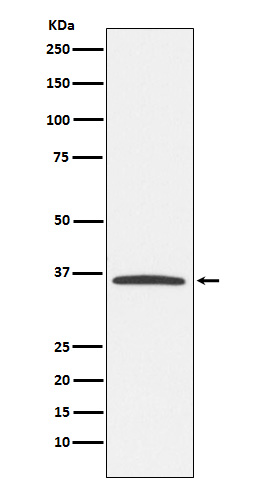

Anti-E2F6 antibody [R09-2A4] (STJA0036816)
SPECIFICATIONS
ClonalityMonoclonal
HostRabbit
ConjugationUnconjugated
IsotypeIgG
ImmunogenA synthesized peptide derived from human E2F6
General Information
| Short Description | Rabbit monoclonal anti-E2F6 for use in WB, ICC, IF and FC in Human samples. Datasheet included with dilution recommendations, and related reagents. |
| Applications | WB/ICC/IF/FC |
| Host | Rabbit |
| Reactivity | Human |
| Note | STRICTLY FOR FURTHER SCIENTIFIC RESEARCH USE ONLY (RUO). MUST NOT TO BE USED IN DIAGNOSTIC OR THERAPEUTIC APPLICATIONS. |
Product Properties
| Clonality | Monoclonal |
| Clone ID | R09-2A4 |
| Isotype | IgG |
| Conjugation | Unconjugated |
| Purification | Affinity Chromatography |
| Dilution Range | WB 1:500-1:1000IF 1:50-1:200FC 1:50-1:100 |
| Formulation | Rabbit IgG in phosphate buffered saline, pH 7.4, 150mM NaCl, 0.02% sodium azide and 50% glycerol. |
| Storage Instruction | Store at 4°C short term. Aliquot and store at-20°C long term. Avoid freeze/thaw cycles. |
Target Information
| Gene Symbol | E2F6 |
| Gene ID | 1876 |
| Uniprot ID | E2F6_HUMAN |
| Immunogen | A synthesized peptide derived from human E2F6 |
Additional Info
| Tissue Specificity | Expressed in all tissues examined. Highest levels in placenta, skeletal muscle, heart, ovary, kidney, small intestine and spleen. |
| Function | Inhibitor of E2F-dependent transcription. Binds DNA cooperatively with DP proteins through the E2 recognition site, 5'-TTTCCGCGC-3'. Has a preference for the 5'-TTTCCCGC-3' E2F recognition site. E2F6 lacks the transcriptional activation and pocket protein binding domains. Appears to regulate a subset of E2F-dependent genes whose products are required for entry into the cell cycle but not for normal cell cycle progression. Represses expression of some meiosis-specific genes, including SLC25A31/ANT4. May silence expression via the recruitment of a chromatin remodeling complex containing histone H3-K9 methyltransferase activity. Overexpression delays the exit of cells from the S-phase. |
| Protein Name | Transcription Factor E2f6E2f-6 |
| Database Links | Reactome: R-HSA-69205Reactome: R-HSA-8953750 |
| Cellular Localisation | Nucleus |
| Alternative Antibody Names | Anti-Transcription Factor E2f6 antibodyAnti-E2f-6 antibodyAnti-E2F6 antibody |
Information sourced from Uniprot.org