



Anti-DECR1 antibody (35-335aa) [AT3B2] (STJA0041805)
SPECIFICATIONS
ClonalityMonoclonal
HostMouse
ConjugationUnconjugated
IsotypeIgG2bk
ImmunogenRecombinant human DECR1 (35-335aa) purified from E. coli
General Information
| Short Description | Mouse monoclonal anti-DECR1 (35-335aa) for use in ELISA, WB, FACS, ICC and IF in Human samples. Datasheet included with dilution recommendations, and related reagents. |
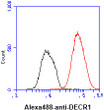
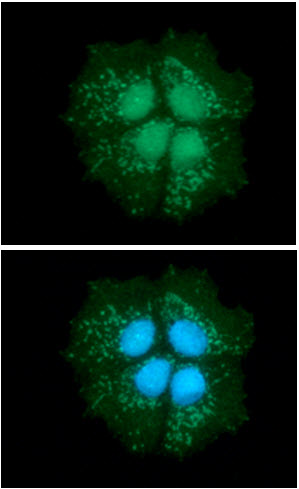
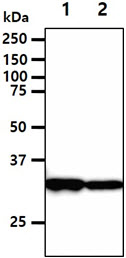
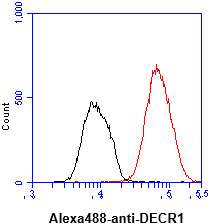
| Applications | ELISA/WB/FACS/ICC/IF |
| Host | Mouse |
| Reactivity | Human |
| Note | STRICTLY FOR FURTHER SCIENTIFIC RESEARCH USE ONLY (RUO). MUST NOT TO BE USED IN DIAGNOSTIC OR THERAPEUTIC APPLICATIONS. |
Product Properties
| Clonality | Monoclonal |
| Clone ID | AT3B2 |
| Isotype | IgG2bk |
| Conjugation | Unconjugated |
| Concentration | 1 mg/mL |
| Purification | By protein-A affinity chromatography |
| Formulation | Liquid in phosphate-Buffered Saline (pH 7.4) with 0.02% Sodium Azide, 10% Glycerol |
| Storage Instruction | For short term storage, keep at +2C to +8C for up to 1 week. For long term storage, aliquot and store at-20C, and avoid repeat freeze-thaw cycles. |
Target Information
| Gene Symbol | DECR1 |
| Gene ID | 1666 |
| Uniprot ID | DECR_HUMAN |
| Accession Number | NP_001350 |
| Immunogen | Recombinant human DECR1 (35-335aa) purified from E. coli |
| Immunogen Region | 35-335aa |
Additional Info
| Tissue Specificity | Heart = liver = pancreas > kidney >> skeletal muscle = lung. |
| Function | Auxiliary enzyme of beta-oxidation. It participates in the metabolism of unsaturated fatty enoyl-CoA esters having double bonds in both even- and odd-numbered positions in mitochondria. Catalyzes the NADP-dependent reduction of 2,4-dienoyl-CoA to yield trans-3-enoyl-CoA. |
| Protein Name | 2 -4-Dienoyl-Coa Reductase (3e-Enoyl-Coa-Producing - Mitochondrial2 -4-Dienoyl-Coa Reductase Nadph4-Enoyl-Coa Reductase NadphShort Chain Dehydrogenase/Reductase Family 18c Member 1 |
| Database Links | Reactome: R-HSA-77288 |
| Cellular Localisation | Mitochondrion |
| Alternative Antibody Names | Anti-2 -4-Dienoyl-Coa Reductase (3e-Enoyl-Coa-Producing - Mitochondrial antibodyAnti-2 -4-Dienoyl-Coa Reductase Nadph antibodyAnti-4-Enoyl-Coa Reductase Nadph antibodyAnti-Short Chain Dehydrogenase/Reductase Family 18c Member 1 antibodyAnti-DECR1 antibodyAnti-DECR antibodyAnti-SDR18C1 antibody |
Information sourced from Uniprot.org