
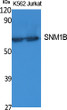

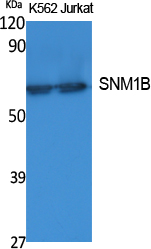
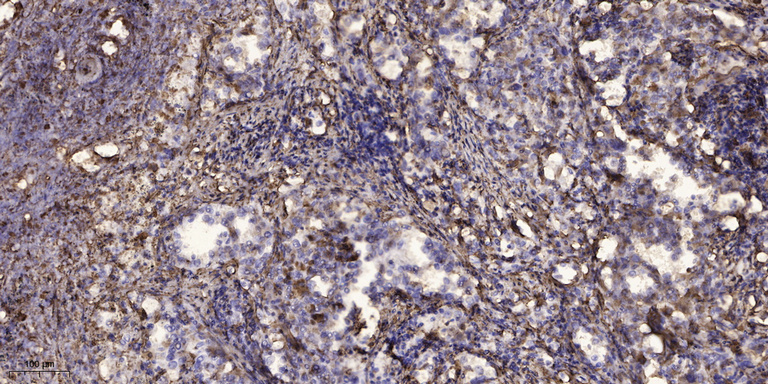

Anti-DCLRE1B antibody (C-Term) (STJ96429)
SPECIFICATIONS
ClonalityPolyclonal
HostRabbit
ConjugationUnconjugated
IsotypeIgG
ImmunogenSynthesized peptide derived from the C-terminal region of human SNM1B.
General Information
| Short Description | Rabbit polyclonal anti-5 exonuclease Apollo (C-Term) for use in WB, ELISA and IHC in Human, Rat and Mouse samples. Datasheet included with dilution recommendations, and related reagents. |
| Applications | WB/ELISA/IHC |
| Host | Rabbit |
| Reactivity | Human/Rat/Mouse |
| Note | STRICTLY FOR FURTHER SCIENTIFIC RESEARCH USE ONLY (RUO). MUST NOT TO BE USED IN DIAGNOSTIC OR THERAPEUTIC APPLICATIONS. |
Product Properties
| Clonality | Polyclonal |
| Isotype | IgG |
| Conjugation | Unconjugated |
| Concentration | 1 mg/mL |
| Purification | The antibody was affinity-purified from rabbit antiserum by affinity-chromatography using epitope-specific immunogen. |
| Dilution Range | WB 1:500-2000IHC-P 1:50-300ELISA 2000-20000 |
| Formulation | Liquid in PBS containing 50% Glycerol, 0.5% BSA and 0.02% Sodium Azide. |
| Storage Instruction | Store at-20°C for up to 1 year from the date of receipt, and avoid repeat freeze-thaw cycles. |
Target Information
| Gene Symbol | DCLRE1B |
| Gene ID | 64858 |
| Uniprot ID | DCR1B_HUMAN |
| Immunogen | Synthesized peptide derived from the C-terminal region of human SNM1B. |
| Immunogen Region | C-Term |
| Specificity | SNM1B Polyclonal Antibody detects endogenous levels of SNM1B protein. |
Additional Info
| Function | 5'-3' exonuclease that plays a central role in telomere maintenance and protection during S-phase. Participates in the protection of telomeres against non-homologous end-joining (NHEJ)-mediated repair, thereby ensuring that telomeres do not fuse. Plays a key role in telomeric loop (T loop) formation by being recruited by TERF2 at the leading end telomeres and by processing leading-end telomeres immediately after their replication via its exonuclease activity: generates 3' single-stranded overhang at the leading end telomeres avoiding blunt leading-end telomeres that are vulnerable to end-joining reactions and expose the telomere end in a manner that activates the DNA repair pathways. Together with TERF2, required to protect telomeres from replicative damage during replication by controlling the amount of DNA topoisomerase (TOP1, TOP2A and TOP2B) needed for telomere replication during fork passage and prevent aberrant telomere topology. Also involved in response to DNA damage: plays a role in response to DNA interstrand cross-links (ICLs) by facilitating double-strand break formation. In case of spindle stress, involved in prophase checkpoint. Possesses beta-lactamase activity, catalyzing the hydrolysis of penicillin G and nitrocefin. Exhibits no activity towards other beta-lactam antibiotic classes including cephalosporins (cefotaxime) and carbapenems (imipenem). |
| Protein Name | 5' Exonuclease ApolloBeta-Lactamase Dclre1bDna Cross-Link Repair 1b ProteinSnm1 Homolog BSnmibHsnm1b |
| Database Links | Reactome: R-HSA-6783310 |
| Cellular Localisation | ChromosomeTelomereNucleusCytoplasmCytoskeletonMicrotubule Organizing CenterCentrosomeMainly Localizes To TelomeresRecruited Via Its Interaction With Terf2During MitosisLocalizes To The Centrosome |
| Alternative Antibody Names | Anti-5' Exonuclease Apollo antibodyAnti-Beta-Lactamase Dclre1b antibodyAnti-Dna Cross-Link Repair 1b Protein antibodyAnti-Snm1 Homolog B antibodyAnti-Snmib antibodyAnti-Hsnm1b antibodyAnti-DCLRE1B antibodyAnti-SNM1B antibody |
Information sourced from Uniprot.org