


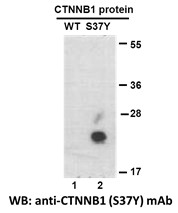


Anti-CTNNB1-S37Y Mutant antibody (STJA0033572)
SPECIFICATIONS
ClonalityMonoclonal
HostMouse
ConjugationUnconjugated
IsotypeIgG
ImmunogenA synthetic peptide from the internal region of CTNNB1 which includes the mutation of S37Y, human origin.
General Information
| Short Description | Mouse monoclonal anti-CTNNB1-S37Y Mutant for use in WB, ICC, IF and ELISA in Vertebrates samples. Datasheet included with dilution recommendations, and related reagents. |
| Applications | WB/ICC/IF/ELISA |
| Host | Mouse |
| Reactivity | Vertebrates |
| Note | STRICTLY FOR FURTHER SCIENTIFIC RESEARCH USE ONLY (RUO). MUST NOT TO BE USED IN DIAGNOSTIC OR THERAPEUTIC APPLICATIONS. |
Product Properties
| Clonality | Monoclonal |
| Isotype | IgG |
| Conjugation | Unconjugated |
| Purification | Purified from ascites |
| Dilution Range | WB-1:500-1:2000IHC-P-1:50-1:100ELISA-1:1000-1:5000IF-1:50-1:200 |
| Formulation | Liquid in PBS (without Mg2+ and Ca2+) , pH 7.4, 150 mM NaCl, 50% glycerol |
| Storage Instruction | Store at-20°C. Avoid freeze/thaw cycles. |
Target Information
| Immunogen | A synthetic peptide from the internal region of CTNNB1 which includes the mutation of S37Y, human origin. |
Additional Info
| Background | CTNNB1 protein is a dual function protein. It is a subunit of a complex of proteins that from adherent junctions, which are important for the establishment and maintenance of epithelial cell layers by regulating cell growth and adhesion between adjacent cells. CTNNB1 protein also pulls double duty as an intracellular signal transducer in the Wnt signaling pathway. Mutant CTNNB1 (ß-catenin) has been implicated in the pathogenesis of several cancers including melanoma, colorectal cancer, hepatocellular carcinoma, and ovarian cancer. Mutations has been implicated in the pathogenesis of several cancers. |
Information sourced from Uniprot.org