

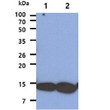


Anti-COX5A antibody (42-150aa) [AT7A6] (STJA0041757)
SPECIFICATIONS
ClonalityMonoclonal
HostMouse
ConjugationUnconjugated
IsotypeIgG1k
ImmunogenRecombinant human COX5A (42-150aa) purified from E. coli
General Information
| Short Description | Mouse monoclonal anti-COX5A (42-150aa) for use in ELISA, WB, ICC and IF in Human samples. Datasheet included with dilution recommendations, and related reagents. |
| Applications | ELISA/WB/ICC/IF |
| Host | Mouse |
| Reactivity | Human |
| Note | STRICTLY FOR FURTHER SCIENTIFIC RESEARCH USE ONLY (RUO). MUST NOT TO BE USED IN DIAGNOSTIC OR THERAPEUTIC APPLICATIONS. |
Product Properties
| Clonality | Monoclonal |
| Clone ID | AT7A6 |
| Isotype | IgG1k |
| Conjugation | Unconjugated |
| Concentration | 1 mg/mL |
| Purification | By protein-A affinity chromatography |
| Formulation | Liquid in phosphate-Buffered Saline (pH 7.4) with 0.02% Sodium Azide, 10% Glycerol |
| Storage Instruction | For short term storage, keep at +2C to +8C for up to 1 week. For long term storage, aliquot and store at-20C, and avoid repeat freeze-thaw cycles. |
Target Information
| Gene Symbol | COX5A |
| Gene ID | 9377 |
| Uniprot ID | COX5A_HUMAN |
| Accession Number | NP_004246 |
| Immunogen | Recombinant human COX5A (42-150aa) purified from E. coli |
| Immunogen Region | 42-150aa |
Additional Info
| Post Translational Modifications | In response to mitochondrial stress, the precursor protein is ubiquitinated by the SIFI complex in the cytoplasm before mitochondrial import, leading to its degradation. Within the SIFI complex, UBR4 initiates ubiquitin chain that are further elongated or branched by KCMF1. |
| Function | Component of the cytochrome c oxidase, the last enzyme in the mitochondrial electron transport chain which drives oxidative phosphorylation. The respiratory chain contains 3 multisubunit complexes succinate dehydrogenase (complex II, CII), ubiquinol-cytochrome c oxidoreductase (cytochrome b-c1 complex, complex III, CIII) and cytochrome c oxidase (complex IV, CIV), that cooperate to transfer electrons derived from NADH and succinate to molecular oxygen, creating an electrochemical gradient over the inner membrane that drives transmembrane transport and the ATP synthase. Cytochrome c oxidase is the component of the respiratory chain that catalyzes the reduction of oxygen to water. Electrons originating from reduced cytochrome c in the intermembrane space (IMS) are transferred via the dinuclear copper A center (CU(A)) of subunit 2 and heme A of subunit 1 to the active site in subunit 1, a binuclear center (BNC) formed by heme A3 and copper B (CU(B)). The BNC reduces molecular oxygen to 2 water molecules using 4 electrons from cytochrome c in the IMS and 4 protons from the mitochondrial matrix. |
| Protein Name | Cytochrome C Oxidase Subunit 5a - MitochondrialCytochrome C Oxidase Polypeptide Va |
| Database Links | Reactome: R-HSA-5628897Reactome: R-HSA-611105Reactome: R-HSA-9707564Reactome: R-HSA-9837999Reactome: R-HSA-9864848 |
| Cellular Localisation | Mitochondrion Inner MembranePeripheral Membrane ProteinMatrix Side |
| Alternative Antibody Names | Anti-Cytochrome C Oxidase Subunit 5a - Mitochondrial antibodyAnti-Cytochrome C Oxidase Polypeptide Va antibodyAnti-COX5A antibody |
Information sourced from Uniprot.org