

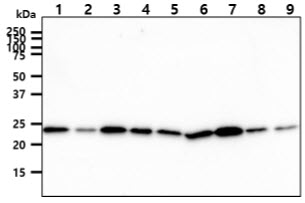

Anti-CINP antibody (1-212aa) [AT1G10] (STJA0041822)
SPECIFICATIONS
ClonalityMonoclonal
HostMouse
ConjugationUnconjugated
IsotypeIgG1k
ImmunogenRecombinant human CINP (1-212aa) purified from E. coli
General Information
| Short Description | Mouse monoclonal anti-CINP (1-212aa) for use in ELISA and WB in Human samples. Datasheet included with dilution recommendations, and related reagents. |
| Applications | ELISA/WB |
| Host | Mouse |
| Reactivity | Human |
| Note | STRICTLY FOR FURTHER SCIENTIFIC RESEARCH USE ONLY (RUO). MUST NOT TO BE USED IN DIAGNOSTIC OR THERAPEUTIC APPLICATIONS. |
Product Properties
| Clonality | Monoclonal |
| Clone ID | AT1G10 |
| Isotype | IgG1k |
| Conjugation | Unconjugated |
| Concentration | 1 mg/mL |
| Purification | By protein-A affinity chromatography |
| Formulation | Liquid in phosphate-Buffered Saline (pH 7.4) with 0.02% Sodium Azide, 10% Glycerol |
| Storage Instruction | For short term storage, keep at +2C to +8C for up to 1 week. For long term storage, aliquot and store at-20C, and avoid repeat freeze-thaw cycles. |
Target Information
| Gene Symbol | CINP |
| Gene ID | 51550 |
| Uniprot ID | CINP_HUMAN |
| Accession Number | NP_116019 |
| Immunogen | Recombinant human CINP (1-212aa) purified from E. coli |
| Immunogen Region | 1-212aa |
Additional Info
| Post Translational Modifications | Phosphorylated by CDC7 but not by CDK2. |
| Function | Component of the DNA replication complex, which interacts with two kinases, CDK2 and CDC7, thereby providing a functional and physical link between CDK2 and CDC7 during firing of the origins of replication. Regulates ATR-mediated checkpoint signaling in response to DNA damage. Part of the 55LCC heterohexameric ATPase complex which is chromatin-associated and promotes replisome proteostasis to maintain replication fork progression and genome stability. Required for replication fork progression, sister chromatid cohesion, and chromosome stability. The ATPase activity is specifically enhanced by replication fork DNA and is coupled to cysteine protease-dependent cleavage of replisome substrates in response to replication fork damage. Uses ATPase activity to process replisome substrates in S-phase, facilitating their proteolytic turnover from chromatin to ensure DNA replication and mitotic fidelity. As part of 55LCC complex, also involved in the cytoplasmic maturation steps of pre-60S ribosomal particles by promoting the release of shuttling protein RSL24D1/RLP24 from the pre-ribosomal particles. |
| Protein Name | Cyclin-Dependent Kinase 2-Interacting ProteinCdk2-Interacting Protein |
| Database Links | |
| Cellular Localisation | NucleusBinds To Nuclear Under G1 ConditionsAnd Dissociates From Chromatin With The Start Of Dna Replication |
| Alternative Antibody Names | Anti-Cyclin-Dependent Kinase 2-Interacting Protein antibodyAnti-Cdk2-Interacting Protein antibodyAnti-CINP antibody |
Information sourced from Uniprot.org