

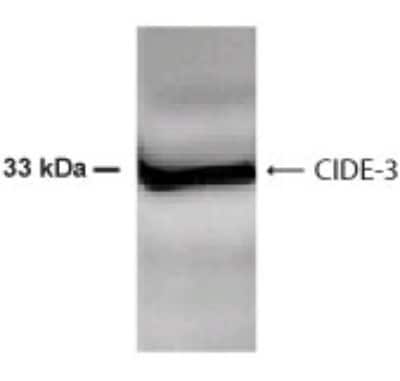

Anti-CIDEC antibody (N-Term) (STJA0005759)
SPECIFICATIONS
ClonalityPolyclonal
HostRabbit
ConjugationUnconjugated
IsotypeIgG
ImmunogenSynthetic peptide corresponding to amino acids from the N-terminal region of human CIDE3 protein
General Information
| Short Description | Rabbit polyclonal anti-CIDE3 (N-Term) for use in WB in Human and Mouse samples. Datasheet included with dilution recommendations, and related reagents. |
| Applications | WB |
| Host | Rabbit |
| Reactivity | Human/Mouse |
| Note | STRICTLY FOR FURTHER SCIENTIFIC RESEARCH USE ONLY (RUO). MUST NOT TO BE USED IN DIAGNOSTIC OR THERAPEUTIC APPLICATIONS. |
Product Properties
| Clonality | Polyclonal |
| Isotype | IgG |
| Conjugation | Unconjugated |
| Purification | Antigen Affinity Purified |
| Dilution Range | WB 1:500-1:1000 |
| Formulation | PBS + 0.02% NaN3 |
| Storage Instruction | Store at-20°C for up to 1 year from the date of receipt, and avoid repeat freeze-thaw cycles. |
Target Information
| Gene Symbol | CIDEC |
| Gene ID | 63924 |
| Uniprot ID | CIDEC_HUMAN |
| Immunogen | Synthetic peptide corresponding to amino acids from the N-terminal region of human CIDE3 protein |
| Immunogen Region | N-Term |
| Specificity | Reacts with the N-terminal region of human and mouse CIDE3 protein |
Additional Info
| Post Translational Modifications | Ubiquitinated and targeted to proteasomal degradation, resulting in a short half-life (about 15 minutes in 3T3-L1 cells). Protein stability depends on triaclyglycerol synthesis, fatty acid availability and lipid droplet formation. |
| Function | Lipid transferase specifically expressed in white adipose tissue, which promotes unilocular lipid droplet formation by mediating lipid droplet fusion. Lipid droplet fusion promotes their enlargement, restricting lipolysis and favoring lipid storage. Localizes on the lipid droplet surface, at focal contact sites between lipid droplets, and mediates atypical lipid droplet fusion by undergoing liquid-liquid phase separation (LLPS) and promoting directional net neutral lipid transfer from the smaller to larger lipid droplets. The transfer direction may be driven by the internal pressure difference between the contacting lipid droplet pair. Its role in neutral lipid transfer and lipid droplet enlargement is activated by the interaction with PLIN1. May also act as a CEBPB coactivator in the white adipose tissue to control the expression of a subset of CEBPB downstream target genes, including SOCS1, SOCS3, TGFB1, TGFBR1, ID2 and XDH. When overexpressed in preadipocytes, induces apoptosis or increases cell susceptibility to apoptosis induced by serum deprivation or TGFB treatment. |
| Protein Name | Lipid Transferase CidecCell Death Activator Cide-3Cell Death-Inducing Dffa-Like Effector Protein CFat-Specific Protein Fsp27 Homolog |
| Database Links | Reactome: R-HSA-8963889 Q96AQ7-1Reactome: R-HSA-8964572Reactome: R-HSA-9841922 |
| Cellular Localisation | Lipid DropletEndoplasmic ReticulumNucleusDiffuses Quickly On Lipid Droplet SurfaceBut Becomes Trapped And Clustered At Lipid Droplet Contact SitesThereby Enabling Its Rapid Enrichment At Lipid Droplet Contact Sites |
| Alternative Antibody Names | Anti-Lipid Transferase Cidec antibodyAnti-Cell Death Activator Cide-3 antibodyAnti-Cell Death-Inducing Dffa-Like Effector Protein C antibodyAnti-Fat-Specific Protein Fsp27 Homolog antibodyAnti-CIDEC antibodyAnti-FSP27 antibody |
Information sourced from Uniprot.org