
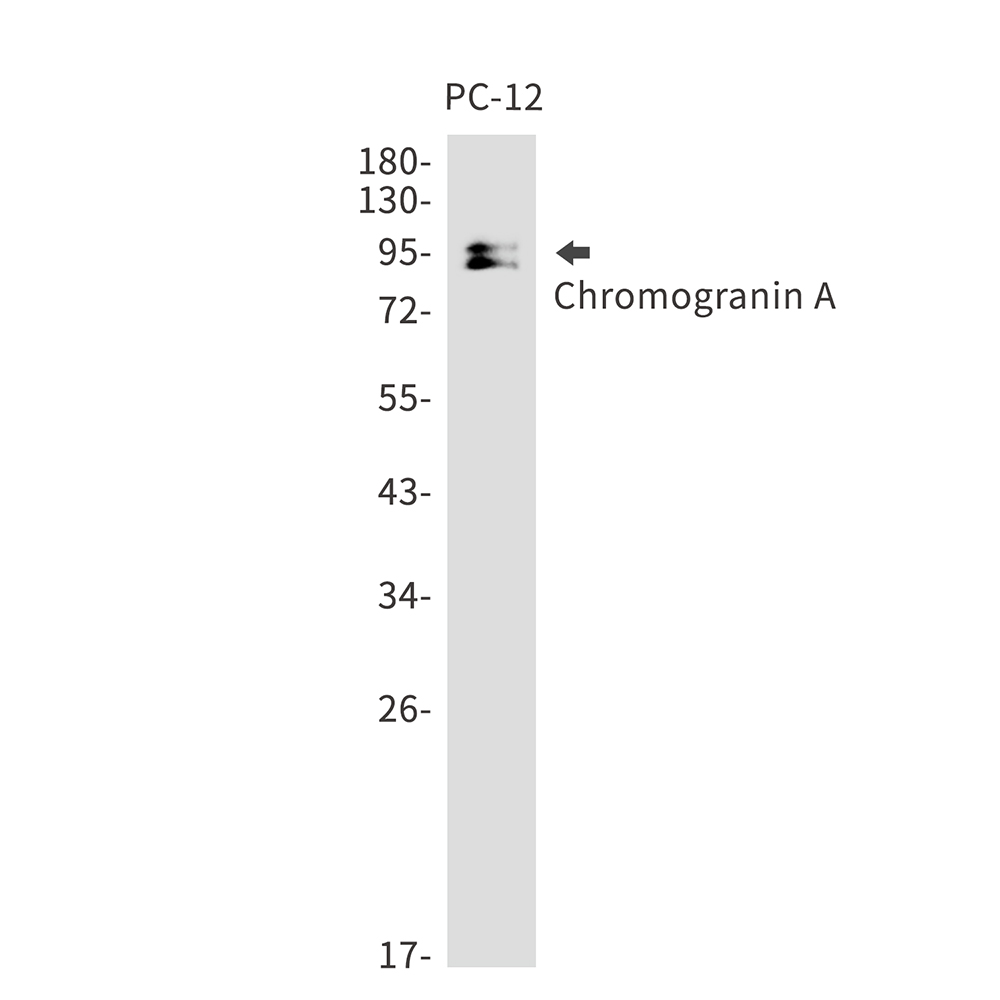

Anti-Chromogranin A antibody [R01-7E1] (STJA0034171)
SPECIFICATIONS
ClonalityMonoclonal
HostRabbit
ConjugationUnconjugated
IsotypeIgG
ImmunogenA synthetic peptide of human Chromogranin A
General Information
| Short Description | Rabbit monoclonal anti-Chromogranin A for use in WB, IHC-F, IHC-P, ICC and IF in Rat samples. Datasheet included with dilution recommendations, and related reagents. |
| Applications | WB/IHC-F/IHC-P/ICC/IF |
| Host | Rabbit |
| Reactivity | Rat |
| Note | STRICTLY FOR FURTHER SCIENTIFIC RESEARCH USE ONLY (RUO). MUST NOT TO BE USED IN DIAGNOSTIC OR THERAPEUTIC APPLICATIONS. |
Product Properties
| Clonality | Monoclonal |
| Clone ID | R01-7E1 |
| Isotype | IgG |
| Conjugation | Unconjugated |
| Concentration | 0.3 mg/mL |
| Purification | Affinity Purified |
| Dilution Range | WB 1:500-1:1000IHC 1:50-1:100IF 1:50-1:200 |
| Formulation | 50mM Tris-Glycine (pH 7.4) , 0.15M NaCl, 40% Glycerol, 0.01% Sodium azide and 0.05% BSA |
| Storage Instruction | Store at 4°C short term. Aliquot and store at-20°C long term. Avoid freeze/thaw cycles. |
Target Information
| Gene Symbol | CHGA |
| Gene ID | 1113 |
| Uniprot ID | CMGA_HUMAN |
| Immunogen | A synthetic peptide of human Chromogranin A |
Additional Info
| Tissue Specificity | Detected in cerebrospinal fluid (at protein level). Detected in urine (at protein level). GE-25: Found in the brain. |
| Post Translational Modifications | Sulfated on tyrosine residues and/or contains sulfated glycans. O-glycosylated with core 1 or possibly core 8 glycans. Contains chondroitin sulfate (CS).CS attachment is pH-dependent, being observed at mildly acidic conditions of pH 5 but not at neutral pH, and promotes self-assembly in vitro. Proteolytic processing gives rise to an additional longer form of catestatin (residues 358-390) which displays a less potent catecholamine release-inhibitory activity. Plasmin-mediated proteolytic processing can give rise to additional shorter and longer forms of catestatin peptides. |
| Function | Pancreastatin: Strongly inhibits glucose induced insulin release from the pancreas. Catestatin: Inhibits catecholamine release from chromaffin cells and noradrenergic neurons by acting as a non-competitive nicotinic cholinergic antagonist. Displays antibacterial activity against Gram-positive bacteria S.aureus and M.luteus, and Gram-negative bacteria E.coli and P.aeruginosa. Can induce mast cell migration, degranulation and production of cytokines and chemokines. Acts as a potent scavenger of free radicals in vitro. May play a role in the regulation of cardiac function and blood pressure. Serpinin: Regulates granule biogenesis in endocrine cells by up-regulating the transcription of protease nexin 1 (SERPINE2) via a cAMP-PKA-SP1 pathway. This leads to inhibition of granule protein degradation in the Golgi complex which in turn promotes granule formation. |
| Protein Name | Chromogranin-ACgaPituitary Secretory Protein ISp-I Cleaved Into - Vasostatin-1Vasostatin I - Vasostatin-2Vasostatin Ii - Ea-92 - Es-43 - Pancreastatin - Ss-18 - Wa-8 - We-14 - Lf-19 - CatestatinSl21 - Al-11 - Gv-19 - Gr-44 - Er-37 - Ge-25 - Serpinin-Rrg - Serpinin - P-Glu Serpinin Precursor |
| Database Links | Reactome: R-HSA-6803157 |
| Cellular Localisation | Serpinin: SecretedCytoplasmic VesicleSecretory VesiclePyroglutaminated Serpinin Localizes To Secretory VesicleNeuronal Dense Core VesicleSecretedAssociated With The Secretory Granule Membrane Through Direct Interaction To Scg3 That In Turn Binds To Cholesterol-Enriched Lipid Rafts In Intragranular ConditionsIn Pituitary GonadotropesLocated In Large Secretory Granules |
| Alternative Antibody Names | Anti-Chromogranin-A antibodyAnti-Cga antibodyAnti-Pituitary Secretory Protein I antibodyAnti-Sp-I Cleaved Into - Vasostatin-1 antibodyAnti-Vasostatin I - Vasostatin-2 antibodyAnti-Vasostatin Ii - Ea-92 - Es-43 - Pancreastatin - Ss-18 - Wa-8 - We-14 - Lf-19 - Catestatin antibodyAnti-Sl21 - Al-11 - Gv-19 - Gr-44 - Er-37 - Ge-25 - Serpinin-Rrg - Serpinin - P-Glu Serpinin Precursor antibodyAnti-CHGA antibody |
Information sourced from Uniprot.org