

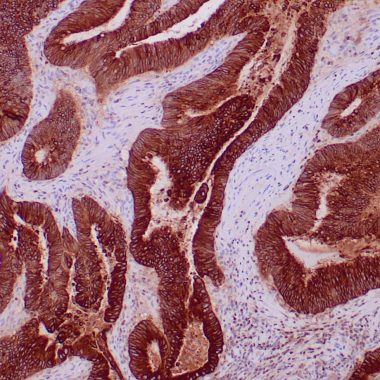

Anti-CEA antibody (Full length) [ZR370] (STJ180500)
SPECIFICATIONS
ClonalityMonoclonal
HostRabbit
ConjugationUnconjugated
IsotypeIgG
ImmunogenRecombinant full-length human CEA protein
General Information
| Short Description | Rabbit monoclonal CEA (Full length) antibody for use in IHC-P in human samples. Datasheet included with dilution recommendations, and related reagents. |
| Applications | IHC-P |
| Host | Rabbit |
| Reactivity | Human |
| Note | STRICTLY FOR FURTHER SCIENTIFIC RESEARCH USE ONLY (RUO). MUST NOT TO BE USED IN DIAGNOSTIC OR THERAPEUTIC APPLICATIONS. |
Product Properties
| Clonality | Monoclonal |
| Clone ID | ZR370 |
| Isotype | IgG |
| Conjugation | Unconjugated |
| Purification | Affinity purified |
| Dilution Range | 1:100-200 |
| Formulation | Tris-HCI buffer containing stabilizing protein (BSA) and <0.1% ProClin |
| Storage Instruction | Store at 2‐8°C for up to 24 months. Predilute: Ready to use, no reconstitution necessary. Concentrate: Use dilution range and appropriate lab‐standardized diluent. Stability after dilution: 7 days at 24°C, 3 months at 2‐8°C, 6months at ‐20°C. |
Target Information
| Gene Symbol | CEACAM5 |
| Gene ID | 1048 |
| Uniprot ID | CEAM5_HUMAN |
| Immunogen | Recombinant full-length human CEA protein |
| Immunogen Region | Full length |
| Specificity | Positive control: Colon carcinoma |
Additional Info
| Tissue Specificity | Expressed in columnar epithelial and goblet cells of the colon (at protein level). Found in adenocarcinomas of endodermally derived digestive system epithelium and fetal colon. |
| Post Translational Modifications | Complex immunoreactive glycoprotein with a MW of 180 kDa comprising 60% carbohydrate. |
| Function | Cell surface glycoprotein that plays a role in cell adhesion, intracellular signaling and tumor progression. Mediates homophilic and heterophilic cell adhesion with other carcinoembryonic antigen-related cell adhesion molecules, such as CEACAM6. Plays a role as an oncogene by promoting tumor progression.induces resistance to anoikis of colorectal carcinoma cells. (Microbial infection) Receptor for E.coli Dr adhesins. Binding of E.coli Dr adhesins leads to dissociation of the homodimer. |
| Protein Name | Cell Adhesion Molecule Ceacam5Carcinoembryonic AntigenCeaCarcinoembryonic Antigen-Related Cell Adhesion Molecule 5Cea Cell Adhesion Molecule 5Meconium Antigen 100Cd Antigen Cd66e |
| Database Links | Reactome: R-HSA-163125Reactome: R-HSA-202733 |
| Cellular Localisation | Cell MembraneLipid-AnchorGpi-AnchorApical Cell MembraneCell SurfaceLocalized To The Apical Glycocalyx Surface |
| Alternative Antibody Names | Anti-Cell Adhesion Molecule Ceacam5 antibodyAnti-Carcinoembryonic Antigen antibodyAnti-Cea antibodyAnti-Carcinoembryonic Antigen-Related Cell Adhesion Molecule 5 antibodyAnti-Cea Cell Adhesion Molecule 5 antibodyAnti-Meconium Antigen 100 antibodyAnti-Cd Antigen Cd66e antibodyAnti-CEACAM5 antibodyAnti-CEA antibody |
Information sourced from Uniprot.org