


Anti-CD155/PVR Antibody antibody (ECD) [M048] (STJA0041100)
SPECIFICATIONS
ClonalityMonoclonal
HostMouse
ConjugationUnconjugated
IsotypeIgG1
ImmunogenClone (M048) was generated from a recombinant protein that included the extracellular region of human CD155 protein.
General Information
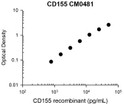
| Short Description | Mouse monoclonal anti-CD155/PVR antibody (ECD) for use in ELISA, WB, IP and ICC in Human samples. Datasheet included with dilution recommendations, and related reagents. |
| Applications | ELISA/WB/IP/ICC |
| Host | Mouse |
| Reactivity | Human |
| Note | STRICTLY FOR FURTHER SCIENTIFIC RESEARCH USE ONLY (RUO). MUST NOT TO BE USED IN DIAGNOSTIC OR THERAPEUTIC APPLICATIONS. |
Product Properties
| Clonality | Monoclonal |
| Clone ID | M048 |
| Isotype | IgG1 |
| Conjugation | Unconjugated |
| Purification | Protein G Purified |
| Dilution Range | WB 1:1000ICC 1:100IP 1:100 |
| Formulation | PBS + 1 mg/ml BSA, 0.05% NaN3 and 50% glycerol |
| Storage Instruction | Storage at-20°C is recommended, as aliquots may be taken without freeze/thawing due to presence of 50% glycerol. Stable for at least 1 year at-20°C. |
Target Information
| Gene Symbol | PVR |
| Gene ID | 5817 |
| Uniprot ID | PVR_HUMAN |
| Immunogen | Clone (M048) was generated from a recombinant protein that included the extracellular region of human CD155 protein. |
| Immunogen Region | ECD |
| Immunogen Sequence | Human |
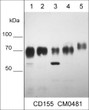
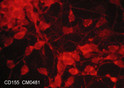
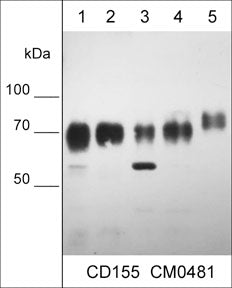
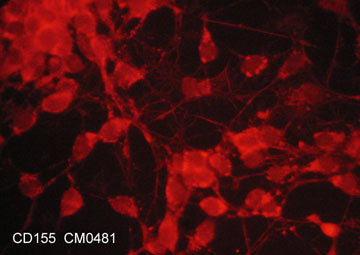
| Specificity | Clone M048 mouse monoclonal antibody detects a 75 kDa* protein on SDS-PAGE Native" or denatured immunoblots of human A549, NCI-H466, NCI-H1299, MDA-MB-231 and A431 carcinomas. The antibody detects CD155 in the membranes and cytoplasm in NCI-H446 cell |
Additional Info
| Post Translational Modifications | N-glycosylated. N-glycan at Asn-120: Hex5HexNAc4. Phosphorylated by Src kinases on tyrosine residues in the ITIM motif upon ligation. Interaction with TIGIT is required for Phosphorylation. |
| Function | Mediates NK cell adhesion and triggers NK cell effector functions. Binds two different NK cell receptors: CD96 and CD226. These interactions accumulates at the cell-cell contact site, leading to the formation of a mature immunological synapse between NK cell and target cell. This may trigger adhesion and secretion of lytic granules and IFN-gamma and activate cytotoxicity of activated NK cells. May also promote NK cell-target cell modular exchange, and PVR transfer to the NK cell. This transfer is more important in some tumor cells expressing a lot of PVR, and may trigger fratricide NK cell activation, providing tumors with a mechanism of immunoevasion. Plays a role in mediating tumor cell invasion and migration. (Microbial infection) Acts as a receptor for poliovirus. May play a role in axonal transport of poliovirus, by targeting virion-PVR-containing endocytic vesicles to the microtubular network through interaction with DYNLT1. This interaction would drive the virus-containing vesicle to the axonal retrograde transport. (Microbial infection) Acts as a receptor for Pseudorabies virus. (Microbial infection) Is prevented to reach cell surface upon infection by Human cytomegalovirus /HHV-5, presumably to escape immune recognition of infected cell by NK cells. |
| Protein Name | Poliovirus ReceptorNectin-Like Protein 5Necl-5Cd Antigen Cd155 |
| Database Links | Reactome: R-HSA-198933Reactome: R-HSA-420597 |
| Cellular Localisation | Isoform Alpha: Cell MembraneSingle-Pass Type I Membrane ProteinIsoform Delta: Cell MembraneIsoform Beta: SecretedIsoform Gamma: Secreted |
| Alternative Antibody Names | Anti-Poliovirus Receptor antibodyAnti-Nectin-Like Protein 5 antibodyAnti-Necl-5 antibodyAnti-Cd Antigen Cd155 antibodyAnti-PVR antibodyAnti-PVS antibody |
Information sourced from Uniprot.org