

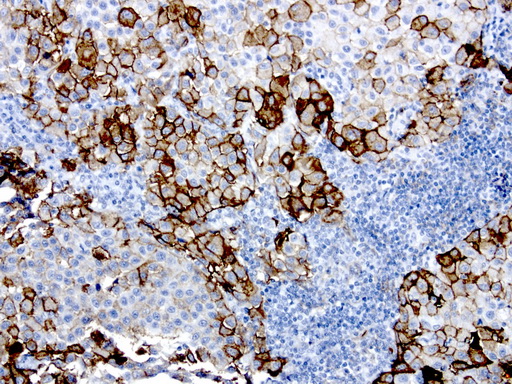
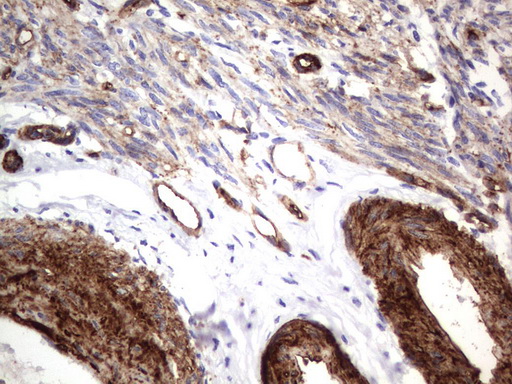

Anti-CD146 antibody [ZN154] (STJA0033329)
SPECIFICATIONS
ClonalityMonoclonal
HostMouse
ConjugationUnconjugated
IsotypeIgG1
ImmunogenFull length human recombinant protein of human MCAM (NP_006491) produced in HEK293T cell.
General Information
| Short Description | Mouse monoclonal anti-CD146 for use in IHC-P in Human samples. Datasheet included with dilution recommendations, and related reagents. |
| Applications | IHC-P |
| Host | Mouse |
| Reactivity | Human |
| Note | STRICTLY FOR FURTHER SCIENTIFIC RESEARCH USE ONLY (RUO). MUST NOT TO BE USED IN DIAGNOSTIC OR THERAPEUTIC APPLICATIONS. |
Product Properties
| Clonality | Monoclonal |
| Clone ID | ZN154 |
| Isotype | IgG1 |
| Conjugation | Unconjugated |
| Concentration | 0.5-1.0 mg/mL |
| Purification | Affinity Chromatography |
| Dilution Range | IHC 1:50-1:100 |
| Formulation | PBS (PH 7.3) containing 1% BSA, 50% glycerol and 0.02% sodium azide. |
| Storage Instruction | Store at 4°C short term. Aliquot and store at-20°C long term. Avoid freeze/thaw cycles. |
Target Information
| Gene Symbol | MCAM |
| Gene ID | 4162 |
| Uniprot ID | MUC18_HUMAN |
| Immunogen | Full length human recombinant protein of human MCAM (NP_006491) produced in HEK293T cell. |
Additional Info
| Tissue Specificity | Detected in endothelial cells in vascular tissue throughout the body. May appear at the surface of neural crest cells during their embryonic migration. Appears to be limited to vascular smooth muscle in normal adult tissues. Associated with tumor progression and the development of metastasis in human malignant melanoma. Expressed most strongly on metastatic lesions and advanced primary tumors and is only rarely detected in benign melanocytic nevi and thin primary melanomas with a low probability of metastasis. |
| Function | Plays a role in cell adhesion, and in cohesion of the endothelial monolayer at intercellular junctions in vascular tissue. Its expression may allow melanoma cells to interact with cellular elements of the vascular system, thereby enhancing hematogeneous tumor spread. Could be an adhesion molecule active in neural crest cells during embryonic development. Acts as a surface receptor that triggers tyrosine phosphorylation of FYN and PTK2/FAK1, and a transient increase in the intracellular calcium concentration. |
| Protein Name | Cell Surface Glycoprotein Muc18Cell Surface Glycoprotein P1h12Melanoma Cell Adhesion MoleculeMelanoma-Associated Antigen A32Melanoma-Associated Antigen Muc18S-Endo 1 Endothelial-Associated AntigenCd Antigen Cd146 |
| Database Links | Reactome: R-HSA-8980692Reactome: R-HSA-9013026Reactome: R-HSA-9013106Reactome: R-HSA-9013149Reactome: R-HSA-9013404Reactome: R-HSA-9013405Reactome: R-HSA-9013408Reactome: R-HSA-9013423Reactome: R-HSA-9035034 |
| Cellular Localisation | MembraneSingle-Pass Type I Membrane Protein |
| Alternative Antibody Names | Anti-Cell Surface Glycoprotein Muc18 antibodyAnti-Cell Surface Glycoprotein P1h12 antibodyAnti-Melanoma Cell Adhesion Molecule antibodyAnti-Melanoma-Associated Antigen A32 antibodyAnti-Melanoma-Associated Antigen Muc18 antibodyAnti-S-Endo 1 Endothelial-Associated Antigen antibodyAnti-Cd Antigen Cd146 antibodyAnti-MCAM antibodyAnti-MUC18 antibody |
Information sourced from Uniprot.org