

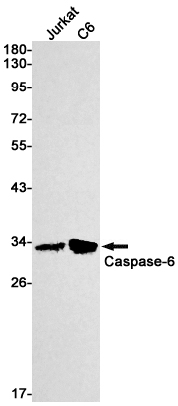

Anti-CASP6 antibody (194-293 aa) [R04-5F9] (STJA0010692)
SPECIFICATIONS
ClonalityMonoclonal
HostRabbit
ConjugationUnconjugated
IsotypeIgG
ImmunogenRecombinant protein of human Caspase-6
General Information
| Short Description | Rabbit monoclonal anti-Caspase 6 (194-293 aa) for use in WB in Human and Rat samples. Datasheet included with dilution recommendations, and related reagents. |
| Applications | WB |
| Host | Rabbit |
| Reactivity | Human/Rat |
| Note | STRICTLY FOR FURTHER SCIENTIFIC RESEARCH USE ONLY (RUO). MUST NOT TO BE USED IN DIAGNOSTIC OR THERAPEUTIC APPLICATIONS. |
Product Properties
| Clonality | Monoclonal |
| Clone ID | R04-5F9 |
| Isotype | IgG |
| Conjugation | Unconjugated |
| Concentration | 0.3 mg/mL |
| Purification | Affinity Purified |
| Dilution Range | WB 1:500-1:1000 |
| Formulation | 50mM Tris-Glycine (pH7.4) , 0.15M NaCl, 40% Glycerol, 0.01% Sodium azide and 0.05% BSA |
| Storage Instruction | Store at 4°C short term. Aliquot and store at-20°C long term. Avoid freeze/thaw cycles. |
Target Information
| Gene Symbol | CASP6 |
| Gene ID | 839 |
| Uniprot ID | CASP6_HUMAN |
| Immunogen | Recombinant protein of human Caspase-6 |
| Immunogen Region | 194-293 aa |
Additional Info
| Post Translational Modifications | Phosphorylated by NUAK1.phosphorylation inhibits self-activation. Phosphorylation at Ser-257 by AMP-activated protein kinase (PRKAA1 or PRKAA2) inhibits autocleavage, preventing caspase activation, thereby preventing hepatocyte apoptosis. Palmitoylation by ZDHHC17 blocks dimerization and subsequent activation, leading to inhibit the cysteine protease activity. Can be cleaved and activated by different caspases, depending on the context. Cleaved and activated by caspase-8 (CASP8) and subsequently by caspase-3 (CASP3). Can also undergo autoactivation by mediating autocleavage at Asp-179 and Asp-193, while it is not able to cleave its N-terminal disordered prodomain. Cleaved and activated by CASP1, possibly in the context of inflammation. |
| Function | Cysteine protease that plays essential roles in programmed cell death, axonal degeneration, development and innate immunity. Acts as a non-canonical executioner caspase during apoptosis: localizes in the nucleus and cleaves the nuclear structural protein NUMA1 and lamin A/LMNA thereby inducing nuclear shrinkage and fragmentation. Lamin-A/LMNA cleavage is required for chromatin condensation and nuclear disassembly during apoptotic execution. Acts as a regulator of liver damage by promoting hepatocyte apoptosis: in absence of phosphorylation by AMP-activated protein kinase (AMPK), catalyzes cleavage of BID, leading to cytochrome c release, thereby participating in nonalcoholic steatohepatitis. Cleaves PARK7/DJ-1 in cells undergoing apoptosis. Involved in intrinsic apoptosis by mediating cleavage of RIPK1. Furthermore, cleaves many transcription factors such as NF-kappa-B and cAMP response element-binding protein/CREBBP. Cleaves phospholipid scramblase proteins XKR4 and XKR9. In addition to apoptosis, involved in different forms of programmed cell death. Plays an essential role in defense against viruses by acting as a central mediator of the ZBP1-mediated pyroptosis, apoptosis, and necroptosis (PANoptosis), independently of its cysteine protease activity. PANoptosis is a unique inflammatory programmed cell death, which provides a molecular scaffold that allows the interactions and activation of machinery required for inflammasome/pyroptosis, apoptosis and necroptosis. Mechanistically, interacts with RIPK3 and enhances the interaction between RIPK3 and ZBP1, leading to ZBP1-mediated inflammasome activation and cell death. Plays an essential role in axon degeneration during axon pruning which is the remodeling of axons during neurogenesis but not apoptosis. Regulates B-cell programs both during early development and after antigen stimulation. (Microbial infection) Proteolytically cleaves the N protein of coronaviruses such as MERS-CoV and SARS-CoV. The cleavage of MERS-CoV N-protein leads to two fragments and modulates coronavirus replication by regulating IFN signaling. The two fragments produced by the cleavage interact with IRF3 inhibiting its nuclear translocation after activation and reduce the expression of IFNB and IFN-stimulated genes. The same mechanism seems to be used by other coronaviruses such as SARS-CoV and SARS-CoV-2 to enhance their replication. |
| Protein Name | Caspase-6Casp-6Csp-6Apoptotic Protease Mch-2 Cleaved Into - Caspase-6 Subunit P18Caspase-6 Subunit P20 - Caspase-6 Subunit P11Caspase-6 Subunit P10 |
| Database Links | Reactome: R-HSA-111465Reactome: R-HSA-264870Reactome: R-HSA-352238Reactome: R-HSA-6803207 |
| Cellular Localisation | CytoplasmNucleus |
| Alternative Antibody Names | Anti-Caspase-6 antibodyAnti-Casp-6 antibodyAnti-Csp-6 antibodyAnti-Apoptotic Protease Mch-2 Cleaved Into - Caspase-6 Subunit P18 antibodyAnti-Caspase-6 Subunit P20 - Caspase-6 Subunit P11 antibodyAnti-Caspase-6 Subunit P10 antibodyAnti-CASP6 antibodyAnti-MCH2 antibody |
Information sourced from Uniprot.org