


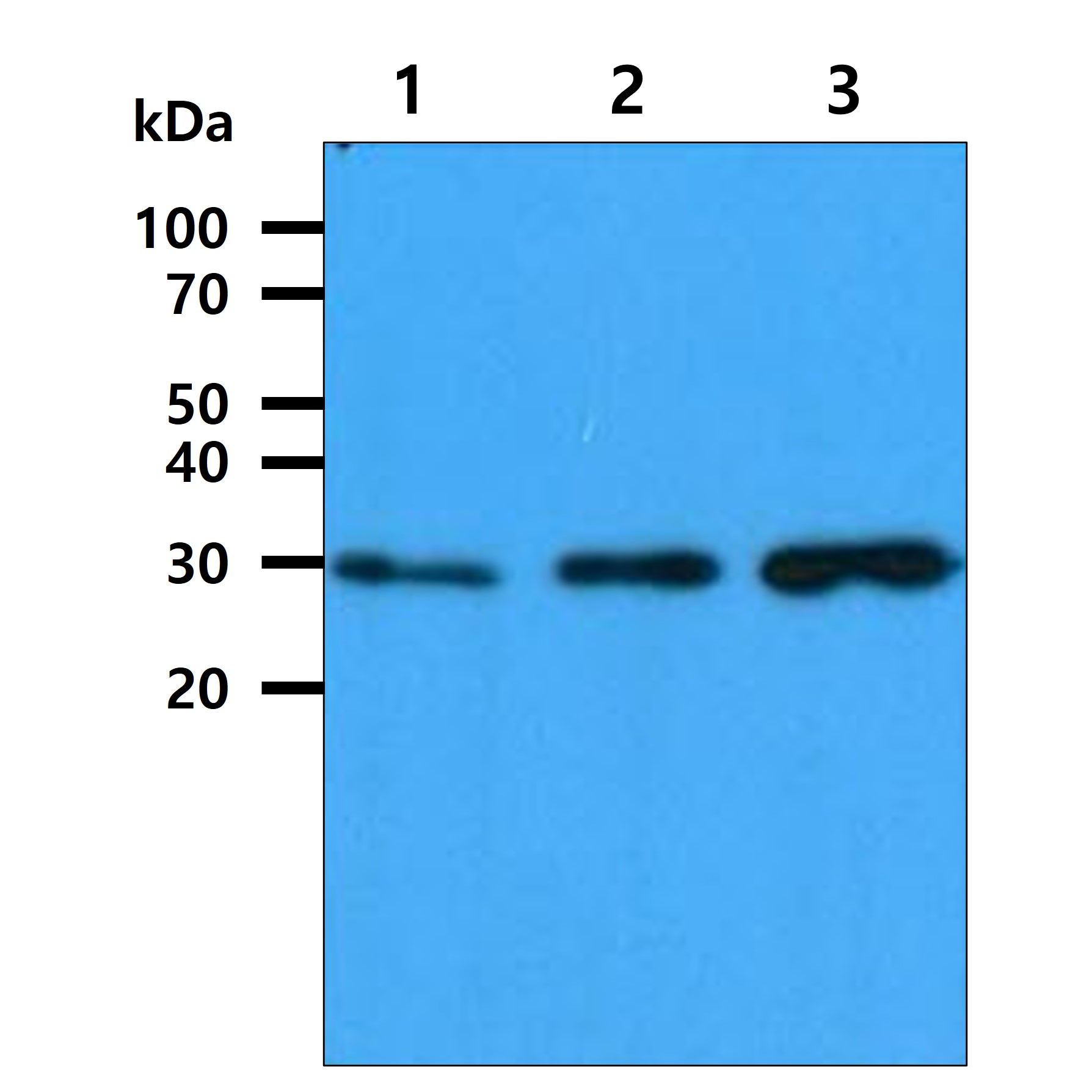

Anti-Carbonyl reductase 1/CBR1 antibody (1-277 aa) [AT4E12] (STJA0041603)
SPECIFICATIONS
ClonalityMonoclonal
HostMouse
ConjugationUnconjugated
IsotypeIgG2ak
ImmunogenRecombinant human CBR1 (1-277 aa ) purified from E. coli
General Information
| Short Description | Mouse monoclonal anti-Carbonyl reductase 1/CBR1 (1-277 aa) for use in ELISA, WB, ICC and IF in Human samples. Datasheet included with dilution recommendations, and related reagents. |
| Applications | ELISA/WB/ICC/IF |
| Host | Mouse |
| Reactivity | Human |
| Note | STRICTLY FOR FURTHER SCIENTIFIC RESEARCH USE ONLY (RUO). MUST NOT TO BE USED IN DIAGNOSTIC OR THERAPEUTIC APPLICATIONS. |
Product Properties
| Clonality | Monoclonal |
| Clone ID | AT4E12 |
| Isotype | IgG2ak |
| Conjugation | Unconjugated |
| Concentration | 1 mg/mL |
| Purification | By protein-G affinity chromatography |
| Formulation | Liquid in phosphate-Buffered Saline (pH 7.4) with 0.02% Sodium Azide, 10% Glycerol |
| Storage Instruction | For short term storage, keep at +2C to +8C for up to 1 week. For long term storage, aliquot and store at-20C, and avoid repeat freeze-thaw cycles. |
Target Information
| Gene Symbol | CBR1 |
| Gene ID | 873 |
| Uniprot ID | CBR1_HUMAN |
| Accession Number | NP_001748 |
| Immunogen | Recombinant human CBR1 (1-277 aa ) purified from E. coli |
| Immunogen Region | 1-277 aa |
Additional Info
| Tissue Specificity | Expressed in kidney (at protein level). |
| Function | NADPH-dependent reductase with broad substrate specificity. Catalyzes the reduction of a wide variety of carbonyl compounds including quinones, prostaglandins, menadione, plus various xenobiotics. Catalyzes the reduction of the antitumor anthracyclines doxorubicin and daunorubicin to the cardiotoxic compounds doxorubicinol and daunorubicinol. Can convert prostaglandin E to prostaglandin F2-alpha. Can bind glutathione, which explains its higher affinity for glutathione-conjugated substrates. Catalyzes the reduction of S-nitrosoglutathione. In addition, participates in the glucocorticoid metabolism by catalyzing the NADPH-dependent cortisol/corticosterone into 20beta-dihydrocortisol (20b-DHF) or 20beta-corticosterone (20b-DHB), which are weak agonists of NR3C1 and NR3C2 in adipose tissue. |
| Protein Name | Carbonyl Reductase Nadph 115-Hydroxyprostaglandin Dehydrogenase Nadp(+20-Beta-Hydroxysteroid DehydrogenaseAlcohol Dehydrogenase Nad(P+ Cbr1Nadph-Dependent Carbonyl Reductase 1Prostaglandin 9-KetoreductasePg-9-KrProstaglandin-E(2 9-ReductaseShort Chain Dehydrogenase/Reductase Family 21c Member 1 |
| Database Links | Reactome: R-HSA-2162123 |
| Cellular Localisation | Cytoplasm |
| Alternative Antibody Names | Anti-Carbonyl Reductase Nadph 1 antibodyAnti-15-Hydroxyprostaglandin Dehydrogenase Nadp(+ antibodyAnti-20-Beta-Hydroxysteroid Dehydrogenase antibodyAnti-Alcohol Dehydrogenase Nad(P+ Cbr1 antibodyAnti-Nadph-Dependent Carbonyl Reductase 1 antibodyAnti-Prostaglandin 9-Ketoreductase antibodyAnti-Pg-9-Kr antibodyAnti-Prostaglandin-E(2 9-Reductase antibodyAnti-Short Chain Dehydrogenase/Reductase Family 21c Member 1 antibodyAnti-CBR1 antibodyAnti-CBR antibodyAnti-CRN antibodyAnti-SDR21C1 antibody |
Information sourced from Uniprot.org