


Anti-CANX antibody (C-Term) {DyLight®755} (STJ140308)
SPECIFICATIONS
ClonalityPolyclonal
HostGoat
ConjugationDyLight®755
IsotypeIgG
ImmunogenPurified recombinant peptide within residues 550 aa to the C-terminus of human CANX produced in E. coli.
General Information
| Short Description | Goat polyclonal CANX (C-Term) antibody for use in WB, IF and IHC-F in human, rat, mouse, canine and monkey samples. Datasheet included with dilution recommendations, and related reagents. |
| Applications | WB/IF/IHC-F |
| Host | Goat |
| Reactivity | Human/Rat/Mouse/Canine/Monkey |
| Note | STRICTLY FOR FURTHER SCIENTIFIC RESEARCH USE ONLY (RUO). MUST NOT TO BE USED IN DIAGNOSTIC OR THERAPEUTIC APPLICATIONS. |
Product Properties
| Clonality | Polyclonal |
| Isotype | IgG |
| Conjugation | DyLight®755 |
| Concentration | 2.5 mg/mL |
| Purification | Epitope affinity purified |
| Dilution Range | WB:1:500-1:5, 000IF:1:50-1:500IHC-F:1:200-1:1, 000 |
| Formulation | PBS, 20% Glycerol and 0.05% Sodium Azide. |
| Storage Instruction | For continuous use, store at 2-8 C for one-two days. For extended storage, store in-20 C freezer. Working dilution samples should be discarded if not used within 12 hours. |
Target Information
| Accession Number | NA NA Gene ID: 821, ENSG00000127022 |
| Immunogen | Purified recombinant peptide within residues 550 aa to the C-terminus of human CANX produced in E. coli. |
| Immunogen Region | C-Term |
| Immunogen Sequence | KSDAEEDGGTVSQEEEDRKP SDAEEDGGTVSQEEEDRKPK |
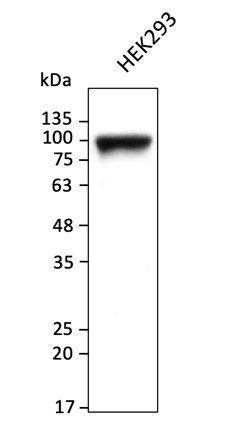
| Specificity | Detects a band of 90 kDa by Western blot whole cell lysates. |
Additional Info
| Background | Goat polyclonal to CANX (Calnexin)-endoplasmic reticulum (ER) membrane marker conjugated to DyLight® 755. CANX is a member of the calnexin family of molecular chaperones. This protein is a calcium-binding, ER-associated protein that interacts transiently with newly synthesized N-linked glycoproteins, facilitating protein folding and assembly. It may also play a central role in the quality control of protein folding by retaining incorrectly folded protein subunits within the ER for degradation. |
Information sourced from Uniprot.org