

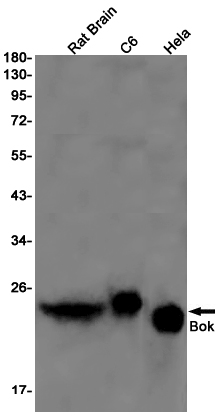

Anti-Bok antibody [R03-1B6] (STJA0034088)
SPECIFICATIONS
ClonalityMonoclonal
HostRabbit
ConjugationUnconjugated
IsotypeIgG
ImmunogenA synthetic peptide of human Bok
General Information
| Short Description | Rabbit monoclonal anti-Bok for use in WB in Human and Rat samples. Datasheet included with dilution recommendations, and related reagents. |
| Applications | WB |
| Host | Rabbit |
| Reactivity | Human/Rat |
| Note | STRICTLY FOR FURTHER SCIENTIFIC RESEARCH USE ONLY (RUO). MUST NOT TO BE USED IN DIAGNOSTIC OR THERAPEUTIC APPLICATIONS. |
Product Properties
| Clonality | Monoclonal |
| Clone ID | R03-1B6 |
| Isotype | IgG |
| Conjugation | Unconjugated |
| Concentration | 0.3 mg/mL |
| Purification | Affinity Purified |
| Dilution Range | WB 1:500-1:1000 |
| Formulation | 50mM Tris-Glycine (pH 7.4) , 0.15M NaCl, 40% Glycerol, 0.01% Sodium azide and 0.05% BSA |
| Storage Instruction | Store at 4°C short term. Aliquot and store at-20°C long term. Avoid freeze/thaw cycles. |
Target Information
| Gene Symbol | BOK |
| Gene ID | 666 |
| Uniprot ID | BOK_HUMAN |
| Immunogen | A synthetic peptide of human Bok |
Additional Info
| Tissue Specificity | Expressed mainly in oocytes.weak expression in granulosa cells of the developing follicles. In adult human ovaries, expressed in granulosa cells at all follicular stages, but expression in primordial/primary follicles granulosa cell is stronger than in secondary and antral follicles. |
| Post Translational Modifications | Ubiquitinated by AMFR/gp78 E3 ubiquitin ligase complex.mediates degradation by ubiquitin-proteasome pathway in a VCP/p97-dependent manner.prevents from pro-apoptotic activity.promotes degradation of newly synthesized proteins that are not ITPR1 associated. |
| Function | Isoform 1: Apoptosis regulator that functions through different apoptotic signaling pathways. Plays a roles as pro-apoptotic protein that positively regulates intrinsic apoptotic process in a BAX- and BAK1-dependent manner or in a BAX- and BAK1-independent manner. In response to endoplasmic reticulum stress promotes mitochondrial apoptosis through downstream BAX/BAK1 activation and positive regulation of PERK-mediated unfolded protein response. Activates apoptosis independently of heterodimerization with survival-promoting BCL2 and BCL2L1 through induction of mitochondrial outer membrane permeabilization, in a BAX- and BAK1-independent manner, in response to inhibition of ERAD-proteasome degradation system, resulting in cytochrome c release. In response to DNA damage, mediates intrinsic apoptotic process in a TP53-dependent manner. Plays a role in granulosa cell apoptosis by CASP3 activation. Plays a roles as anti-apoptotic protein during neuronal apoptotic process, by negatively regulating poly ADP-ribose polymerase-dependent cell death through regulation of neuronal calcium homeostasis and mitochondrial bioenergetics in response to NMDA excitation. In addition to its role in apoptosis, may regulate trophoblast cell proliferation during the early stages of placental development, by acting on G1/S transition through regulation of CCNE1 expression. May also play a role as an inducer of autophagy by disrupting interaction between MCL1 and BECN1. Isoform 2: Pro-apoptotic molecule exerting its function through the mitochondrial pathway. |
| Protein Name | Bcl-2-Related Ovarian Killer ProteinHbokBcl-2-Like Protein 9Bcl2-L-9 |
| Database Links | |
| Cellular Localisation | Isoform 1: Mitochondrion MembraneSingle-Pass Membrane ProteinEndoplasmic Reticulum MembraneMitochondrion Inner MembraneCytoplasmNucleusMitochondrionEndoplasmic ReticulumMitochondrion Outer MembraneEarly Endosome MembraneRecycling Endosome MembraneNucleus Outer MembraneGolgi ApparatusCis-Golgi Network MembraneTrans-Golgi Network MembraneMembraneNuclear And Cytoplasmic Compartments In The Early Stages Of Apoptosis And During Apoptosis It Associates With MitochondriaIn Healthy CellsAssociates Loosely With The Membrane In A Hit-And-Run ModeThe Insertion And Accumulation On Membranes Is Enhanced Through The Activity Of Death SignalsResulting In The Integration Of The Membrane-Bound Protein Into The MembraneThe Transmembrane Domain Controls Subcellular LocalizationConstitutes A Tail-AnchorLocalizes In Early And Late Endosome Upon Blocking Of ApoptosisMust Localize To The Mitochondria To Induce Mitochondrial Outer Membrane Permeabilization And ApoptosisIsoform 2: Membrane |
| Alternative Antibody Names | Anti-Bcl-2-Related Ovarian Killer Protein antibodyAnti-Hbok antibodyAnti-Bcl-2-Like Protein 9 antibodyAnti-Bcl2-L-9 antibodyAnti-BOK antibodyAnti-BCL2L9 antibody |
Information sourced from Uniprot.org