


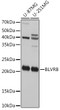


Anti-BLVRB antibody (1-206) (STJ29401)
SPECIFICATIONS
ClonalityPolyclonal
HostRabbit
ConjugationUnconjugated
IsotypeIgG
General Information
| Short Description | Rabbit polyclonal BLVRB (1-206) antibody for use in WB, IHC-P and ELISA in human, mouse and rat samples. Datasheet included with dilution recommendations, and related reagents. |
| Applications | WB/IHC-P/ELISA |
| Host | Rabbit |
| Reactivity | Human/Mouse/Rat |
| Note | STRICTLY FOR FURTHER SCIENTIFIC RESEARCH USE ONLY (RUO). MUST NOT TO BE USED IN DIAGNOSTIC OR THERAPEUTIC APPLICATIONS. |
Product Properties
| Clonality | Polyclonal |
| Isotype | IgG |
| Conjugation | Unconjugated |
| Concentration | Lot specific |
| Purification | Affinity purification |
| Dilution Range | WB:1:500-1:2000IHC-P:1:50-1:100ELISA:Recommended starting concentration is 1 Mu g/mL. Please optimize the concentration based on your specific assay requirements. |
| Formulation | PBS with 0.02% Sodium Azide, 50% Glycerol, pH 7.3. |
| Storage Instruction | Store at-20°C for up to 1 year from the date of receipt, and avoid repeat freeze-thaw cycles. |
Target Information
| Gene Symbol | BLVRB |
| Gene ID | 645 |
| Uniprot ID | BLVRB_HUMAN |
| Immunogen Region | 1-206 |
| Immunogen Sequence | MAVKKIAIFGATGQTGLTTL AQAVQAGYEVTVLVRDSSRL PSEGPRPAHVVVGDVLQAAD VDKTVAGQDAVIVLLGTRND LSPTTVMSEGARNIVAAMKA HGVDKVVACTSAFLLWDPTK VPPRLQAVTDDHIRMHKVLR ESGLKYVAVMPPHIGDQPLT GAYTVTLDGRGPSRVISKHD LGHFMLRCLTTDEYDGHSTY PSHQYQ |
| Specificity | Recombinant fusion protein containing a sequence corresponding to amino acids 1-206 of human BLVRB (NP_000704.1). |
Additional Info
| Tissue Specificity | Predominantly expressed in liver and erythrocytes. At lower levels in heart, lung, adrenal gland and cerebrum. Expressed in adult red blood cells. |
| Function | Enzyme that can both act as a NAD(P)H-dependent reductase and a S-nitroso-CoA-dependent nitrosyltransferase. Promotes fetal heme degradation during development. Also expressed in adult tissues, where it acts as a regulator of hematopoiesis, intermediary metabolism (glutaminolysis, glycolysis, TCA cycle and pentose phosphate pathway) and insulin signaling. Has a broad specificity oxidoreductase activity by catalyzing the NAD(P)H-dependent reduction of a variety of flavins, such as riboflavin, FAD or FMN, biliverdins, methemoglobin and PQQ (pyrroloquinoline quinone). Contributes to fetal heme catabolism by catalyzing reduction of biliverdin IXbeta into bilirubin IXbeta in the liver. Biliverdin IXbeta, which constitutes the major heme catabolite in the fetus is not present in adult. Does not reduce bilirubin IXalpha. Can also reduce the complexed Fe(3+) iron to Fe(2+) in the presence of FMN and NADPH. Acts as a protein nitrosyltransferase by catalyzing nitrosylation of cysteine residues of target proteins, such as HMOX2, INSR and IRS1. S-nitroso-CoA-dependent nitrosyltransferase activity is mediated via a 'ping-pong' mechanism: BLVRB first associates with both S-nitroso-CoA and protein substrate, nitric oxide group is then transferred from S-nitroso-CoA to Cys-109 and Cys-188 residues of BLVRB and from S-nitroso-BLVRB to the protein substrate. Inhibits insulin signaling by mediating nitrosylation of INSR and IRS1, leading to their inhibition. |
| Protein Name | Flavin ReductaseNadphFrBiliverdin Reductase BBvr-BBiliverdin-Ix Beta-ReductaseGreen Heme-Binding ProteinGhbpNadph-Dependent DiaphoraseNadph-Flavin ReductaseFlrS-Nitroso-Coa-Assisted NitrosyltransferaseSno-Coa-Assisted Nitrosyltransferase |
| Database Links | Reactome: R-HSA-189483Reactome: R-HSA-9707564 |
| Cellular Localisation | Cytoplasm |
| Alternative Antibody Names | Anti-Flavin Reductase antibodyAnti-Nadph antibodyAnti-Fr antibodyAnti-Biliverdin Reductase B antibodyAnti-Bvr-B antibodyAnti-Biliverdin-Ix Beta-Reductase antibodyAnti-Green Heme-Binding Protein antibodyAnti-Ghbp antibodyAnti-Nadph-Dependent Diaphorase antibodyAnti-Nadph-Flavin Reductase antibodyAnti-Flr antibodyAnti-S-Nitroso-Coa-Assisted Nitrosyltransferase antibodyAnti-Sno-Coa-Assisted Nitrosyltransferase antibodyAnti-BLVRB antibodyAnti-FLR antibodyAnti-SCAN antibody |
Information sourced from Uniprot.org